Sunday, February 27, 2011

Vienna Philharmonic in Berkeley

Cal PerfomancesI was on the Berkeley campus Saturday evening for the 2nd of 3 programs given by the Vienna Philharmonic Orchestra. In his pre-concert lecture, Prof. Clemens Hellsberg, 1st violinist & Vienna Phil President, told us about the orchestra's collaborations with Schumann & Brahms, the composers on the program. Prof. Hellsberg also slipped in some dry humor along with many dry facts about the orchestra's history.

The 2nd Schumann Symphony was performed with a slightly reduced, classical-sized orchestra. I've never heard the Vienna Phil before, so I was fascinated by its transparent string texture & the brilliant woodwind timbres, though a couple of brass hiccups in the opening measures dismayed me. The principal oboe has an unusually distinct sound, piercing, high, wide & reedy. The clarinet solo in the Adagio was beautifully clean & floaty & seemingly effortless. The orchestra's players are very animated & at times look unable to stay seated. The Scherzo felt barely kept in check & always just about to fall out of balance. The timpani made a wonderfully big, bloated roll in the finale. The audience applauded each movement except the Adagio.

The orchestra was full-sized for the Brahms 2. The horns were perfect in the opening, & there was a gorgeous horn solo, the instrument sounding smooth yet brassy. I was very happy whenever another oboe or clarinet solo popped out. The orchestra has great dynamic range, & the strings play with a taut energy. Conductor Semyon Bychkov led the entire program without a score. He always looked engaged with the music, but it was not clear to me by his gestures what his contributions were.

The orchestra ripped into Brahms's Hungarian Dance No. 5 as their encore. Suddenly the strings had a meaty, woody tone & the whole ensemble sounded twice as loud & twice as brilliant. Their intensity & exuberance startled & even frightened me a bit. They made the piece feel new & not over-familiar.

Of course Zellerbach was full for this event, & it was difficult to maneuver around the hall. I sat at the very back of the balcony, where I felt that a lot of the orchestra's sound was simply lost in the cave-like auditorium. There were several small children seated around me. During the performance I heard much whispering, & someone kept opening something made of velcro. A young couple in front of me was especially fidgety. They snacked, drank, whispered, pointed out things in the program to one another & even searched under their seats, all while the music was going on. I brought my binoculars specifically to count the number of women in the ensemble, & I spotted 6 throughout the evening.

§ Cal Performances
Vienna Philharmonic Orchestra
Semyon Bychkov, conductor

Schumann: Symphony No. 2
Brahms: Symphony No. 2

Encore: Brahms: Hungarian Dance No. 5


Sat, Feb 26, 8 pm
Zellerbach Hall

Saturday, February 26, 2011

MTT conducts Mozart’s Requiem

MTT PosterWithout the orchestra, the stage at Davies Hall looked barren for the 1st half of this program, which fitted 20th century works with Mozart's Requiem. Chorus Director Ragnar Bohlin conducted Mindaugas Urbaitis's Lacrimosa for a cappella chorus. It is tonal, chant-like & short. Melodic patterns in a triplet rhythm arise, repeat & overlap until they organically coalesce into the Lacrimosa of the Mozart Requiem. I did not know this would happen, & I found the effect eerie.

In his introductory remarks to Morton Feldman's Rothko Chapel, MTT called the composer a "self-styled New York Jew Zen Master" & humorously imitated his heavy New York accent. He described the piece as sound evolving into notes, then notes evolving into melodies & harmonies. A tune that emerges at the end he called a "cross between Anton Webern & Duke Ellington." The piece recreates the experience of staring into a Rothko painting. I felt like I was trying to discern minute differences within a featureless void. Principal violist Jonathan Vinocour was a suave soloist, playing a repeated motif consisting of just a few long notes. It was a surprise when he suddenly burst into a fully melody, accompanied by the vibraphone. Mr. Vincour's tone was even & controlled, every note a discrete event. He changed locations on stage several times, adding a spatial dimension to the sound. Soprano Kiera Duffy was like a brief glimpse of light, singing with a pure & focused sound from the terrace. The piece was performed with theatrical lighting that faded into darkness at the end.

We had a large, hundred-plus chorus for the Requiem & a reduced orchestra in which individual string players sometimes dropped out. Even the brass was not allowed to play out. All 4 vocal soloists were wonderful. Ms. Duffy's sound is clear & smooth, & she communicates the words. Mezzo Sasha Cooke has a distinct, hall-filling voice that is thrilling. Tenor Bruce Sledge sounded very Mozartian, sweet & bright. Bass-baritone Nathan Berg has a commanding sound, metallic & hollow. His first entrance & his Tuba Mirum brought me to attention. The performance flowed evenly, without sharp edges or a sense of urgency. MTT made the Lacrimosa a major climax, emphasizing the break where Süssmayr takes over. The performance received a standing ovation. There were special cheers for the chorus.

I was fortunate to attend this sold-out concert as a guest of John Marcher. At our pre-concert dinner at The Grove, he proved himself a gallant gentleman when the lady next to him at our tightly packed table ended up on the floor instead of in her seat.

§ MTT conducts Mozart’s Requiem

San Francisco Symphony
Michael Tilson Thomas, conductor

San Francisco Symphony Chorus
Ragnar Bohlin, director

URBAITIS: Lacrimosa
Ragnar Bohlin, conducting

FELDMAN: Rothko Chapel
Kiera Duffy, soprano
Sasha Cooke, mezzo-soprano
Jonathan Vinocour, viola
Jack Van Geem, percussion
David Herbert, timpani
Robin Sutherland, celesta

MOZART: Requiem in D minor, K.626 (completed by Franz Süssmayr)
Kiera Duffy, soprano
Sasha Cooke, mezzo-soprano
Bruce Sledge, tenor
Nathan Berg, bass-baritone

Fri, Feb 25, 2011 8:00pm
Davies Symphony Hall

Thursday, February 24, 2011

Publicity Spill

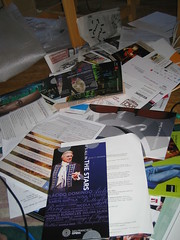
Brochure AvalancheWhile trying to clean up my apartment earlier this week, I knocked over my folder of performing arts brochures, resulting in this avalanche. The actual stack of papers is at least 3 inches high, it's mostly stuff for San Francisco only, & I cull it regularly. But no doubt many of you out there have more impressive archives.

Sunday, February 20, 2011

The Illusionist

I enjoy Jacques Tati's movies, so I have had my doubts about this animated version of his character. However, the rainy weekend finally drove me into a theater to see The Illusionist, Sylvain Chomet's homage, based on a controversial, unproduced scenario by Tati. Set in 1959 in a rainy Edinburgh, the story feels like it is from a different era, one in which indoor plumbing & electric light bulbs are temperamental novelties. Tati appears as Tatischeff, a music hall magician increasingly marginalized in the modern world. He finds himself supporting a young woman, Alice, who is drawn to him for his acts of kindness. The animators have convincingly recreated Jacques Tati's teetering walk, awkward movements & slow-witted timing. With its preponderance of long shots, multilingual mumbling in place of dialogue, & clash of the traditional & the modern, the movie mimics a Tati production. I just wish it were funny.

The cityscapes & dilapidated yet cozy settings are depicted lovingly, & the film has a hand-drawn look mixed with CGI. However, I found it disconcerting on many levels. Uncaring fates are meted out to all the elderly characters. Grotesque caricatures, such as a blob of a soprano in a viking helmet, inhabit the film's corners. The cartoon Tati runs into a movie theater & sees footage of the real Tati in Mon Oncle. The relationship between Tatischeff & Alice, for whom the older man may have fatherly feelings, romantic feelings or neither, made me uncomfortable. She is so stupid that when she hooks up with a handsome young man at the end, I did not think the young man lucky.

There were a number of people at the afternoon show, all of them adults except for 2 small children with their father. The movie does not seem to be for kids, though. Since most of the story takes place in a rainy city, when I emerged from the theater into the rainy late afternoon, I felt like I was walking back into the film.

§ L'illusionniste (2010)
Director: Sylvain Chomet
Writers: Jacques Tati (original screenplay), Sylvain Chomet (adaptation)

Saturday, February 19, 2011

SFCO: Now or Never

San Francisco Chamber OrchestraIt's impressive that the San Francisco Chamber Orchestra can present all their concerts with free admission. This program required only a wind octet, yet it spanned 4 centuries of music, included 2 world premieres & featured a screening of Harold Lloyd's Now or Never. We sat in the 1st row of the balcony, which was sparsely populated. Downstairs was more crowded, but it was not competitive to find seats.

Conductor Ben Simon is a friendly presence, giving the pre-concert talk & making introductory remarks before each piece. The concert opened with a Gabrieli Canzona, the 2 trumpets & 2 trombones playing from the stage, without a conductor. Before the Stravinsky Octet, Maestro Simon introduced Painter in Residence Peggy Gyulai. 3 of her large, vertical, abstract canvases were on the stage next to the musicians. Each corresponds to a movement of the Octet & is inspired by a different artist: Chagall, Calder & Klee. Even though they were right on the stage, I found that I did not look at them during the actual performance.

Cindy Cox's Cañon is a companion piece to the Stravinsky Octet & uses the identical instrumentation. Maestro Simon demonstrated how the opening riff for 2 bassoons links it directly to the Octet. It is a 20 minute piece in 3 movements, convincingly evoking South American landscapes, often in a literal way, through the use of extended techniques such as multiphonics on the clarinet & bassoon or quiet whistling sounds from the flute. The 1st movement has a lot of dynamic contrast & an exciting ending with all the instruments winding higher & higher. In the 2nd movement the ensemble made comical whines & the flutist made sounds by clicking his keys. Something, perhaps the trombone, sounded like a didgeridoo. The 3rd movement used a motif based on the overtone series, making me think of an exotic version of the prelude to Das Rheingold. The piece ends softly. Ms. Cox was present & came on stage to take a bow.

After intermission, Maestro Simon jokingly told us, "I know you're really here to see the movie." Donald Sosin's movie score is so tightly synced to the film that the conductor wore headphones so he could hear a click track. The music has a period jazz feel, with references to classical pieces & children's songs thrown in. The music parallels all the action, sometimes changing with each cut. The musicians seemed very coordinated with the movie. Most of it takes place on a moving train, a prop I usually associate with Buston Keaton. It also stars a small toddler, whose excessive cuteness is part of the joke. Mr. Sosin was present & came on stage to shake hands with each musician.

§ San Francisco Chamber Orchestra
Main Stage Concert #2: Now or Never

Benjamin Simon, conductor

Flute: Tod Brody
Clarinet: Peter Josheff
Bassoons: Karla Ekholm & Carolyn Lockhart
Trumpets: Kale Cummings & John Freeman
Trombones: Craig McAmis & Bruce Chrisp

Giovanni Gabrieli: Canzona per Sonare #4
Igor Stravinsky: Octet for Wind Instruments (1923)
Cindy Cox: Cañon (2011) [SFCO Commission & World Premiere]
Donald Sosin: Now or Never (2011) [SFCO Commission & World Premiere]

Fri, Feb 18 @8:00pm
Herbst Theatre

Saturday, February 12, 2011

SF Silent Film Festival Winter Event

PhotobucketDespite the sunny weather, the Castro Theatre was packed for the San Francisco Silent Film Festival's Winter Event. In his enthusiastic opening remarks, festival founder Stephen Salmons welcomed us to this "one day cabinet of wonders" & invited us to step back into the 20th century. I would have liked to see all 3 programs, but I only had the stamina for 2. I did see a lot of people wearing all-day passes, though. Many of the volunteers wore spiffy 20's fashions.

It was great fun to see the program of 3 Chaplin shorts with the festival's responsive crowd. The joy of Chaplin's Mutual period was clear. Some young children in the audience giggled at every fall & kick in the pants. Donald Sosin accompanied the shorts on the piano, playing tunes that sounded like dance music of the period. The music matched the films so well that I was often not aware of it.

After taking a break to walk down Market Street for a coffee & pastry, I returned for L'Argent, a nearly 3-hour epic from France with a timely story about a bank scandal. Romain Serman, Consul General of France, briefly introduced the film, which he described as a gem of French cinema. He noted the irony that this film about the evils of money itself cost a whopping 5 million francs in 1928. He called director Marcel L'Herbier the James Cameron of the period. I never got into the film itself. It has a novelistic pace, strongly delineated characters, & many large crowd scenes, but the story-telling seems inefficient. There are a lot of intertitles to read. The movie was accompanied by the Mont Alto Motion Picture Orchestra, comprising piano, violin, clarinet, trumpet, cello & percussion. They played a melodic score that evoked French classical music as well as salon music & period jazz. They also provided airplane engine & jungle sounds. They paced themselves well, never sounding tired for the entire duration of the film.

§ San Francisco Silent Film Festival Winter Event

It’s Mutual: Charlie Chaplin Shorts
The Pawn Shop (1916)
The Rink (1916)
The Adventurer (1917)
Accompanied by: Donald Sosin

L’Argent (1928)
Accompanied by: Mont Alto Motion Picture Orchestra

February 12, 2011
Castro Theatre

Wednesday, February 09, 2011

Aquarium of the Bay

Aquarium of the BayI've wanted to check out the Aquarium of the Bay, even though its Fisherman's Wharf location makes it look like a tourist trap. I saw in the paper that they are having free days this week for SF residents, so I visited this afternoon. The main attractions are the 2 clear tunnels on the bottom floor that wind through large tanks, surrounding the viewers with sea life. I have to say it is pretty cool to see a school of anchovies or a shark swim close overhead. The tunnel path is curved, so one does feel immersed. It took me a while to realize that soothing space music was being piped in as well. The aquarium also has dramatically-lit jelly fish, touch pools, & some non-aquatic animals, including chinchillas & bees. There were several volunteers around to talk about the exhibits. I went through in about an hour & felt like I had done it full justice. The paper crowns available at the welcome desk were popular with many of the adult visitors.

Tuesday, February 08, 2011

Hot Air Music Festival 2011

Hot Air Music Festival 2011Sunday I was at the San Francisco Conservatory of Music to check out the Hot Air Music Festival. This is an entirely student-run marathon of contemporary music, taking place in 2 halls for 8 hours non-stop. I went in & out & heard a half-dozen or so pieces. I started in the small recital hall & found the piano trio by Pierre Jalbert immediately appealing. It is in 2 contrasting movements, the 1st rhythmically driving & blues-like, the 2nd spiritual & meditative. The Delphi Trio gave a secure, incisive performance. I like the pianist's playing, which is forceful without being too percussive. The next group of musicians wore half-masks covering their eyes while they performed George Crumb's Vox Balanae. In the opening movement, Daniel Sharp impressively hummed & played the flute at the same time. He also whistled delicately. Composer Anthony Porter explained that his piece, not quite what i was planning, is a game of telephone played between 2 vocalists & a group of instruments. At the end, a 6-word phrase emerges, which in our case was "wasn't noticed so fuck him louder."

Hot Air Music Festival 2011In the concert hall I heard Louis Andriessen's raucous Worker's Union, which one of the musicians explained is written for "any number of loud, discordant instruments." He emphasized the point by noting that even though he was a guitarist, he would be playing for us on an out-of-tune violin. The performance began with 2 violins, but as it progressed more musicians walked on stage & joined in. The mix eventually included cello, marimba, electric guitar, piano, trombone & even an accordion. Everyone plays in a kind of raucous unison. An extra level of chaos was injected by random mishaps. A violinist lost his shoulder rest, & 2 players apparently ran out of music & had to find new stand partners.

Steve Reich's Six Pianos was performed on 6 electronic keyboards in a horseshoe arrangement. The pianists executed the piece with confidence, & the end was startling when they all stopped at once. It was a novelty to see an ensemble of 12 guitars for Dan Becker's DoubleSpeak. The piece's rhythmic pulsing made me think of John Adams. Everyone looked like they were focusing hard on staying together.

A cancellation allowed the organizers to commemorate Milton Babbitt by inserting his taped piece Occasional Variations. There was much laughter when someone applauded the announcement that Milton Babbitt had died the previous week. The piece, with its blips & synthesized tones, reminded me of a primitive video game. The day ended with John Adams's expansive concerto for electric violin, The Dharma at Big Sur. The performance had to be re-started when something went wrong with the electronic instrument's amp. Morgan O'Shaughnessey was a happy soloist & communicated a sense of joy in performing.

People came & went throughout the day, but the audiences were never large, perhaps maxing out at 90 for the John Adams. During the afternoon, I met the up-beat Rik Malone of KDFC as well as cheerful violist Mr. O'Shaughnessey. He showed us the beautiful Jordan electric 7-string hybrid violin he would play, with its inlay figures of schooling dolphins. He even let me tuck it under my chin, where it was quite comfortable to hold.

§ Hot Air Music Festival 2011

Trio: Pierre Jalbert
Delphi Trio: Liana Bérubé, violin; Michele Kwon, cello; Jeffrey LaDeur, piano

Vox Balaenae: George Crumb
Daniel Sharp, flute; Sung Bin Choi, cello; Sandra Gu, piano

not quite what i was planning: Anthony Porter
Maria Janus, Elizabeth Kimble, vocalists; Adam Cockerham, guitar; Sasha Launer, flute; Joanne De Mars, cello; Anthony Porter, accordion; Paul Psarras, conductor

Worker's Union: Louis Andriessen
Red Bennett, David Boyden, Raphael Chinn, Matthew Cmiel, Chris Edwards, David Gottlieb, Jesse Jenks, Anthony Porter, Anna Rubenstein, Kevin Schlossman, Kevin Villalta, Kelsey Walsh

Six Pianos: Steve Reich
Mark Clifford, Dominique Leone, Lucy Moore, Anthony Porter, Regina Schaffer, Zizhu Zhao, pianos

Double Speak: Dan Becker
Mason Fish, Carolyn Smith, Eric Sandoval, Matthew Holmes-Linder, Tatiana Senderowicz, Tony Kakamakov, Robert Nance, Paul Psarras, Yu Wu, classical guitar; Ramon Fermin, Nahuel Bronzini, electric guitar; Adam Cockerham, bass guitar; David Tanenbaum, conductor

Occasional Variations: Milton Babbitt

The Dharma at Big Sur: John Adams
Morgan O'Shaughnessey, electric 6-string hybrid violin; Ross Thomas Ipsen, conductor; The Hot Air Adams Orchestra

Sunday, 6 February, 2011 1:45p - 9:00p
San Francisco Conservatory of Music

Friday, February 04, 2011

Kim Kashkashian at SFCM

Thursday evening I was at the SF Conservatory of Music for a chamber music recital featuring violist Kim Kashkashian performing with Conservatory students & faculty. Students performed the opening Haydn Quartet, Op. 54, No. 2. 1st violinist Joseph Maile had a slightly restless style that contrasted nicely with the more blended sound of the others, especially in the free-form slow movement. Ms. Kashkashian was warm, even & expansive in the Brahms Viola Sonata in E-flat Major. Her sound was mellow & aged, always distinctly like a viola & not a violin. All the movements had the same not-too-slow, not-too-fast tempo, like a gentle seesaw motion. Ms. Kashkashian had a calm demeanor & seemed to be enjoying the piece from moment to moment. Her accompanist, Paul Hersh, sounded muted, always staying in the background.

The 2nd half of the program brought faculty & students together in the Dvorak Sextet. Ms. Kashkashian sat across from the 1st violin. Everyone played with involvement. The audience laughed at the mordant humor of the speedy 3rd movement. The bright & intense sound of 1st violin Axel Strauss stood out. The violin looks like a small toy in his hands.

The event was well-attended by a mix of students & older music lovers. The appreciative audience cheered the performers after each piece. I bought my ticket when I got there, but I arrived with a friend who had purchased his in advance. When a woman at the box office saw that we were together, she accommodatingly switched our tickets so that we could sit together.

§ Chamber Music Masters
Kim Kashkashian, viola


with Faculty Members:
Jennifer Culp, cello
Paul Hersh, piano
Axel Strauss, violin

and Conservatory Students:
Gretchen Claassen, cello
Mac Kim, violin
Pei-Ling Lin, viola
Joseph Maile, violin
Emily Nenniger, violin
Sebastian Plano, cello

Haydn
String Quartet in C Major, Op. 54

Brahms
Viola Sonata in E-flat Major, Op. 120, No. 2

Dvořák
String Sextet in A Major, Op. 48

Thursday, February 3, 8:00 PM
San Francisco Conservatory of Music
Caroline H. Hume Concert Hall

Thursday, February 03, 2011

Clue at Boxcar Theatre

ClueWednesday night I saw Boxcar Theatre's Clue, "a play based on a movie based on a board game." The audience sits on a high platform above & on all 4 sides of a life-size version of a Clue board. We look down on the actors, who are basically performing in a square pit. The seats are right at the edge, so this is not a show for the acrophobic. The arrangement accommodates about 45 people, each of whom has a front row seat.

The actors recreate the movie & its loony characters, & the show itself doesn't have to do anything else but be completely silly. It's loose & fast, & the actors have as much fun as the audience. A running gag is that whenever all the characters assemble in the same room, they have to cram together in the corresponding small space on the board. The production has been playing to full houses, & they have recently added more performances. The audience is encouraged to take drinks into the theater. Apparently at the 11pm shows the cast may be as drunk as the audience.

One of my theater companions, after passing a Clue trivia test, was tapped to select one of 3 possible endings. At the appropriate moment in the play he got to yell out his choice: A, B or C. We were impressed at how promptly he responded to his cue. After the show, the actors, looking quite unlike their characters, mingled with the audience in the lobby.

The Boxcar Playhouse is at Natoma & 6th Street, in the basement of a mercy house. As I waited to use the restroom, I could peek into their rec room, where I saw pizza being served. Walking to the space from Market Street is an urban adventure in itself, so I'm intrigued by Boxcar Theatre's up-coming staging of Little Shop of Horrors which will take place partly on the street.

§ Clue
Boxcar Theatre
Based on the movie written by Jonathan Lynn & John Landis
Adapted for the stage by Peter Matthews & Nick A. Olivero
Directed by Peter Matthews & Nick A. Olivero

J. Conrad Frank, Mrs Peacock
Michelle Ianiro, Mrs. White
Justin Liszanckie, Prof. Plum
Peter Matthews, Mr. Green
Nick A. Olivero, Col. Mustard
Sarah Savage, Miss Scarlet
Brian Martin, Wadsworth
Linnea George, Yvette
Adam Simpson, Mr. Boddy, et al.
Stephanie Desnoyers, Stage Manager

Boxcar Playhouse
February 2, 2011 8p

Wednesday, February 02, 2011

The Cost of Traffic

American Idle: On the Road
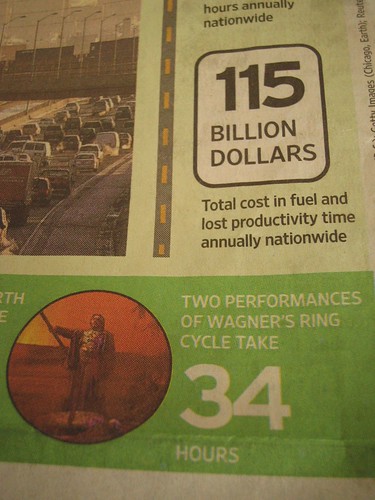
According to a graphic in today's Wall Street Journal, the average commuter spends 34 hours delayed by traffic a year. The article compares this to the time of two performances of Wagner's Ring Cycle. Average traffic delays for San Francisco are an even longer 49 hours, allowing residents of the Bay Area to take in an extra cycle.

Tuesday, February 01, 2011

Schubert's Birthday with Classical Revolution

Revolution CafeI was invited separately by 2 friends to join them this Monday evening at Revolution Cafe, where Classical Revolution, the scrappy weekly chamber music party, would be celebrating Schubert's birthday. However, both of them bailed on me at the last minute. I showed up anyway & settled into a Guinness just as the 1st performer began playing a Schubert piano sonata. The atmosphere is by design an unintimidating mix of classical music, alcohol & sociability. The place gets packed, & people crowd around the musicians close enough to read their music. During the 90 minutes I was there around 10 musicians came & went, performing Schubert piano works, songs & a string quartet. I enjoyed hearing the clarinet in The Shepherd on the Rock. The performers for the most part look like young conservatory students. Some performances were well-prepared, though the string quartet was clearly having fun just reading together. The violist had a disconcerting ability to cross & uncross his legs while playing.

As it turned out, I knew one of the musicians who turned up to play, & so I was able to have a nice chat as we waited for his turn. Bar noises, conversations, street noise & smokey odors are all part of the scene, so I was shocked when a man sitting at a laptop next to us told us we were talking too loud for him to hear the music. I've never been sushed at Davies Hall, but I guess I better watch my behavior when hanging out at Classical Revolution.

§ Classical Revolution
Schubert Birthday Bash at Revolution Cafe
Monday, January 31 · 7:00pm - 11:00pm

Monday, January 31, 2011

British Television Advertising Awards 2010

YBCAThe 100-seat screening room upstairs at the YBCA was full yesterday afternoon for this 75 minute program of around 50 commercials & public service ads from Britain. Humor & high concept seem to be what the selections are mostly about. Frequently you sit through the commercial without finding out who the sponsor is until the very end. A slapstick film about a jockey who loses his horse turns out to be for Weetabix. A CGI extravaganza depicting rugged men turning deserts into lush, life-filled landscapes seems to have an environmental message, but it's advertising Guinness.

Many of the ads are elaborate stunts. One unbelievably quirky ad documents shepherds attaching colored LEDs to their sheep & using them as pixels to simulate a pong game, the Mona Lisa & a fireworks display. It actually caused our audience to applaud. In a Johnny Walker ad, an actor talks to us as he strides purposefully through a mountain landscape in a single tracking shot, while relevant objects come into view at just the right moments in his narration. I found it nerve-wracking. Curiously, the best commercial award went to a T-Mobile ad featuring a flash mob dancing in Liverpool Street Station, which is not a very original concept. Many of the award-winning ads can be viewed on the BTAA Web site.

§ British Television Advertising Awards 2010
January 30, 2011 2:00 pm
Screening Room
Yerba Buena Center for the Arts

NCCO: Tour Kick-Off Concert

Pink or Orange City HallSaturday evening I was at the New Century Chamber Orchestra's Tour Kick-Off Concert. In the next 2 weeks they will perform in venues in California, Ohio, Michigan & Illinois. They already have a tour blog. I like their audience-friendly program. Music director Nadja Salerno-Sonnenberg, clearly buzzed, began by thanking the staff, board, musicians & audience. She joked that since this was the group's 1st time playing the program, this might be the worst performance of the tour.

There was a sense of excitement about the evening. The 19 string players attacked the dance-themed program aggressively. The final movements of Bartók Romanian Folk Dances sounded like a hoedown. Ms. Salerno-Sonnenberg was soloist for the Piazzolla Four Seasons of Buenos Aires. She plays with a nervous energy & gyrates like a rock star. A section in Summer with glissandos & a unison slide sounded like space music. Bass player Tony Manzo provided a plump yet discreet pizzicato accompaniment in the coda of Winter. He may be my favorite musician in the group. The audience laughed at the quote from Vivaldi's La Primavera in the 1st movement, & they clapped appreciatively for each movement. At the end there was cheering & a standing ovation.

The Tchaikovsky Serenade was played emphatically & had a somewhat disjointed feel, though the 2nd violin & viola sections often played very uniformly & cleanly. The ensemble is conductorless, so one sees a lot of eye contact between the players. The enthusiastic audience gave the show an immediately standing ovation, even resorting to stamping their feet. We were rewarded with 2 encores. Schnittke's evil version of a Polka made the musicians laugh as well as the audience. Salerno-Sonnenberg was the soloist for "Bess you is my woman now" by Gershwin.

A correspondent reported that he was seated next to an older woman who apparently lost count of the movements during the Piazzolla. Thinking the piece was already over, she was surprised by the final movement & asked aloud, "Just how many seasons do they have in Buenos Aires?"

§ New Century Chamber Orchestra
Nadja Salerno-Sonnenberg, Music Director
Tour Kick-Off Concert

Wolf (arr. Drew): Italian Serenade
Bartók: Romanian Folk Dances
Piazzolla (arr. Desyatnikov): Four Seasons of Buenos Aires
Tchaikovsky: Serenade for Strings in C Major, Op. 48

Encores:
Schnittke: Polka
Gershwin: "Bess you is my woman now"

Saturday, January 29 at 8pm
Herbst Theatre

Saturday, January 29, 2011

Opera Night at the de Young

Friday Nights at the de YoungAt tonight's Friday Night at the de Young, I got another peek at Ensemble Parallèle's up-coming production of Philip Glass's Orphée. The presentation ran about half an hour & consisted of several performed scenes, some spoken narration, prerecorded music & videos projected onto the walls above Wilsey Court. This time the circus theme for the underworld was evident. The Princess wore a female ringmaster costume. The poet Cegeste was lured to his death by an acrobatic clown circling him in a roue cyr. The final show ought to create some unusual stage pictures.

For the vocal excerpts, conductor Nicole Paiement led 5 singers & a band consisting of flute, clarinet, violin, harp & keyboard. Several of the singers had their parts memorized already. I like the contrast in timbre between the principal male voices of tenor John Duykers & baritone Eugene Brancoveanu. The performers were miked -- a necessity, I suppose -- but it resulted in some unnatural instrumental balances.

A large crowd gathered for the performance. Immediately following, we rushed over to Koret Auditorium, where young singers from Argentina were to perform next, but the venue was already full, & we were among many who were turned away. These Friday night events clearly bring crowds into the museum. It is possible to purchase drinks, but at one point I was surrounded by people eating chicken legs, & I have no idea how they got them.

§ Friday Nights at the de Young
Opera Night
Ensemble Parallèle presents “Love, Obsession, and Death”: excerpts from the Philip Glass opera Orphée
January 28, 2011 - 6:00pm
Wilsey Court

Friday, January 28, 2011

MacWorld 2011

MacWorld 2011This morning I visited the MacWorld Expo at Moscone Center West. Though the show is much smaller than it used to be, it was crowded. I suppose they should call it "iWorld" nowadays, since it is mostly accessories for iPhones & iPads. I came across at least 3 vendors hawking a strap attachment that allows you to hold the iPad in your open palm like a mitt. I saw one exhibitor demonstrate his iPad app using a stylus with ends like a felt-tip pen. This seems like such an obvious accessory, but that was the only time I saw anyone use a stylus at the show.

This is not the kind of show with a lot of booth babes, but the outdoorsy-looking employees in the DryCASE booth showing us how to vacuum-pack our iPhones are rather good-looking. One could have one's picture taken with an Elvis impersonator at the codeweaver booth. At another booth, one could see the unhappy, charred remains of an iMac that was well-cooked by a major fire. Its mouse had melted into a blob resembling pancake batter. I was surprised to see whole families attending the expo, including babies & screaming children. There was even a panel discussion on parenting in the age of the Internet.

§ MacWorld 2011
January 26 - 29
Moscone Center, West Hall

Thursday, January 27, 2011

Dhobi Ghat (Mumbai Diaries)

I was at the funky Balboa Theater Wednesday afternoon to see Dhobi Ghat (Mumbai Diaries), an art-house movie from India. The minimal plot follows the intersecting lives of 4 individuals living in Mumbai: a reclusive painter, a good-looking laundry boy, a banker & a young wife seen only through her videotaped diaries. The story unfolds as a sequence of progressively more dramatic, yet predictable, revelations. I was quickly absorbed into the characters' interlocking lives, each dominated by an unexpressed yearning. Despite the seriousness of the scenario, the film has a light hand. I was amused by a restaurant scene in which the painter Arun pointedly ignores his agent by folding an origami boat out of a heavily starched napkin.

The movie is gorgeous. It opens with a dream-like montage of Mumbai's rainy city streets, as seen from inside a taxi. I loved the interiors of the characters' homes, looking realistically cluttered & lived-in. The city is shown so teeming with life & color that it seems to be a creature in itself. I was sometimes distracted from reading the subtitles because I was trying to take in all the details of the picture. And the film is made even more beautiful by its ridiculously good-looking cast.

§ Dhobi Ghat (Mumbai Diaries)
Director: Kiran Rao
Starring: Aamir Khan, Prateik, Monica Dogra, Kriti Malhotra

Thursday, January 20, 2011

Carmina Burana Dessert

According to this Examiner review of Teatro ZinZanni's latest show, the plot revolves around a special dessert, which is served to the music of Carmina Burana. The review does not mention if the menu includes swan on a spit.

Clarinet Thing at the Rex

PhotobucketThis month's intimate Salon at the Rex featured Clarinet Thing, a jazz clarinet quartet. The program consisted mostly of original compositions by members of the quartet, who playfully took their inspiration from such unlikely sources as Balkan dance music, Buckminster Fuller & psychiatric disorders. They used several sizes of instruments, including the bassoon-like contra-alto clarinet. One of the musicians called it a "paper clip," accurately describing its silver color & the way it doubles back on itself. The quartet does not make a blended or uniform sound, & the players themselves admitted that they each have very different influences & backgrounds. They ended with a lively performance of 2300 Skidoo by Hergie Nichols. The piece has a hip, 1950's feel to it & reminded me of the jazziest parts of West Side Story.

The atmosphere was relaxed. The audience seemed pleased with each number, & there was humorous banter among the musicians. In the question & answer session afterward, people wanted to know about the difference between the clarinet, bassoon & saxophone. They were also curious about the backgrounds of each of the players, who pursue disparate musical interests outside of this quartet. When Sheldon Brown demonstrated an ornate Balkan melody, many in the audience found it similar to klezmer music.

§ Salons at the Hotel Rex
Clarinet Thing
Sheldon Brown, Beth Custer, Ben Goldberg, Harvey Wainapel

Wednesday, January 19
6:30pm
Hotel Rex

Wednesday, January 19, 2011

Orphée Sneak Preview

Strawberry BowlLast night I was part of an invited audience for a preview of Ensemble Parallèle's up-coming production of Philip Glass’s Orphée. In an hour-long presentation, artistic director & conductor Nicole Paiement gave us an informative overview of the work & led several excerpts performed by cast members Eugene Brancoveanu, Susannah Biller, John Duykers & Brooke Muñoz with piano accompaniment. Even though the singers have only just begun rehearsals, they sound like they will be a terrific cast. Baritone Eugene Brancoveanu's gorgeous & communicative singing as Orphée made me think I understood French perfectly.

The opera is based closely on the Jean Cocteau film Orphée, which was playing when the audience came in. Indeed, the libretto is essentially the dialogue from the movie, a concept which one audience member declared "insane" during the Q & A. Ms. Paiement engagingly explained the ways in which the opera is stylistically French in its lyricism & yet completely characteristic of Philip Glass.

Director Brian Staufenbiel discussed the staging, which will present the underworld as a surreal circus. The motorcycle henchmen from the movie are represented by a roue cyr, a kind of giant metal hula hoop with an acrobat rolling around inside it. We also saw samples of videos featuring the cast, which will be projected inside 5 pictures frames above the set. Ensemble Parallèle will present a further peak at the production at the free Friday Night at the de Young on January 28 at 6:30pm & 7:45pm.

§ Orphée Sneak Preview
Ensemble Parallèle
San Francisco Conservatory of Music
January 18, 2011, 6pm