Showing posts with label New York City. Show all posts

Friday, June 25, 2010

Persephassa on the Lake

File this under "Why don't I live in New York?" Earlier this week, Make Music New York put on a performance of Xenakis's percussion piece Persephassa, featuring performers situated on floating platforms & along the shore of The Lake in Central Park. The audience enjoyed the performance from row boats in the middle of the lake. The event description instructs that after the "stunning conclusion, members of the audience will row their boats back to the dock."

Some links to coverage of the event here.

Thursday, January 07, 2010

Haydn at the Hayden

Events like this make me wonder why I'm not trying harder to relocate to New York. This month Gotham Chamber Opera, "Taking advantage of breakthroughs in laser and light technology," performs Haydn's Il Mondo Della Luna in The Hayden Planetarium. Opera under the stars with a laser light show. Wow. The production is "directed by Diane Paulus, director of the Tony-award winning revival of 'Hair.'"

Monday, October 12, 2009

MAD: Slash

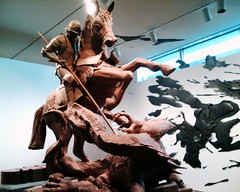
The triumph of good  and evilMuseum of Arts & Design
Slash: Paper Under The Knife
October 7, 2009 - April 4, 2010

Read My Pins: The Madeleine Albright Collection

September 30, 2009 - January 31, 2010

Sunday was my last full day in New York, & the only thing I cared to do was take a pleasant stroll in Central Park. But this being New York, I also ran into a parade on 5th Avenue, & then I was lured into the Museum of Arts & Design's new building, which seemed to be saying "HI" to me.

As advertised, the exhibit Slash: Paper Under The Knife featured a lot of elaborate paper cuttings & books with things cut out of them. My favorite work, however, was Chris Gilmour's The Triumph of Good & Evil, a large sculpture of St. George slaying the dragon, all made from cardboard boxes. It's probably 5 feet high & has incredible detail, down to individual scales on the dragon.

I also liked Oliver Herring's life-size sculpture of Alex, a young fellow with tattoos & surgical scars. The artist took photographs of every surface of the subject's body, cut the pictures into shard-like shapes, then pasted them onto a Styrofoam core. The colors are not true to life but instead are bright greens, blues, reds, oranges & yellows. Alex's short haircut is naturalistically represented by thin strips of shredded paper. The effect is simultaneously realistic & abstract, & it is definitely a bit freaky.

Several of the pieces are still being installed, & in at least one case an artist was busily working on a piece right in the gallery. I suppose this is what happens when you turn in your homework late.

On the 2nd floor I discovered a baffling display of large pins worn by Madeleine Albright in her official capacity as Secretary of State. These pins are enormous pieces of jewelry, in often insinuating animal shapes. Butterflies, spiders, & stinging insects seems to be well-represented.

Sunday, October 11, 2009

The Hispanic Society of America

Yesterday afternoon I journeyed to Washington Heights to visit The Hispanic Society of America. It sits in a complex of buildings designed in the classical style & decorated with bizarre over-sized statues. The museum is a bit decrepit, & they obviously haven't had resources to update the exhibits for decades. The collection ranges from Neolithic bronzes to a decorative charger from the 1920's with a flapper girl painted on it. But the core of the collection comes from 17th century Spain, & I was shocked to discover myself at the feet of Goya's imperious & bold Duchess of Alba. My museum companion thought she could be Carmen's sister. Upstairs were more Goya & excellent samples of El Greco & Velázquez. I was especially taken by Velázquez's warm Portrait of a Little Girl, with her wary & intelligent look. Unfortunately the viewing conditions in the upstairs gallery are less than ideal, & it is impossible to find a good place to stand to view the finest paintings.

I also marveled at an exquisite Silver Filigree Casket from 17th century Goa. I can't imagine that there is much jewelry worthy to be stored in such a thing. Most surprising of all is that I & my companion were the only visitors the whole time we were there. So it is actually possible to go someplace in New York that is not swamped with people. I'm sure the Duchess of Alba would love to have more visitors.

Milkmaid at the Met Museum

Met museum of artFriday morning began with rain, so I, along with thousands of others, herded into the Metropolitan Museum of Art. I find the Met both deeply inspiring & just plain exhausting. I've been visiting since I was a kid, but I've only seen a few parts of the collection. & every time I come back, the museum seems to have gotten bigger!

This day I decided to let someone else keep me focused, so I joined a couple of docent-led tours. In the morning I viewed the Ancient Near Eastern Art gallery with an over-eager group of visitors, including an English couple & an eccentric older gentleman with a German accent. When the docent suggested that a lovely pendant figure of a goat depicted the animal dead, the German fellow remained skeptical & thought we should all vote as to whether the animal was supposed to be dead or alive.

After a late afternoon coffee in the American Wing Courtyard, I visited the small exhibit highlighting Vermeer's Milkmaid, generously on loan from the Rijksmuseum. It is brought together with the 5 other Vermeers owned by the Met. Even surrounded by its peers, it stands out glowingly. The painting is small, & one has to jockey continually for a position closer to it. The rich blue of the apron & the red of the dress are quite unlike any of the reproductions. I enjoyed being able to discern details like the tan line on the woman's forearm & the yellow edge of her rolled-up sleeve. The only thing I was unclear about is the white shape between her foreshortened right arm, the pitcher & her blue apron. Perhaps it is a dishcloth.

The Milkmaid is supplemented by additional images & commentary to support the curator's theory that the painting is not simply about domestic virtue, but also suggests the sexual availability of the kitchen maid.

The museum is open late on weekends, & the balcony above the Great Hall was turned into a cocktail lounge, complete with a small salon band. I was amused to find something called a "Clearance Shop" inside the museum. No art works were being deaccessioned at bargain prices. Instead, they stocked the first Christmas items I've seen for sale this year.

Saturday, October 10, 2009

Met: Barbiere

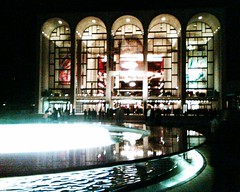
Lincoln center fountain
Il Barbiere di Siviglia
The Metropolitan Opera

Thursday, October 8, 2009, 8:00 pm

Conductor: Maurizio Benini
Rosina: Joyce DiDonato
Count Almaviva: Barry Banks
Figaro: Rodion Pogossov
Dr. Bartolo: John Del Carlo
Don Basilio: Orlin Anastassov
Berta: Claudio Waite
Ambrogio: Rob Besserer

Production: Bartlett Sher


I was able to be in a comfy seat in the Grand Tier this evening, & therefore had an excellent view for this cartoonish & silly production of Il Barbiere di Siviglia. The stage is extended around & in front of the pit, so that singers can walk right up to the 1st row of the auditorium. The set consists primarily of doors which are rearranged for every scene. Everything on stage is in motion at some point. Even Figaro's barber shop is a huge wagon, pulled by several women & followed by a very sweet live donkey.

The production is full of outrageous gags, many of which took me by surprise. Even a giant anvil descending slowly from the flys during the Act I finale somehow worked. Poor Ambrogio takes a lot of physical abuse, being stepped on, crushed by a tree & even blown up.

John Del Carlo as Dr. Bartolo not only sang with a large, resonant voice but also created a great character. His Bartolo was funny & yet always remained a serious obstacle to the lovers. Joyce DiDonata has a delightfully ingratiating stage presence. Her voice easily executes long, even lines, & she applied liberal ornamentation.

Rodion Pogossov made Figaro a likeably self-confident fellow, & he kept up an extremely rapid tempo for Largo al factotum. During his curtain call, it look liked Figaro gave out business cards to people in the front row. Barry Banks has a very high & light voice, & he negotiates Almaviva's long lines fearlessly, though his coloratura is sometimes a little blurry. He sang all of the Count's final bravura aria, Cessa di più resistere. I may never have heard the whole thing in a theater before.

I found Maurizio Benini's conducting to be relentless fast, but no one seemed to have any problems keeping up. The musicians in the Met's pit continue to astonish me. The guitarist accompanying the Count's two serenades in the 1st scene played with great beauty & finesse. If someone played the guitar like that for me, I'd fall for it.

Friday, October 09, 2009

High Line Park

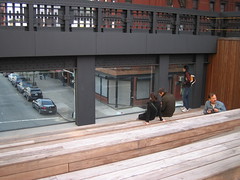
High Line ParkHigh Line Park is another of those attractions that people keep mentioning. Yesterday morning just before noon I took a walk along this fragment of elevated train tracks turned into an urban park. It's 3 stories up, so one gets unusual views of the surrounding architecture, the river & billboards, which are now at eye-level. It's definitely more urban than park. There is an observation deck of sort, designed explicitly for viewing the traffic below. The planted areas are made to look wild, but they are contained & clearly delineated, more like decorations for the walkways. There is plenty of seating, & even a coffee stand & restrooms midway down the path. Lots of people, with cameras in hand, were promenading on this windy morning.

For lunch, I had take-out sushi from Chelsea Market, an over-crowded gourmet food mall right beneath the park. The overcrowding may have been due to preparations for the New York City Wind & Food Festival opening that night.

Thursday, October 08, 2009

Hamlet on Broadway

Times square
Hamlet on Broadway
Donmar Warehouse production of Hamlet
at the Broadhurst Theatre
7 October 2009, 7:30pm

Ross Armstrong (Cornelius)
Harry Attwell (Guildenstern)
Ron Cook (Polonius, Gravedigger)
Ian Drysdale (Osric)
Peter Eyre (Ghost of Hamlet's Father, Player King)
Michael Hadley (Barnardo, Priest, Captain)
Colin Haigh (Member of the Court)
Sean Jackson (Reynaldo)
Geraldine James (Gertrude)
James Le Feuvre (Member of the Court)
Gwilym Lee (Laertes)
Jenny Funnell (Player Queen)
Jude Law (Hamlet)
John MacMillan (Rosencrantz)
Gugu Mbatha-Raw (Ophelia)
Kevin R. McNally (Claudius)
Henry Pettigrew (Marcellus, Gravedigger, English Ambassador)
Matt Ryan (Horatio)
Alan Turkington (Fortinbras, Francisco, Player)
Faye Winter (Member of the Court)

Michael Grandage (Director)


This Broadway production of Hamlet opens with Jude Law crouching on a darkened stage as ominous music rumbles through the theater. The action that follows takes place in an empty interior with high marble walls. 2 massive sliding doors in the back can open to reveal a shallow exterior space. The cast is in modern dress & mostly in black, of course. In one of the production's few scenic effects, snow falls on Hamlet as he recites "To be, or not to be?"

Jude Law's Hamlet is dominated by the emotion of disgust, & Mr. Law communicates this well, though he displays a limited emotional range otherwise. He does cut a trim & attractive figure on stage & shows occasional flashes of amusing mime, as when imitating the walk of a crab or an ape. His best piece of business was when he moved apart the chairs set up for Claudius & Gertrude in the play scene. The rest of the cast was a mixed bag, though I liked Kevin R. McNally's unflappable Claudius, with a speech pattern reminiscent of a British Prime Minister. I also liked the simple presence of Geraldine James as Gertrude.

The production itself is rather tame & without distinctive moments. I was dismayed that Laertes's followers are dropped entirely from IV.v. Instead, Laertes simply walks into the scene as if he just happened to be passing by. I was also upset that we lost half of Gertrude's narration of the drowning of Ophelia. They also truncated a favorite speech of mine, when Hamlet admonishes Polonius, "Use every man after his own desert, & who shall 'scape whipping?"

There was a only one intermission, taken after III.i. This meant that the 2nd half was an endurance test at over an hour & a half long. I think we all would have benefited from a 2nd intermission, & I was impressed by how well-disposed the audience was despite the static staging. The seats around me were populated mostly with teenage girls. A pre-curtain announcement requested the audience to "refrain from texting during the performance." The young lady next to me periodically checked her mobile phone anyway.

Wednesday, October 07, 2009

Met: Tosca

Painting at the met
Tosca
The Metropolitan Opera

Tuesday, October 6, 2009, 8:00 pm

Conductor: Joseph Colaneri
Tosca: Karita Mattila
Cavaradossi: Marcelo Álvarez
Scarpia: George Gagnidze
Sacristan: Paul Plishka
Angelotti: David Pittsinger
Spoletta: Joel Sorensen
Sciarrone: James Courtney
Shepherd: Jonathan Makepeace
Jailer: Keith Miller

Production: Luc Bondy
Set Designer: Richard Peduzzi

Everyone here is talking about the Met's new Tosca, & I attended expecting a scandal, complete with outraged booing. Instead I found an audience cheering for the principals & a drab modern setting that looks like Fascist Italy. Act II took the most liberties with the text. Scarpia has 3 whores lounging around his office. Tosca stabs him closer to the groin than the heart. There's no crucifix or candles. Instead Tosca retrieves the Attavanti fan then languidly reclines on a sofa. We never see her leave the room. I think the idea is to expunge the religiosity of the story. But talk of God & the Modonna is all over the place, & the libretto makes a clear contrast between Tosca's piety & Cavaradossi's atheism, so I think the approach is incorrect.

There are surprises at the end of each of each act, however, & the magic-show ending, with Tosca seen frozen at the top of her fall, elicited a genuine gasp from the audience. But what really kept me focused during the evening were the performances of all 3 principals & the gorgeous playing of the Met orchestra. Karita Matilla's voice & stage presence are thrilling. There's a physicality & strength to everything she does, & she seems able to sing in any position, even when Scarpia looks like he's bending her over enough to break her back. Her Vissi d'arte is more disbelieving & angry than traditionally sorrowful & pathetic. She also does great stage gasps, screams & breakdowns.

Marcelo Álvarez as Cavaradossi had dependable high notes that were strong & bright, & he was convincingly fearless in Act II. His E lucevan le stelle was plaintive & low-key rather than brilliant. George Gagnidze was appropriately menacing & heavy as Scarpia. Scarpias in 18th century garb sometimes come across as foppish. Not so this thoroughly modern version.

TV cameras were quite visible all over the auditorium, especially one on a crane extending from a box. It was probably a rehearsal for an up-coming broadcast. Poor Spoletta tripped on stairs in both Act II & Act III. I hope he recovers his footing for the actual broadcast.

Tuesday, October 06, 2009

Met Rush Tickets

Rush line at the metBy the generosity of the Agnes Varis and Karl Leichtman Rush Tickets program, I will sit in the orchestra for tonight's Tosca at the Met for a mere $20. Ticket sales start 2 hours before curtain, & I was advised to join the line by 3:30pm for the 6pm sales time, which I did. I was about number 40 in line. The line starts downstairs & winds through an underground parking garage. However, people complained about fumes from on-going construction, so the management moved us upstairs at around 4:30pm. By 5:30pm the line was quite long, & I wonder if everyone in it was able to get a rush ticket. Once the sales started, things moved very quickly, & I was back in the plaza with ticket in hand within 3 minutes. Seniors are permitted to reserve rush tickets by phone, so they do not have to stand in line. This is most considerate.

This is for the controversial Luc Bondy production, & I hope to hear some booing.

Monday, October 05, 2009

Kandinsky at the Guggenheim

Solomon R. Guggenheim Museum
Kandinsky


Since I had such a short visit to the Neue Galerie in the morning, I thought I would have plenty of time to take in the Guggenheim, which is just a few blocks away. I got sucked into their massive Kandinsky survey, & it totally wore me down. Not only is the entire spiral filled with paintings from all periods of his career, but there was another gallery filled with works on paper, as well as an historical survey of photographs of him & his wife. The free audio tour emphasizes Kandinsky's interest in the synesthetic connection between painting & music. It includes excerpts of Schoenberg to listen to while looking at the pictures.

I liked what I saw, but it was too much of a good thing. It also made me realize that I've been seeing Kandinsky rip-offs everywhere without knowing it. A surprisingly large number of works in the show are from the Guggenheim itself.

The permanent collection has a favorite painting, though: Picasso's alarmingly precocious Le Moulin de la Galette, done when the artist was 19.

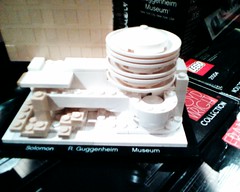
The Guggenheim in LegoFor some reason I didn't like any of the picture postcards of the building. Instead, my favorite gift shop item was this Lego set version of the museum.

Neue Galerie

After a pleasant walk cross-town through Central Park, I made it for the last day of the Oskar Kokoschka show at the Neue Galerie. This museum is elegant but quite small, & the 3rd floor was closed due to the hanging of a new exhibit, making it even smaller. Kokoschka is represented by half a dozen portraits, the sitters looking fretful at best, & a selection of drawings, water color studies & prints. I was amused by the colored drawing Die christliche Liebe (Alma Mahler und der Künstler). The 2 figures are walking in a garden. Alma is a large, pear-shaped figure in a blue dress, & the artist represents himself as an undersized, child-like figure in a red outfit walking beside her. His outstretched hand directs the viewer to a couple kissing in the bushes.

I can't say that I have much of an eye for Klimt, but the room of his decorative square canvases, featuring the portrait of Adele Bloch-Bauer I, is admittedly stunning & worth the price admission.

Also striking is the period furniture sitting in the corners of the gallery. I liked the large Koloman Moser collector's cabinet with its oak veneer stained black but with the grain pattern chalked white. The scroll-like "Knieschwimmer" club chair by Adolf Loos generated much discussion among the visitors, as we tried to figure out if it could be made comfortable. We decided that the chair must have had a separate foot rest which is now missing.

For the full experience, I had lunch in the pricey, Viennese-themed restaurant, Cafe Sabarsky. This seems to be an attraction of its own. There was a line to get in, though I could be seated immediately if I was willing to share a table. As a result, I had a delightful conversation with a woman from Mississippi who once did standing room at the San Francisco Opera to hear Beverly Sills in Traviata.

Sunday, October 04, 2009

Safety Last! at Loew's Jersey

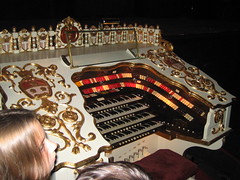
Morton Organ at Loew's Jersey TheatreSafety Last! (1923)
The Landmark Loew's Jersey - Jersey City

Sat, Oct 3, 2009 8:00 pm
Silent, shown with LIVE ORGAN accompaniment by
Ralph Ringstad, Jr. on the Loew’s Wonder Morton


To see Harold Lloyd's Safety Last! in an original 1920's movie palace with organ accompaniment, I suppose I did something most New Yorkers almost never do: travel to New Jersey. Loew's Jersey is an opulent & cavernous theater, vaster than the Castro Theatre in San Francisco. The lobby, with promenade areas on 2 levels, is quite spacious. The building, however is falling apart & in urgent need of restoration. It does have a kind of decaying grandeur, however. A devoted community of volunteers, including those in the projection booth, are keeping it alive.

Ralph Ringstad, Jr accompanied the film on a powerful Morton theater organ, the only one in such a space in the Metropolitan Area. At dramatic moments, Mr. Ringstad vamped on a steadily repeating chord, a trick that made me think of Philip Glass.

This would be a hard theater to fill, but there was a good turn out, & the audience was happy & really got into the picture. They applauded the iconic moment when Harold dangles from the clock hands. Because of the simplicity of its scenario & the wealth of inventive gags, the movie still entertains. The few children in the audience could be heard laughing throughout. The movie ends with a clever but curiously irrelevant gag in which Harold loses his shoes & socks in a sticky puddle.

Saturday, October 03, 2009

GEMS at LPR

The GEMS Project at Le Poisson Rouge
Friday, October 2 at 6:30 pm
Ensemble Viscera
Brooklyn Baroque
New York Baroque Dance Company


This was the last evening in a series of early music programs sponsored by the Gotham Early Music Scene. 3 groups each did a 30 minute set for an audience of largely older patrons, not unlike your average opera or symphony audience. I guess it's still hard to bring out the younger audience for classical music, even to such a hip venue.

The 5-member Ensemble Viscera, accompanying themselves on lutes & guitars, sang a set of Jácara, 17th century Spanish ballads about criminals & whores. Their delivery was pretty & surprisingly tame given the subject matter. Translations & pictures from the period were projected behind them. I liked the refrain "Anyone who sings is a singing rat" that occured in their 1st & last numbers. Nell Snaidas, singing of a woman confessing her sins of love, created an operatic scene in miniature.

Brooklyn Baroque, a trio of Baroque flute, harpsichord & cello, performed flute sonatas by Telemann, Bach & Joseph Bodin de Boismortier. Flutist Andrew Bolotowsky has a very clean, pleasant flute sound with no breathiness in it at all. Their playing is easy to listen to, though lacking in dynamic contrast.

In the last set, dancers Catherine Turocy and Carlos Fittante, in full 17th century court regalia, played out strange courtship rituals with plenty of flourishes of capes, fans & swords. They were accompanied by a violin, harpsichord & modern flute playing French period music. They wore expressionless face masks for their dance to Les Folies, & I found it a bit freaky. Perhaps it was post-modern Baroque.

I had an ideal viewing position, perched atop a bar stool at the edge of the table seating area. For some reason I also got more attentive service than when I was in preferred seating on Tuesday & as a consequence was able to imbibe an extra drink or two, along with a small plate of bratwurst, sauerkraut & bretzel. I can see how LPR could be dangerously addictive.

Friday, October 02, 2009

Met: Le Nozze di Figaro

Water fountain at the met

Le Nozze di Figaro
Metropolitan Opera

Thursday, October 1, 2009, 8:00 pm

Conductor: Dan Ettinger

Countess Almaviva: Emma Bell
Susanna: Danielle de Niese
Cherubino: Isabel Leonard
Count Almaviva: Bo Skovhus
Figaro: John Relyea
Don Bartolo: Maurizio Muraro
Marcellina: Wendy White
Don Basilio: Philip Langridge
Antonio: Patrick Carifizzi
Don Curzio: Ton Stevenson
Barbarina: Ashley Emerson

Production: Jonathan Miller


I had never heard of conductor Dan Ettinger before, & I found him quite impressive. He led with varied & flexible tempos & seemed to have ideas for nearly every bar of the score, starting with the Overture, which had some careful dynamic contrasts. He conducted with a closed score for most of the evening, which seems both risky & a bit cocky.

As last night, the cast was remarkably uniform & of a high level. With both John Relyea & Bo Skovhus, we had 2 manly baritones on stage. Mr. Relyea was a bundle of energy & intelligence, while Mr. Skovhus looks the part of a successful seducer, even though he was constantly being foiled throughout the evening. Emma Bell's majestic soprano contrasted effectively with Danielle de Niese's youthful & spritely voice. Isabel Leonard gave a winning & elegant performance as Cherbino & was a clear audience favorite. And smaller roles were extremely well-done. Philip Langridge was hilarious as the toadying Don Basilio, & Wendy White's motherly Marcellina was a completely rounded-out character.

The production by Jonathan Miller is naturalistic, humorous, & firmly set in the correct 18th century period. I liked some of the contextual details, such as the swarm of people trying to get into the Countess's room every time the door opened. The Countess also seems to have a young daughter & a baby, though there was some debate about whether those are really supposed to be her children. The huge indoor set in Act III rotates spectacularly to transition smoothly into the outdoor scene of Act IV.

I sat in the family circle level along the left side. At this position, nearly over the pit, the orchestral sound is astonishingly vivid. It is admittedly a poor view of the stage, even if one leans over the railing, which feels both uncomfortable & precarious. From this high vantage, I caught a 2nd violinist returning into the pit late at the beginning of Act II. Also inadvertently entertaining is the occasional sight of the prompter's hands, sometimes waving hysterically when a lot of performers are on stage. For those who enjoy reading scores instead of watching the stage, there are desks provided with lamps. The desks have no view of the stage or the Met titles.

During the intermission I was a guest of an officer of the John Relyea #1 Fan Club, who was holding court in the Grand Tier Restaurant & modeling the club's striking T-shirt. Those fan club members really know how to show their devotion!

Rink Foto at Leslie/Lohman

Leslie/Lohman Gay Art Foundation
SAN FRANCISCO: THE MAKING OF A QUEER MECCA
Early photos of Rink Foto and Harvey Milk
Sept 16 - Oct 24, 2009


In a classic example of having to travel in order to see one's home better, I found this documentary photo exhibit of San Francisco at the Leslie/Lohman Gay Art Foundation in SoHo. Most interesting were photos of parades, rallies & social gatherings from the late 1970's, with optimistic portraits of Harvey Milk, Cleve Jones & Steve Smith. These give way to glimpses of 1980's Act-Up protests, die-ins & the AIDS Quilt. A photo of a policeman in a surgical mask totally made me remember that back then the sight of cops in rubber gloves & face masks was a sure sign of an AIDS rally. Closer to the present day & perhaps more hopeful, there is an amazing photo of the City Hall rotunda filled with shirtless men at a 2001 Reunion Circuit Party. The exhibit also includes a few photos taken by Harvey Milk himself.

Thursday, October 01, 2009

Met: Die Zauberflöte

The met
Die Zauberflöte
Metropolitan Opera

Wednesday, September 30, 2009, 8:00 pm

Conductor: Bernard Labadie

Pamina: Susanna Phillips
Queen of the Night: Erika Miklósa
Tamino: Matthias Klink
Papageno: Christopher Maltman
Speaker: David Pittsinger
Sarastro: Georg Zeppenfeld
Monostatos: Greg Fedderly
Speaker: David Pittsinger
Papagena: Kathleen Kim

Production: Julie Taymor
Set Designer: George Tsypin
Costume Designer: Julie Taymor
Lighting Designer: Donald Holder
Puppet Designers: Julie Taymor, Michael Curry
Choreographer: Mark Dendy

I totally see why this production is so popular. I didn't see an empty seat anywhere in the family circle, & was happy to settle for standing room. While there were pyramids & Egyptian motifs, the costumes looked Asian, perhaps reflecting the setting of the source fairy tale. The Queen of Night had a great costume with Peking Opera banners sprouting from her back. I was delighted with all the spectacle, especially the giant dancing bears that Tamino conjures with his flute. They more than made up for missing Siegfried's bear on a previous visit. I was highly entertained by Papageno's floating banquet, & the way that Sarastro's enemies disappear under a giant gold fabric at the end was also very effective.

The cast was uniformly fine. Christopher Maltman's Papageno is as comfortable acting as singing, & the same goes for his Papagena, Kathleen Kim, who surprised me when she finally started singing in her strong, clear voice. Erika Miklósa has an unexpectedly pleasant, almost fluffy, voice even on the highest notes. She startled me with her subito piano during a high passage in O zittre nicht. There is nothing ferocious or scary about her interpretation. Instead it's strain-free beauty impressed. Her Der Hölle Rache got the most sustained applause of the evening. Susanna Phillips as Pamina acted with her singing, & her Bie Männern duet with Papageno & Ach, Ich fühl's were musical highlights. Greg Fedderly was obviously having great fun as Monostatos, costumed as a cross between a bat & an over-weight beetle. Even the small role of the Speaker was impressively delivered by David Pittsinger.

The only thing I couldn't get excited about was Bernard Labadie's conducting, which seemed to lack structure. The singers sometimes pushed or pulled at the tempos, but to no avail. I continue to be impressed by the orchestral sound way up at the top of the house. It just takes a really long time to egress after it's all over!

Tuesday, September 29, 2009

Gil Shaham at LPR

Gil Shaham, violin and The Knights
with Adele Anthony and music of Pablo Sarasate
Le Poisson Rouge
Tuesday, September 29, 2009

Carmen Fantasy
Song of the Nightingale
Concert Fantasy on Gounod's "Faust"
Introduction and Tarantella
Navarra


The show opened with a video featuring an extremely silly Gil Shaham being chased through the streets of New York by a man in a ridiculous bull costume. The show itself carried on this mood of fun, consisting of Mr. Shaham & his wife, violinist Adele Anthony, alterating in Sarasate show pieces, then concluding with the duet Navarra. Mr. Shaham's playing of this repertoire is both virtuosic & big-hearted. He treats it as real music, not just show pieces. I especially enjoyed the Faust fantasy. In fact I enjoyed it more than a recent hearing of the actual opera.

Mr. Shaham & Ms. Anthony were backed by an excellent chamber orchestra called The Knights, conducted by Eric Jacobsen. I was delighted by this full complement of strings, woodwinds, brass, percussion & harp. I liked the joyful playing of their concertmaster as well as his great facial hair. The facile playing of their trumpet stood out as a great bonus. For some reason the show was miked. Though it was done with discretion, I doubt that this was necessary.

I have to say that I even had fun showing up at Le Poisson Rouge early & being in a line outside a night club, as if I we were waiting to see a favorite rock band. For the full effect, we sat at a table right next to the stage & got drinks & food. Le Poisson Rouge is an ideal fusion of alcohol, appetizers & classical music. A definite pleasure.

Jennifer Koh Plays Solo Bach

Lunchtime Concerts
Tuesday, September 29, 12:30pm
Philosophy Hall at Columbia University

Jennifer Koh

J.S.Bach for Solo Violin
Sonata No. 1 for solo violin in g minor, BWV 1001


This is the 2nd in a mini-series of Bach Solo Violin programs Jennifer Koh is giving on the Columbia University campus. She plays one work on each of three successive days. The concerts are held in a student lounge of only moderate size, so by noon it was standing room only. Those of us who showed up early enough to get in experienced Ms. Koh quite close up. After making a few opening remarks about the formal structure of the Sonata, she launched into an intensely focused & technically clean performance. She is able to make every note clear, & one felt that she wanted to make every note count as well, even in the complex Fuga movement & the rapid Presto. She plays on a wonderfully mellow-sounding Strad with a very even timbre on all strings. The audience was appreciative & attentive. A woman seated in front of me even brought the sheet music with her & followed along.

I hadn't expected to have such a nice performance to attend on my 1st afternoon in New York, so a big thanks to my New York contact who was in the know & even saved me a seat.

Friday, May 08, 2009

Met Ring: Götterdämmerung

The Metropolitan Opera
Saturday, May 2, 2009, 6:00 pm

Götterdämmerung

Conductor: James Levine
Brünnhilde: Katarina Dalayman
Gutrune: Margaret Jane Wray
Waltraute: Yvonne Naef
Siegfried: Christian Franz
Gunther: Iain Paterson
Alberich: Tom Fox
Hagen: John Tomlinson

Production: Otto Schenk


The performance got off to a gripping start with an excellent Norn scene. Levine's conducting was expansive, & each of the Norns had a weighty but distinct voice. Again, the lighting was so dim that I had no idea what was occurring on stage. Christian Franz's Siegfried sounded a bit better than the previous evening, though it was still clearly effortful. Dalayman, back from Walküre, was a warm Brünnhilde

The Gibichung scenes were brightly lit, & I felt like I could at last make out the stage. I liked that Gunther & Gutrune were not the effete wimps I have often seen in other productions. On the other hand, I thought it was silly when Hagen observed, "dich, Gutrun, ohne Mann", & Gutrune responded by sobbing into Gunther's shoulder.

Tomlinson continued to be one of my favorite singers. His Hagen was ominous, heavy & dark, & he was completely domineering in the Gibichung scenes. Hagen's Watch & the dream scene with Alberich are 2 of my favorites in the Ring, & I enjoyed Tomlinson tremendously in both. The Met chorus is terrific & their thrillingly loud entrance in Act II was stupendous & very welcome. Here Dalayman became a very emotive & sympathetic Brünnhilde. At one point the staging had her throw her robe & a crown violently at Gunther.

There had been some horn bloopers throughout the evening, but the trio of horns at the beginning of Act III was absolutely clean. Our Rheinmaidens got a laugh when they popped up like gophers through a hole in the stage. I thought that Franz managed to rally a bit for his death scene, though he often seemed short of breath. Levine took a controlled, measured pace for the funeral music, allowing it to build only slowly & deliberately. Unfortunately you could hear scraping, pounding & even shouting from behind the scrim during this scene change.

Dalayman sang the Immolation Scene with much variety of expression. She has some striking low notes & also pushed out some very big high ones. Hers was a warm & sympathetic Brünnhilde. The final moments on stage are very busy & involve a series of sets that drop into view then descend, ending with the ruins of Gibichung Hall & a couple of survivors. The audience applauded as soon as the curtain began to descend, so I did not hear the final notes. In fact, due to this phenomenon, I don't think I heard the final notes of any act of this Ring.

P.S.
One of the distinct pleasure of attending a full Ring cycle is the temporary sense of community it creates. We were all quite chummy in standing room, perhaps even a bit proud. When some seats opened up in the Family Circle, one of standees declared, "I can't sit now. I need the bragging rights!" Also, I would be remiss if I failed to mention that The Opera Tattler graced our presence with delightfully high-maintenance headgear containing feathers & fresh white roses.