Today I ventured outside The City to visit the Computer History Museum in Mountain View. Being a techie myself, I've wanted to visit for some time. It's located in an impressively large new building.
The big draw for the next year is the modern incarnation of Charles Babbage's legendary Difference Engine No. 2, built by the Science Museum of London. Nathan Myhrvold is responsible for the version on display, which is destined for his private collection. If you want to see this, time your visit for one of the live demonstrations. The machine calculates 7th order polynomials to 31 decimal places & is cranked by hand! It's massive, & there's definitely a certain romance to it as you watch columns of disks rise & fall, hear rhythmic ker-chunks, & become mesmerized by the carry-over wheels, which corkscrew up like rotating DNA molecules.
I took the tour of Visible Storage, which is a large warehouse space filled with all sorts of calculating machines, from abacuses & slide-rules to Crays & microcomputers. The layout is wonderfully informal & has lots of random surprises. I saw core memory for the 1st time. There's a rack of hilariously sagging motherboards from an early Google server. A tangle of wires used to program an early IBM plugboard gives a new meaning to the phrase "spaghetti code." The whole thing tells the story of the rapid replacement of old technologies by new ones. As the tour guide said, "Electronics constantly eats its young."
It also inspired a certain amount of nostalgia in me. I saw a teletype machine, which took me back to my 1st contact with computers, back when I was about 12. Visible Storage starts with a huge shelf full of microcomputers dating back to the 70's, & I was surprised by how many of these machines I had once used. & now they are museum pieces!
Sunday, May 25, 2008


Octopus at The Magic
I was at the Saturday night performance of Steve Yockey's new play Octopus at the Magic Theatre in Fort Mason. It's a joint production with Encore Theatre Company. First things first: the big attraction of this show is the 1st scene, depicting some serious group sex flippantly orchestrated by the play's anti-hero. 4 male actors appear completely naked, & the foreplay is explicit. Fortunately our cast is fit, trim &, in at least one case, unusually pretty. It does the shower scene from Take Me Out one better. Come to think of it, Take Me Out was the last play I saw, so I guess we now know what it takes to get me out for an evening of theater...
The come-on of this 1st scene quickly gives way to catastrophic consequences. More likely to be talked about than the sex scene are the increasingly fantastical turns the action takes. A telegram delivery boy shows up dripping wet for no apparent reason. Characters vanish. Water seeps into apartments from no discernible source. A fearful monologue is set at the bottom of the sea. & the water in this production is real. As if we were about to see Shamu the Killer Whale, a sign at the box office warns us that the first row is likely to get wet.
It's an angry story about gay relationships, AIDS, simple consideration for others & love. The tone & focus sometimes shift strangely, but the dramatic situations always had my attention. The play feels like it's one re-write away from being brilliant.
There's a lot of physicality, & the characters' distress quickly becomes extreme. The cast does a terrific job with all this. I liked Patrick Alparone's pretty boy looks & expressive face. It's perfect casting. Rowan Brooks is at first lightly comic but then frighteningly potent.
During the curtain calls, they announced that the run has been extended, so check it out. It's a compact, intermissionless 80 minutes, & it will give you something you'll want to talk about.
The come-on of this 1st scene quickly gives way to catastrophic consequences. More likely to be talked about than the sex scene are the increasingly fantastical turns the action takes. A telegram delivery boy shows up dripping wet for no apparent reason. Characters vanish. Water seeps into apartments from no discernible source. A fearful monologue is set at the bottom of the sea. & the water in this production is real. As if we were about to see Shamu the Killer Whale, a sign at the box office warns us that the first row is likely to get wet.
It's an angry story about gay relationships, AIDS, simple consideration for others & love. The tone & focus sometimes shift strangely, but the dramatic situations always had my attention. The play feels like it's one re-write away from being brilliant.
There's a lot of physicality, & the characters' distress quickly becomes extreme. The cast does a terrific job with all this. I liked Patrick Alparone's pretty boy looks & expressive face. It's perfect casting. Rowan Brooks is at first lightly comic but then frighteningly potent.
During the curtain calls, they announced that the run has been extended, so check it out. It's a compact, intermissionless 80 minutes, & it will give you something you'll want to talk about.
Saturday, May 24, 2008
SFS Brahms Festival
San Francisco Symphony Brahms Festival
Thursday, May 22, 2008 at 8:00pm
Pre-concert Chamber Music
Brahms String Quartet No. 3 in B-flat major, Opus 67
Chen Zhao violin
Amy Hiraga violin
Nancy Ellis viola
Peter Wyrick cello
Michael Tilson Thomas, conductor
Laura Claycomb, soprano
Matthias Goerne, baritone
SFS Chorus
Brahms Geistliches Lied
Brahms Four Songs for Women's Chorus
Brahms A German Requiem
When I purchased my ticket early in the day, the box office told me that there would be chamber music at 7:00pm, so I returned in time for this very nice extra. We were asked to sit as close to the stage as possible, & the house lights were kept up for the 1/2 hour performance. The quartet sounded great. There was good communication between the players, the ensemble was taut, & they looked like they were having a great time. It even managed to feel intimate, as chamber music should. I ended up enjoying this unexpected treat more than the concert itself. The quartet seemed to like it too. We heard one of them give a victorious whoop once he was off-stage.
The concert itself belonged to the chorus. Indeed, for the short 1st half, MTT was standing in front of a nearly empty orchestra. The contrapuntal Geistliches Lied was an appropriate mood-setting curtain-raiser. The Four Songs for Women's Chorus, however, seemed not quite a good fit for the rest of the program. They are a bit frilly, & the music didn't seem to match the melancholy texts. The women's chorus is accompanied by 2 horns & a harp, all nicely played.
The Requiem had 2 excellent soloists. Laura Claycomb was steely voiced, & Goerne gave us his smooth, solid sound. Aside from a chance to hear the Requiem, he was the main reason I attended, even though I knew his contribution would be brief. Goerne was confident enough to use no music. There was some beautiful orchestral playing as well, especially from the woodwinds.
I sat in the side terrace, overlooking the orchestra. I'd never sat here before. The balance was sometimes odd, but it was fun to see the conductor from the orchestra's point of view. I felt like I was a behind the scenes. I was also close enough to wave to someone I recognized in the chorus.
From my vantage point, I caught the Mark Ruffalo lookalike violinist, though hidden behind the organ console, getting lost & bowing the wrong way in the final bars of Herr, lehre doc mich. He seems to be a chatty guy too.
Thursday, May 22, 2008 at 8:00pm
Pre-concert Chamber Music
Brahms String Quartet No. 3 in B-flat major, Opus 67
Chen Zhao violin
Amy Hiraga violin
Nancy Ellis viola
Peter Wyrick cello
Michael Tilson Thomas, conductor
Laura Claycomb, soprano
Matthias Goerne, baritone
SFS Chorus
Brahms Geistliches Lied
Brahms Four Songs for Women's Chorus
Brahms A German Requiem
When I purchased my ticket early in the day, the box office told me that there would be chamber music at 7:00pm, so I returned in time for this very nice extra. We were asked to sit as close to the stage as possible, & the house lights were kept up for the 1/2 hour performance. The quartet sounded great. There was good communication between the players, the ensemble was taut, & they looked like they were having a great time. It even managed to feel intimate, as chamber music should. I ended up enjoying this unexpected treat more than the concert itself. The quartet seemed to like it too. We heard one of them give a victorious whoop once he was off-stage.
The concert itself belonged to the chorus. Indeed, for the short 1st half, MTT was standing in front of a nearly empty orchestra. The contrapuntal Geistliches Lied was an appropriate mood-setting curtain-raiser. The Four Songs for Women's Chorus, however, seemed not quite a good fit for the rest of the program. They are a bit frilly, & the music didn't seem to match the melancholy texts. The women's chorus is accompanied by 2 horns & a harp, all nicely played.
The Requiem had 2 excellent soloists. Laura Claycomb was steely voiced, & Goerne gave us his smooth, solid sound. Aside from a chance to hear the Requiem, he was the main reason I attended, even though I knew his contribution would be brief. Goerne was confident enough to use no music. There was some beautiful orchestral playing as well, especially from the woodwinds.
I sat in the side terrace, overlooking the orchestra. I'd never sat here before. The balance was sometimes odd, but it was fun to see the conductor from the orchestra's point of view. I felt like I was a behind the scenes. I was also close enough to wave to someone I recognized in the chorus.
From my vantage point, I caught the Mark Ruffalo lookalike violinist, though hidden behind the organ console, getting lost & bowing the wrong way in the final bars of Herr, lehre doc mich. He seems to be a chatty guy too.
Wednesday, May 21, 2008
Michael Chabon at Stacey's
At lunch time today local literary rock star Michael Chabon gave a reading at Stacey's Bookstore. I'd say there were about a hundred fans in attendance, half of us standing & jockeying for viewing spots. He read 2 selections from his new book of essays, Maps and Legends. He'll be happy to know that I found both his readings entertaining.
There's something very engaging about him as a person. He's funny & even a bit sweet. You feel like he would make a good friend. The first thing he said was, "I hope you all had lunch already!" Obviously he's done a million of these readings, so before taking questions, he preempted the most obvious ones by first giving us the "The Author's FAQ", stuff like:
There's something very engaging about him as a person. He's funny & even a bit sweet. You feel like he would make a good friend. The first thing he said was, "I hope you all had lunch already!" Obviously he's done a million of these readings, so before taking questions, he preempted the most obvious ones by first giving us the "The Author's FAQ", stuff like:
- Status of the Kavalier & Clay movie: unplugged by the studio at the last minute.
- His process: he writes 5 days a week, 10am - 3pm & 10pm - midnight.
- Favorite authors: Poe, Raymond Chandler, Roth, John Cheever.
- Advice to young writers: live now, write later; read everything, even stuff you don't want to read, if only to prove your judgment correct.
- The movie version of Wonder Boys: liked it.
Tuesday, May 20, 2008
Matthias Goerne Recital
Saturday, May 17, 8:00 pm
Herbst Theatre
Matthias Goerne, baritone
Alexander Schmalcz, piano
SHOSTAKOVICH: Suite on Verses of Michelangelo, Op. 145 (Truth, Morning, Love, Separation, Anger, Dante, To the Exile, Creativity, Night, Death, Mortality)
WOLF: Michelangelo Lieder (Wohl denk' ich oft; Alles endent, was entstehet; Fuhlt meine Seele)
BRAHMS: Four Serious Songs, Op. 121
I was back at Herbst Theatre for this much-anticipated song recital. This time they didn't open the doors until 8:15, reportedly because they were still tuning the piano. I wonder if the late start in the morning had pushed everything back, like a late patient at the dentist's office causing a back-up for the whole day.
I'm not an aficionado of song recitals or even that knowledgeable, but Goerne is one performer who makes it easy to appreciate this rarefied art form. For me, his appeal starts with the beauty of his sound. I have some recordings of him, but there is something about that voice that does not come across in recordings. It flows out of him like it's a viscous material. & then there's the way he gets to the heart of the emotion so quickly. I feel like I barely need to refer to the texts to understand what's going on. As soon as he launched into the Wolf songs that began the 2nd half, I got so swept up in the music that it was impossible for me to be critical of the experience. I was discretely wiping away tears during the Brahm's song "Ich wandte mich".
Goerne gave his accompanist a big hug when he was done, & he had good reason to be so appreciative. Schmalcz was a truly supportive collaborator. He would set up the mood for each song efficiently, stay close to Goerne, then maintain the mood at the close, all without drawing particular attention to himself.
Our audience reaction was far too subdued, I thought. This was an exceptional evening, but the applause didn't last long enough for Goerne to give us an encore. Perhaps part of this is due to Goerne's austere stage presence. He simply walks out on stage & does his thing without attempting to be charming or wanting to win us over. He gives us the illusion that we are being moved solely by the music.
Herbst Theatre
Matthias Goerne, baritone
Alexander Schmalcz, piano
SHOSTAKOVICH: Suite on Verses of Michelangelo, Op. 145 (Truth, Morning, Love, Separation, Anger, Dante, To the Exile, Creativity, Night, Death, Mortality)
WOLF: Michelangelo Lieder (Wohl denk' ich oft; Alles endent, was entstehet; Fuhlt meine Seele)
BRAHMS: Four Serious Songs, Op. 121
I was back at Herbst Theatre for this much-anticipated song recital. This time they didn't open the doors until 8:15, reportedly because they were still tuning the piano. I wonder if the late start in the morning had pushed everything back, like a late patient at the dentist's office causing a back-up for the whole day.
I'm not an aficionado of song recitals or even that knowledgeable, but Goerne is one performer who makes it easy to appreciate this rarefied art form. For me, his appeal starts with the beauty of his sound. I have some recordings of him, but there is something about that voice that does not come across in recordings. It flows out of him like it's a viscous material. & then there's the way he gets to the heart of the emotion so quickly. I feel like I barely need to refer to the texts to understand what's going on. As soon as he launched into the Wolf songs that began the 2nd half, I got so swept up in the music that it was impossible for me to be critical of the experience. I was discretely wiping away tears during the Brahm's song "Ich wandte mich".
Goerne gave his accompanist a big hug when he was done, & he had good reason to be so appreciative. Schmalcz was a truly supportive collaborator. He would set up the mood for each song efficiently, stay close to Goerne, then maintain the mood at the close, all without drawing particular attention to himself.
Our audience reaction was far too subdued, I thought. This was an exceptional evening, but the applause didn't last long enough for Goerne to give us an encore. Perhaps part of this is due to Goerne's austere stage presence. He simply walks out on stage & does his thing without attempting to be charming or wanting to win us over. He gives us the illusion that we are being moved solely by the music.
Mission Bazaar
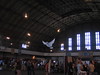 Since I was in the neighborhood, after the previously reported concert, I walked to the other side of Market Street to check out the Mission Bazaar. Actually what I really wanted to do was get inside the Armory building The place is pretty run-down, in a romantic kind of way. The entry-way made me think of a 1950's high school. Some of doors still have the old signage on them, which is pretty cool. The fair was held in a huge indoor space like an airplane hangar that probably takes up half the building. It definitely has performance space possibilities.
I wasn't interested in any of the clothes or jewelry on sale, but I did have a nice chat with a woman involved in creating these beautiful crop-circle-like Playa Paintings with Andres Amador on Ocean Beach.
Alexander String Quartet & Robert Greenberg
Alexander String Quartet & Robert Greenberg
Saturday, May 17 10:00 AM
Herbst Theatre
Franz Schubert, String Quartet No. 14, “Death and the Maiden”
George Crumb, Black Angels (Images I) for electric string quartet
I think 10:00am is too early for audiences & musicians, & apparently it's too early for the venue as well. The doors to the auditorium didn't open until barely 5 minutes to 10:00, due to "technical difficulties". The stage was encumbered by microphone stands, extra chairs, a huge tangle of power cords, 2 gongs & a grand piano, most of this clearly for the Crumb piece. Already it made me think that what was state-of-the-art & avant-garde in 1970 now looks quaintly dated.
The format is for Greenberg & the quartet to come on stage together. Greenberg speaks for about 25 minutes before each piece. The quartet provides musical excerpts at appropriate moments. There was a grand piano on stage for the 1st half, just so Greenberg coudd play a few chords from the lieder version of Death & the Maiden. The entire concert lasted almost 2½ hours, including intermission, so it's perhaps a bit longer than a typical chamber recital.
For the Schubert, Greenberg provided a brief biographical sketch of the composer & related the quartet to the context of Schubert's long illness & death. For the Crumb, Greenberg pointed out the quartet's explicit connection to the Vietnam War, its long quotation from the Schubert quartet, & some of its unusual performance requirements.
The quartet's ensemble certainly feels like a conversation among equals. I liked the bite of the 1st violinist's playing. A quartet has to be pretty game for the Crumb piece, & one is kept busy just watching them. The are asked to hit gongs, bow on tuned glasses, play maracas & do left hand pizzicato at the same time, shout & play at the same time & even bow on the fingerboard on the "wrong" side of the fingering hand. This last effect is supposed to sound like a concert of viols. There's also selective amplification of the instruments. The quiet end of the piece left the audience uncertain it was safe to applaud until the 1st violinist closed his music.
This was definitely an older audience. I was in the middle of a row that had an elderly woman seated at each end. Since neither one of them seemed inclined to moved after the end of the performance, we were trapped for a considerable amount of time afterwards.
Greenberg himself is very much the image of the New York baby-boomer. He made a parallel between the Vietnam War era & today, & he got applause for expressing an election-time wish for a new administration based on truth & decency. As far as his musical commentary, I think I got just as much background from the printed program notes. I was glad to have a chance to hear the Crumb piece, though. It's wide-ranging in both its technique & emotional range, going from the strident & violent to the eerily beautiful.
Saturday, May 17 10:00 AM
Herbst Theatre
Franz Schubert, String Quartet No. 14, “Death and the Maiden”
George Crumb, Black Angels (Images I) for electric string quartet
I think 10:00am is too early for audiences & musicians, & apparently it's too early for the venue as well. The doors to the auditorium didn't open until barely 5 minutes to 10:00, due to "technical difficulties". The stage was encumbered by microphone stands, extra chairs, a huge tangle of power cords, 2 gongs & a grand piano, most of this clearly for the Crumb piece. Already it made me think that what was state-of-the-art & avant-garde in 1970 now looks quaintly dated.
The format is for Greenberg & the quartet to come on stage together. Greenberg speaks for about 25 minutes before each piece. The quartet provides musical excerpts at appropriate moments. There was a grand piano on stage for the 1st half, just so Greenberg coudd play a few chords from the lieder version of Death & the Maiden. The entire concert lasted almost 2½ hours, including intermission, so it's perhaps a bit longer than a typical chamber recital.
For the Schubert, Greenberg provided a brief biographical sketch of the composer & related the quartet to the context of Schubert's long illness & death. For the Crumb, Greenberg pointed out the quartet's explicit connection to the Vietnam War, its long quotation from the Schubert quartet, & some of its unusual performance requirements.
The quartet's ensemble certainly feels like a conversation among equals. I liked the bite of the 1st violinist's playing. A quartet has to be pretty game for the Crumb piece, & one is kept busy just watching them. The are asked to hit gongs, bow on tuned glasses, play maracas & do left hand pizzicato at the same time, shout & play at the same time & even bow on the fingerboard on the "wrong" side of the fingering hand. This last effect is supposed to sound like a concert of viols. There's also selective amplification of the instruments. The quiet end of the piece left the audience uncertain it was safe to applaud until the 1st violinist closed his music.
This was definitely an older audience. I was in the middle of a row that had an elderly woman seated at each end. Since neither one of them seemed inclined to moved after the end of the performance, we were trapped for a considerable amount of time afterwards.
Greenberg himself is very much the image of the New York baby-boomer. He made a parallel between the Vietnam War era & today, & he got applause for expressing an election-time wish for a new administration based on truth & decency. As far as his musical commentary, I think I got just as much background from the printed program notes. I was glad to have a chance to hear the Crumb piece, though. It's wide-ranging in both its technique & emotional range, going from the strident & violent to the eerily beautiful.
Tuesday, May 13, 2008
Raj Patel at Stacey's
There was a sizable SRO crowd at lunch hour at Stacey's Bookstore today to hear Raj Patel. With the global food shortages recently in the news, his new book about the global food economy, Stuffed and Starved, has good timing. He's a terrific speaker, lively, funny, full of ideas, a little indecent & happily on the side of the working class. Plus he's good-looking & has a great English accent. He's got the kind of personality that can make communism seem sexy again.
I was laughing out loud at times. He compared the World Bank to John Cleese's patronizing & malicious Robinhood in The Time Bandits, performing his own rendition of this scene from the movie. He finds the Slow Food movement a bit too bourgeois, describing it as an "olive oil circle-jerk." He told us about bunny chow, a South African convenience food consisting of a loaf of white bread hollowed out & filled with Indian curry. He interprets this as a "miscegenated" food. He slammed fair trade goods for reducing democracy in this country to the conceit that we can make this a better world by shopping. He reminded us that in a democracy we own the political system.
Patel had me completely fired up to buy his book, only Stacey's hadn't anticipated such a big turn-out & actually ran out. If you get a chance, check him out.
P.S. (05.15.2008)
He's appearing at Cody's Books in Berkeley on Friday, May 16th at 7:00pm. You can see the man in action on CBC television here & here.
I was laughing out loud at times. He compared the World Bank to John Cleese's patronizing & malicious Robinhood in The Time Bandits, performing his own rendition of this scene from the movie. He finds the Slow Food movement a bit too bourgeois, describing it as an "olive oil circle-jerk." He told us about bunny chow, a South African convenience food consisting of a loaf of white bread hollowed out & filled with Indian curry. He interprets this as a "miscegenated" food. He slammed fair trade goods for reducing democracy in this country to the conceit that we can make this a better world by shopping. He reminded us that in a democracy we own the political system.

Patel had me completely fired up to buy his book, only Stacey's hadn't anticipated such a big turn-out & actually ran out. If you get a chance, check him out.
P.S. (05.15.2008)
He's appearing at Cody's Books in Berkeley on Friday, May 16th at 7:00pm. You can see the man in action on CBC television here & here.
Sunday, May 11, 2008
Transforming Art
Today I walked through the small exhibit at the Presidio Officers’ Club entitled Transforming Art Exhibition: The Art of Chris Hardman. The exhibit is presented by Antenna Theater. Mostly stuff with mirrors & wood & the modest use of optical illusions. It's nothing earth-shattering, but it's free & part of a visit to the building.
I knew that the Officer's Club building was old, but I didn't realize it dated to the 1st decades of the 19th century. I also learned that part of the motivation for building these garrisons in the 19th century was that the Russians also had colonies on the West Coast then (hence the name of Russian River). I had no idea there were Russian settlements here way back then. What were they doing? What happened to them?
I knew that the Officer's Club building was old, but I didn't realize it dated to the 1st decades of the 19th century. I also learned that part of the motivation for building these garrisons in the 19th century was that the Russians also had colonies on the West Coast then (hence the name of Russian River). I had no idea there were Russian settlements here way back then. What were they doing? What happened to them?
Godard's Contempt; KFOG Fireworks
At the invitation of a friend, last night I saw Godard's Contempt at the Castro. I went in knowing nothing about it. It's a 1963 wide-screen technicolor movie & superficially looks like a Hollywood movie of the era. The cast includes Bridgette Bardot, frequently nude, & Jack Palance. However, it keeps doing unconventional things, starting with the opening credits, which are read in voice-over while we watch the movie itself being filmed, the camera eventually turning toward the audience itself. So I guess it's really an avant-garde classic. The print looked great, which is especially important because of the use of primary colors in the design. I found myself paying a lot of attention to the movie's settings, but I was not much engaged by the characters or the plot. Even Godard seems pretty flippant about the plot, considering the arbitrary way he dispatches 2 of the main characters at the end. The most emotion I felt was in the middle section in the apartment, when I could identify with the frustration, annoyance & disdain of the writer's wife.
Immediately after the show, I rushed into the Muni Metro to catch a train to the Embarcadero for KFOG's beautiful fireworks show. Sadly it took 20 minutes to get out there, so it was well under way by the time I got there. Still fun, & the best show fireworks show in the City. I could not believe how massive the crowds were.
Immediately after the show, I rushed into the Muni Metro to catch a train to the Embarcadero for KFOG's beautiful fireworks show. Sadly it took 20 minutes to get out there, so it was well under way by the time I got there. Still fun, & the best show fireworks show in the City. I could not believe how massive the crowds were.
Sunday, April 27, 2008
All-Haydn Program at SF Symphony
Friday April 25, 2008 at 8:00
Bernard Labadie, conductor
Christine Brandes, soprano
Kelley O’Connor, mezzo-soprano
John Tessier, tenor
Nathan Berg, bass-baritone
San Francisco Symphony Chorus
Haydn Te Deum for the Empress Maria Therese
Haydn Symphony No. 100, Military
Haydn Mass in Time of War
A great program for those of us who feel like we don't know Haydn as well as we should. I just discovered that I don't own a single Haydn CD. All the pieces on this program were written by Haydn in hs 60s, yet they all sound happy & fresh. There were clumps of empty seats in the hall, so I guess either Haydn or Labadie are not big draws.
Labadie had a full-sized chorus but cut the orchestra down by about half for the entire program, so the balances definitely favored the voices. The Te Deum was a grand way to start, but the performance sounded a bit fuzzy around the edges to me.
The Military Symphony was the most satisfying interpretation of the evening for me. There was impressively fleet playing by the winds, & it was fun to hear the Turkish march appear in the slow movement. Labadie is very busy on the podium, giving lots of phrasing cues & even hopping up & down on occassion.
The Mass is dominated by the chorus. The soloists usually just interject short statements here & there. The only thing resembling an aria was the Qui tollis for the bass, accompanied by Grebanier doing a beautiful job with the high obligato part. I felt like I didn't get to hear enough singing by the soloists, though I liked the sound of the bass Nathan Berg (sporting a pony-tail) & the deep-voiced Kelley O'Connor.
Bernard Labadie, conductor
Christine Brandes, soprano
Kelley O’Connor, mezzo-soprano
John Tessier, tenor
Nathan Berg, bass-baritone
San Francisco Symphony Chorus
Haydn Te Deum for the Empress Maria Therese
Haydn Symphony No. 100, Military
Haydn Mass in Time of War
A great program for those of us who feel like we don't know Haydn as well as we should. I just discovered that I don't own a single Haydn CD. All the pieces on this program were written by Haydn in hs 60s, yet they all sound happy & fresh. There were clumps of empty seats in the hall, so I guess either Haydn or Labadie are not big draws.
Labadie had a full-sized chorus but cut the orchestra down by about half for the entire program, so the balances definitely favored the voices. The Te Deum was a grand way to start, but the performance sounded a bit fuzzy around the edges to me.
The Military Symphony was the most satisfying interpretation of the evening for me. There was impressively fleet playing by the winds, & it was fun to hear the Turkish march appear in the slow movement. Labadie is very busy on the podium, giving lots of phrasing cues & even hopping up & down on occassion.
The Mass is dominated by the chorus. The soloists usually just interject short statements here & there. The only thing resembling an aria was the Qui tollis for the bass, accompanied by Grebanier doing a beautiful job with the high obligato part. I felt like I didn't get to hear enough singing by the soloists, though I liked the sound of the bass Nathan Berg (sporting a pony-tail) & the deep-voiced Kelley O'Connor.
Events at Stacey's
Stacey's bookstore was quite the forum of ideas this week. I went to 3 interesting book events. On Monday, LA Times columnist Steve Lopez talked about The Soloist. It's his way of bringing attention to the appalling plight of LA's poor on skid row. He recounts his relationship with a musician struggling with mental illness & homelessness. Mr. Lopez tells a tough & inspiring story, & he's really part of the story himself, becoming friends with the musician & spending the night with him on skid row. He eventually gets his friend housing & entree into Disney Hall. Soon to be a major motion picture.
On Tuesday, Gary Marcus described how our memories & thought processes can be quite faulty. His book has the amusing title Kluge: The Haphazard Construction of the Human Mind. There is no reason that evolution has to hit upon the optimal design, & our memories do not work like addressable computer memory at all. Sounds like the book contains good arguments against intelligent design.
On Friday Susan Jacoby discussed her book The Age of American Unreason, which is about how we've all gotten so dumb in public discourse. It's pretty disheartening to be in a book store & hear that the reading culture is going away. I was intrigued by her suggestion that the Internet actually allows people to isolate themselves from differing view-points instead of challenging them with new ideas. Ms Jacoby is an excellent speaker, concise, energetic & funny. You can tell that she enjoys a good argument.
Stacey's runs these events efficiently, not letting things go on for too long. I'm not a fan of the Q & A format, but the people attending seem to be a well-informed lot.
On Tuesday, Gary Marcus described how our memories & thought processes can be quite faulty. His book has the amusing title Kluge: The Haphazard Construction of the Human Mind. There is no reason that evolution has to hit upon the optimal design, & our memories do not work like addressable computer memory at all. Sounds like the book contains good arguments against intelligent design.
On Friday Susan Jacoby discussed her book The Age of American Unreason, which is about how we've all gotten so dumb in public discourse. It's pretty disheartening to be in a book store & hear that the reading culture is going away. I was intrigued by her suggestion that the Internet actually allows people to isolate themselves from differing view-points instead of challenging them with new ideas. Ms Jacoby is an excellent speaker, concise, energetic & funny. You can tell that she enjoys a good argument.
Stacey's runs these events efficiently, not letting things go on for too long. I'm not a fan of the Q & A format, but the people attending seem to be a well-informed lot.
Sunday, April 20, 2008
August Wilson's Fences
This past Friday night I saw August Wilson's Fences at the Lorraine Hansberry Theatre. This is a poetic & multi-layered play which I've read but never seen before. This production was very straight-forward & unadorned. Occasionally the lighting changes to highlight one of Troy's monologues, but otherwise there is little theatrical artifice. The front yard set was impressively realistic, complete with a dirt floor & a brick wall backdrop with a faded Coca-Cola ad.
The play is a showcase for the actor playing Troy Maxson, in this case the likable Alex Morris. He may be almost too likable for a character who is not only funny but also annoying, frightening & cruel. Very convincing were Elizabeth Carter as the maternal & reliable Rose & Hosea Simmons Sr. as the spiritually touched Gabriel. He was believably brain-damaged without being uncomfortable to watch. I liked how all of the characters had a distinctive way of moving as well as of speaking.
August Wilson ends the play with an open-ended stage direction that announces Troy's ascent into heaven. In this case, the production opted for a very simple solution to the challenge, with a celestial light suddenly shining down on the characters. It's not an especially daring or theatrical moment, but it does fit with the realistic & grounded style of the production.
The audience I saw the show with included a contingent of students from the San Francisco School of the Arts. I didn't even know we had such a school in the City. There was also a pre-show pitch for donations involving a confusing Macy's coupon offer.
The audience was very responsive, though I wasn't sure what to make of some of the audience reaction. I often felt there was a lot of inappropriate laughter. Was this an unsophisticated audience? Was it nervous laughter? Someone suggested to me that perhaps we've come full circle & that some of these situations have become stereotypes all over again.
The play is a showcase for the actor playing Troy Maxson, in this case the likable Alex Morris. He may be almost too likable for a character who is not only funny but also annoying, frightening & cruel. Very convincing were Elizabeth Carter as the maternal & reliable Rose & Hosea Simmons Sr. as the spiritually touched Gabriel. He was believably brain-damaged without being uncomfortable to watch. I liked how all of the characters had a distinctive way of moving as well as of speaking.
August Wilson ends the play with an open-ended stage direction that announces Troy's ascent into heaven. In this case, the production opted for a very simple solution to the challenge, with a celestial light suddenly shining down on the characters. It's not an especially daring or theatrical moment, but it does fit with the realistic & grounded style of the production.
The audience I saw the show with included a contingent of students from the San Francisco School of the Arts. I didn't even know we had such a school in the City. There was also a pre-show pitch for donations involving a confusing Macy's coupon offer.
The audience was very responsive, though I wasn't sure what to make of some of the audience reaction. I often felt there was a lot of inappropriate laughter. Was this an unsophisticated audience? Was it nervous laughter? Someone suggested to me that perhaps we've come full circle & that some of these situations have become stereotypes all over again.
Tuesday, April 15, 2008
Jazz + Silent Film Festival
Saturday, April 12, 3PM
Jazz + Silent Film Festival
Castro Theatre
Sherlock Jr.
The Cabinet of Dr. Caligari
Nosferatu
Club Foot Orchestra
This weekend was warm & sunny, & such days are rare & precious in The City, even in the age of global warming. I, however, spent most of the Saturday in the Castro Theater to hear the Club Foot Orchestra accompany 3 silent movies as part of the SF Jazz Festival. I've heard them do each of these movies before, but never in one day. These are really fun events, & there was a full house for all the shows.
The Club Foot Orchestra scores are especially fun because they do not merely accompany the action on screen but also comment on it. When Buster is rejected by this girlfriend's father in Sherlock Jr., we hear a bluesy guitar riff. On a bigger scale, whenever the vampire in Nosferatu is biting someone, we get a version of slinky burlesque-show music at full volume. At this distance, Dr. Caligari & Nosferatu may be more important for historical reasons than for their entertainment value, but the Club Foot Orchestra's modern scores go a long way to making them effective again. Sherlock Jr. is possibly Keaton's best, minute for minute packed with some of his cleverest gags.
Each screening was preceded by the Castro's organ & then the animated short Felix the Cat Woos Whoopee. For the Felix cartoon, the orchestra improvises freely to the wild on-screen images. Since I ended up sitting through this 3 times, I got to hear the band get better & better at matching the movie's timing.
All the movies seemed to be DVD projections instead of actual film. There were a couple of glitches when the image froze momentarily. The versions of Dr. Caligari & Nosferatu were in really poor condition & looked terrible. Nosferatu seems to be missing scenes. I hope that better restorations of these films exist.
Jazz + Silent Film Festival
Castro Theatre
Sherlock Jr.
The Cabinet of Dr. Caligari
Nosferatu
Club Foot Orchestra
This weekend was warm & sunny, & such days are rare & precious in The City, even in the age of global warming. I, however, spent most of the Saturday in the Castro Theater to hear the Club Foot Orchestra accompany 3 silent movies as part of the SF Jazz Festival. I've heard them do each of these movies before, but never in one day. These are really fun events, & there was a full house for all the shows.
The Club Foot Orchestra scores are especially fun because they do not merely accompany the action on screen but also comment on it. When Buster is rejected by this girlfriend's father in Sherlock Jr., we hear a bluesy guitar riff. On a bigger scale, whenever the vampire in Nosferatu is biting someone, we get a version of slinky burlesque-show music at full volume. At this distance, Dr. Caligari & Nosferatu may be more important for historical reasons than for their entertainment value, but the Club Foot Orchestra's modern scores go a long way to making them effective again. Sherlock Jr. is possibly Keaton's best, minute for minute packed with some of his cleverest gags.
Each screening was preceded by the Castro's organ & then the animated short Felix the Cat Woos Whoopee. For the Felix cartoon, the orchestra improvises freely to the wild on-screen images. Since I ended up sitting through this 3 times, I got to hear the band get better & better at matching the movie's timing.
All the movies seemed to be DVD projections instead of actual film. There were a couple of glitches when the image froze momentarily. The versions of Dr. Caligari & Nosferatu were in really poor condition & looked terrible. Nosferatu seems to be missing scenes. I hope that better restorations of these films exist.
Monday, April 14, 2008
András Schiff Beethoven Cycle IV
4/13/2008 07:00 PM
Davies Symphony Hall
András Schiff, Piano
Beethoven Piano Sonatas Nos. 12, 13, 14 and 15
Encore: Bach French Suite #5 in G
This was the biggest audience I'd seen for the cycle so far, no doubt because we reached the Moonlight Sonata with this program. To build anticipation, Schiff even left the stage briefly before playing it. Usually Schiff has remained on stage between sonatas. Typically his use of the sustain pedal is sparing to non-existent, but for the 1st movement he held it down through changes in the harmony. The accumulated chords created a kind of blurry halo of pitches. The accompaniment moved evenly & deliberately, with just a hint of a pulse. The mood was restrained, delicate & fragile. Schiff usually goes straight from one movement to the next, attaca, & in this case the contrast between movements was extreme. Schiff does a good job of preserving the sometimes weird character of Beethoven's music. He received a partial standing ovation before intermission for his rendition of this famous piece.
Schiff continues to play intelligently & with exacting precision in these recitals. I like improvisatory feel he gave to the meandering & sometimes halting Rondo of Sonata #15. He made it humorous & surprising.
As another generous encore, we got the whole of Bach's French Suite in G, executed with Schiff's now familiar crystalline dispatch, plus embellishments.
To emphasize the fact that some of these sonata movements are very quiet, we had a relatively noisy audience. There was a magnificent cougher during the 1st movement of the 1st piece who had 2 outbursts that nearly stopped the performance. Another cougher then made himself known during the 1st movement of the 2nd piece. A couple of other times it sounded like someone slapped a heavy object to the floor.
Davies Symphony Hall
András Schiff, Piano
Beethoven Piano Sonatas Nos. 12, 13, 14 and 15
Encore: Bach French Suite #5 in G
This was the biggest audience I'd seen for the cycle so far, no doubt because we reached the Moonlight Sonata with this program. To build anticipation, Schiff even left the stage briefly before playing it. Usually Schiff has remained on stage between sonatas. Typically his use of the sustain pedal is sparing to non-existent, but for the 1st movement he held it down through changes in the harmony. The accumulated chords created a kind of blurry halo of pitches. The accompaniment moved evenly & deliberately, with just a hint of a pulse. The mood was restrained, delicate & fragile. Schiff usually goes straight from one movement to the next, attaca, & in this case the contrast between movements was extreme. Schiff does a good job of preserving the sometimes weird character of Beethoven's music. He received a partial standing ovation before intermission for his rendition of this famous piece.
Schiff continues to play intelligently & with exacting precision in these recitals. I like improvisatory feel he gave to the meandering & sometimes halting Rondo of Sonata #15. He made it humorous & surprising.
As another generous encore, we got the whole of Bach's French Suite in G, executed with Schiff's now familiar crystalline dispatch, plus embellishments.
To emphasize the fact that some of these sonata movements are very quiet, we had a relatively noisy audience. There was a magnificent cougher during the 1st movement of the 1st piece who had 2 outbursts that nearly stopped the performance. Another cougher then made himself known during the 1st movement of the 2nd piece. A couple of other times it sounded like someone slapped a heavy object to the floor.
Wednesday, April 09, 2008
Olympic Torch Bait-and-Switch
I was part of the crowd at the Ferry Building at 2:00pm, hoping to get a glimpse of the Olympic torch. It was a big turn-out. Clearly thousands of people lined the closed-off Embarcadero. There were plenty of the expected protesters as well. At one point I was between 2 different groups of banner-waving protesters marching down the route. A rumor went through the crowd that the police had put the torch on a boat in McCovey Cove & were taking it to the Ferry Building over the water. I confirmed this with someone back at my office who was on the Web. But this was probably a decoy.
I went through Justin Herman Plaza on my way back to the office. It was filled with media people, lion dancers & a noisy rock sound track. The video screen set up there suddenly started broadcasting an aerial view of the torch relay, which was apparently going north up Van Ness. At this point it was obvious that the relay had been completely re-routed, though it wasn't clear how it could have made it to Van Ness from the ball park. I was side-swiped by a group of students with flags running at full speed towards Market Street.
Back at my desk, I followed the confusing turn of events through Team Tibet's twitter feed. The torch ended up in the Marina, & closing ceremonies at Justin Herman Plaza were canceled. The most dramatic event was the report of a torch bearer who pulled out a Tibetan flag & then was ejected from the relay. Gavin Newsom will no doubt claim that this was all done for the sake of safety & order, but he duped not only the protesters but thousands of legitimate spectators.
I went through Justin Herman Plaza on my way back to the office. It was filled with media people, lion dancers & a noisy rock sound track. The video screen set up there suddenly started broadcasting an aerial view of the torch relay, which was apparently going north up Van Ness. At this point it was obvious that the relay had been completely re-routed, though it wasn't clear how it could have made it to Van Ness from the ball park. I was side-swiped by a group of students with flags running at full speed towards Market Street.
Back at my desk, I followed the confusing turn of events through Team Tibet's twitter feed. The torch ended up in the Marina, & closing ceremonies at Justin Herman Plaza were canceled. The most dramatic event was the report of a torch bearer who pulled out a Tibetan flag & then was ejected from the relay. Gavin Newsom will no doubt claim that this was all done for the sake of safety & order, but he duped not only the protesters but thousands of legitimate spectators.
Tuesday, April 08, 2008
András Schiff Beethoven Cycle
Sunday April 6, 2008 7:00 PM
Davies Symphony Hall
András Schiff, piano
Beethoven Piano Sonatas Nos. 19, 20, 9, 10, 11
Encore: Bach Partita #1
Now that Schiff is a known quantity to me, I settled into my seat secure in the knowledge that this would be an evening with a lot to admire. The program began with a pair of short sonatas. Though these are light pieces, Schiff made them substantial with his full & solid sound. He ornamented both of them, which added a nice improvisatory element. In fact, Schiff's playing often has this feeling, as though even he isn't quite sure what is going to happen next. It's a fine illusion, since at the same time it's obvious that he's worked out very detailed interpretations.
He made the Sonata No. 10 into a small comedic masterpiece. In the 2nd movement theme-and-variations, Schiff teased us with the short, overly-insistent repeated notes of the theme. It was so captivating that the audience burst into applause immediately after its coyly explosive ending. Or maybe they simply mis-counted the movements. Schiff ended the final movement with a bit of physical humor, throwing down the final 3-note figure with his left hand just as he stood up to take a bow.
I really like Schiff's incisive phrasing & solid sound. I feel like he's on top of every note when he presses down those keys. So far he has been very sparing in his use of he pedal. He often uses an effect where the sound has a definite start & cut-off, as if the sound just stops instead of decaying.
More importantly, Schiff has ideas & communicates them. For instance, when the fugal entrances occur during No. 11, the sense of something urgent & emphatic happening is unmistakable. No. 11 was the major sonata in this grouping & the only piece after intermission. He filled out this short 2nd half with a virtuoso rendition of the Bach Partita No. 1 in B-flat major. His playing was crystal clear & unfussy. I especially enjoyed the introspective Sarabande & the effortlessly swift & even Gigue. It was as good as anything else in the program.
Davies Symphony Hall
András Schiff, piano
Beethoven Piano Sonatas Nos. 19, 20, 9, 10, 11
Encore: Bach Partita #1
Now that Schiff is a known quantity to me, I settled into my seat secure in the knowledge that this would be an evening with a lot to admire. The program began with a pair of short sonatas. Though these are light pieces, Schiff made them substantial with his full & solid sound. He ornamented both of them, which added a nice improvisatory element. In fact, Schiff's playing often has this feeling, as though even he isn't quite sure what is going to happen next. It's a fine illusion, since at the same time it's obvious that he's worked out very detailed interpretations.
He made the Sonata No. 10 into a small comedic masterpiece. In the 2nd movement theme-and-variations, Schiff teased us with the short, overly-insistent repeated notes of the theme. It was so captivating that the audience burst into applause immediately after its coyly explosive ending. Or maybe they simply mis-counted the movements. Schiff ended the final movement with a bit of physical humor, throwing down the final 3-note figure with his left hand just as he stood up to take a bow.
I really like Schiff's incisive phrasing & solid sound. I feel like he's on top of every note when he presses down those keys. So far he has been very sparing in his use of he pedal. He often uses an effect where the sound has a definite start & cut-off, as if the sound just stops instead of decaying.
More importantly, Schiff has ideas & communicates them. For instance, when the fugal entrances occur during No. 11, the sense of something urgent & emphatic happening is unmistakable. No. 11 was the major sonata in this grouping & the only piece after intermission. He filled out this short 2nd half with a virtuoso rendition of the Bach Partita No. 1 in B-flat major. His playing was crystal clear & unfussy. I especially enjoyed the introspective Sarabande & the effortlessly swift & even Gigue. It was as good as anything else in the program.
Sunday, April 06, 2008
Ukiyo-e at the Asian Art Museum
I was at the Asian Art Museum yesterday to see the exhibit Drama and Desire: Japanese Paintings from the Floating World 1690–1850. The works contain a lot of pictorial details about the clothes, objects & manners of this subculture. I was impressed by the great colors & especially the depictions of the kimono fabrics. The paintings of Katsushika Hokusai rise above the decorative nature of most of the exhibit. I really liked his elongated Phoenix screen in comic-book colors & the reflective composition of Li Bi Admiring a Waterfall. He's also represented by a pair of cool hand-painted paper lanterns with dragons snaking around them.
I usually don't have the patience to sit through videos in the galleries, but this time I watched with interest the video about the British Museum's painstaking restoration of a Ukiyo-e screen. I learned that these screens have paper hinges that cleverly allow the panels to hinge in either direct.
I also took a quick peek at Zhan Wang's humorous
shiny silver model of San Francisco built from restaurant supply store merchandise.
I usually don't have the patience to sit through videos in the galleries, but this time I watched with interest the video about the British Museum's painstaking restoration of a Ukiyo-e screen. I learned that these screens have paper hinges that cleverly allow the panels to hinge in either direct.
I also took a quick peek at Zhan Wang's humorous
shiny silver model of San Francisco built from restaurant supply store merchandise.
Thursday, April 03, 2008
Free the Piano Player
Wednesday, April 02, 2008
Nikolaj Znaider
Wednesday, March 26 8:00 PM
Herbst Theater
Nikolaj Znaider, violin
Robert Kulek, piano
BEETHOVEN: Sonata for Violin and Piano No. 3 in E-flat Major
BACH: Partita No. 2 in D minor for Solo Violin
SCHOENBERG: Phantasy for Violin with Piano Accompaniment, Op. 47
BEETHOVEN: Violin Sonata in G Major, Op. 96
ENCORE:
BRAHMS: Hungarian Dances No. 17 & 7
I had never heard of Nikolaj Znaider before. I was attracted to this recital by the great program. The printed program listed the Bach 1st, but Znaider made his 1st entrance followed by his accompanist. He explained that due to the special nature of the Partita it made more sense to end the 1st half with it, leaving the silence after the Chaconne uninterrupted by Beethoven. This may have been a calculated bit of showmanship, but the Partita was indeed the highlight of the evening. Znaider has a complete & easy technical mastery, & he played the Partita with an intense focus. The Gigue flew by, & my ears were almost ringing after the sustained onslaught of sound of the Chaconne. Znaider got a scattered standing ovation after the Chaconne.
Znaider is a tall man, & the violin looks tiny in his hands. I kept watching his rapid bow arm & his use of the entire length of the bow. The program allowed him to show off his proficiency in different styles. He played the early Beethoven Sonata in a tight classical style, but played the final Beethoven Sonata broadly. He managed to give the Schoenberg a sense of shape & momentum, placing a climax near the end of the piece. Znaider is Danish, but the apparent ease of his playing reminds me of Israeli violinists like Perlman or Shaham.
Znaider's accompanist was a little sloppy, & musically I did not feel that there was a lot of communication between the 2 of them, even though they sometimes conferred between movements.
For some reason the audience applauded immediately after the 1st movement of the Beethoven Sonata that opened the program. I have no idea why this happened, since after this no one interrupted any other piece with inappropriate applause. Znaider gave us 2 vigorous encores & even threw in a down-bow staccato all the way to the tip of the bow in Hungarian Dance #7.
Herbst Theater
Nikolaj Znaider, violin
Robert Kulek, piano
BEETHOVEN: Sonata for Violin and Piano No. 3 in E-flat Major
BACH: Partita No. 2 in D minor for Solo Violin
SCHOENBERG: Phantasy for Violin with Piano Accompaniment, Op. 47
BEETHOVEN: Violin Sonata in G Major, Op. 96
ENCORE:
BRAHMS: Hungarian Dances No. 17 & 7
I had never heard of Nikolaj Znaider before. I was attracted to this recital by the great program. The printed program listed the Bach 1st, but Znaider made his 1st entrance followed by his accompanist. He explained that due to the special nature of the Partita it made more sense to end the 1st half with it, leaving the silence after the Chaconne uninterrupted by Beethoven. This may have been a calculated bit of showmanship, but the Partita was indeed the highlight of the evening. Znaider has a complete & easy technical mastery, & he played the Partita with an intense focus. The Gigue flew by, & my ears were almost ringing after the sustained onslaught of sound of the Chaconne. Znaider got a scattered standing ovation after the Chaconne.
Znaider is a tall man, & the violin looks tiny in his hands. I kept watching his rapid bow arm & his use of the entire length of the bow. The program allowed him to show off his proficiency in different styles. He played the early Beethoven Sonata in a tight classical style, but played the final Beethoven Sonata broadly. He managed to give the Schoenberg a sense of shape & momentum, placing a climax near the end of the piece. Znaider is Danish, but the apparent ease of his playing reminds me of Israeli violinists like Perlman or Shaham.
Znaider's accompanist was a little sloppy, & musically I did not feel that there was a lot of communication between the 2 of them, even though they sometimes conferred between movements.
For some reason the audience applauded immediately after the 1st movement of the Beethoven Sonata that opened the program. I have no idea why this happened, since after this no one interrupted any other piece with inappropriate applause. Znaider gave us 2 vigorous encores & even threw in a down-bow staccato all the way to the tip of the bow in Hungarian Dance #7.
Alan Gilbert Leads the SF Symphony
Friday March 28, 2008 8:00 PM
Davies Symphony Hall
San Francisco Symphony
Alan Gilbert conductor
Richard Goode piano
Stucky Son et lumière
Mozart Piano Concerto No. 18
Nielsen Symphony No. 2, The Four Temperaments
I've heard Alan Gilbert conduct here before, but he never made a big impression on me. Now that he's the in-coming music director of the NY Phil, I thought I should give him another hearing. This turned out to be a very nice program. The Stucky piece is percussion-heavy & audience-friendly. It kept sounding like it was about to turn into something by either Stravinsky or John Adams. Gilbert made sure that the matching opening & closing percussion ensemble was tight.
In the Mozart, I found Richard Goode's interpretation to be very respectful of the composer. His playing is light & crisp. I felt like he wasn't trying to add anything to Mozart. In contrast, Gilbert was much more emphatic & urgent. Oddly, Goode was using a score for his performance.
Nielsen can be a cool customer, but this symphony was very accessible & easy to follow in a programmatic way. Gilbert has a very active podium style & is always doing something from moment to moment. He does a lot of cueing, though at times he is conducting along with the orchestra instead of being ahead of it.
I enjoy reading Opera Tattler's catty remarks about the audience, but in this case I'd like to tattle on the orchestra. A 1st violinist in the 1st movement of the Nielsen went bowing the wrong way for quite a noticeable stretch. The Symphony's strings are quite uniform in their playing these days, so this lapse stood out. The player seemed a bit amused by it himself.
Davies Symphony Hall
San Francisco Symphony
Alan Gilbert conductor
Richard Goode piano
Stucky Son et lumière
Mozart Piano Concerto No. 18
Nielsen Symphony No. 2, The Four Temperaments
I've heard Alan Gilbert conduct here before, but he never made a big impression on me. Now that he's the in-coming music director of the NY Phil, I thought I should give him another hearing. This turned out to be a very nice program. The Stucky piece is percussion-heavy & audience-friendly. It kept sounding like it was about to turn into something by either Stravinsky or John Adams. Gilbert made sure that the matching opening & closing percussion ensemble was tight.
In the Mozart, I found Richard Goode's interpretation to be very respectful of the composer. His playing is light & crisp. I felt like he wasn't trying to add anything to Mozart. In contrast, Gilbert was much more emphatic & urgent. Oddly, Goode was using a score for his performance.
Nielsen can be a cool customer, but this symphony was very accessible & easy to follow in a programmatic way. Gilbert has a very active podium style & is always doing something from moment to moment. He does a lot of cueing, though at times he is conducting along with the orchestra instead of being ahead of it.
I enjoy reading Opera Tattler's catty remarks about the audience, but in this case I'd like to tattle on the orchestra. A 1st violinist in the 1st movement of the Nielsen went bowing the wrong way for quite a noticeable stretch. The Symphony's strings are quite uniform in their playing these days, so this lapse stood out. The player seemed a bit amused by it himself.
Tuesday, April 01, 2008
Paul Galbraith Recital
PAUL GALBRAITH, guitar
Sunday, March 30 at 2:00 pm in the Florence Gould Theater
Chamber Music San Francisco
W.A. Mozart Andante cantabile
Lennox Berkeley Theme and Variations for Guitar, opus 77
J.S. Bach Cello Suite No.4
Franz Schubert Piano Sonata in A-flat major, D. 557
W.A. Mozart Piano Sonata in F major, K. 280
Guitar recitals must be among the most rarefied of chamber music experiences. The strongest impression I came away with was the quietness of it. There aren't that many shared quiet experiences in modern life. The classical guitar is not a loud instrument, & Paul Galbraith is not a demonstrative player. The audience has to be very still in order for this to work at all, & this audience was admirably quiet. In fact it was so quiet that I could hear sounds of the restaurant next door, the tapping of someone's foot nearby, even a door opening backstage. When someone started clapping after the 1st movement of the Bach, she was quickly shushed.
The auditorium was almost completely dark. The stage was dark too, except for a spot light on Galbraith. He was dressed mostly in black, so the stage picture gave the impression of 2 disembodied hands flitting around the guitar.
Galbraith plays a custom guitar with 8 strings. The most obvious difference in range is the low notes it can play. He sits on a kind of throne a foot & a half high & plays the guitar like a cello. The instrument sits upright between his knees, supported by an end-pin. Instead of bowing, he plucks it, but his left hand is positioned just like a cellists. Some of the left hand stretches look very wide.
He gave a brief, knowledgeable introduction to each piece. His interpretations were contemplative, deliberate & without showiness. The slow movement of the Mozart was particularly exquisite. I got the feeling that he had spent a lot of time working out how everything was going to go, so that a piece sounded pretty much the same each time he played it.
The Legion of Honor was a happening place that afternoon. There were a lot of people of at the museum, no doubt for the Annie Leibovitz exhibit. The start of the recital had to be held for 10 minutes due to the crunched parking situation. While I was in the museum I also saw a jazz singer in the restaurant & an organ recital in the atrium.
Sunday, March 30 at 2:00 pm in the Florence Gould Theater
Chamber Music San Francisco
W.A. Mozart Andante cantabile
Lennox Berkeley Theme and Variations for Guitar, opus 77
J.S. Bach Cello Suite No.4
Franz Schubert Piano Sonata in A-flat major, D. 557
W.A. Mozart Piano Sonata in F major, K. 280
Guitar recitals must be among the most rarefied of chamber music experiences. The strongest impression I came away with was the quietness of it. There aren't that many shared quiet experiences in modern life. The classical guitar is not a loud instrument, & Paul Galbraith is not a demonstrative player. The audience has to be very still in order for this to work at all, & this audience was admirably quiet. In fact it was so quiet that I could hear sounds of the restaurant next door, the tapping of someone's foot nearby, even a door opening backstage. When someone started clapping after the 1st movement of the Bach, she was quickly shushed.
The auditorium was almost completely dark. The stage was dark too, except for a spot light on Galbraith. He was dressed mostly in black, so the stage picture gave the impression of 2 disembodied hands flitting around the guitar.
Galbraith plays a custom guitar with 8 strings. The most obvious difference in range is the low notes it can play. He sits on a kind of throne a foot & a half high & plays the guitar like a cello. The instrument sits upright between his knees, supported by an end-pin. Instead of bowing, he plucks it, but his left hand is positioned just like a cellists. Some of the left hand stretches look very wide.
He gave a brief, knowledgeable introduction to each piece. His interpretations were contemplative, deliberate & without showiness. The slow movement of the Mozart was particularly exquisite. I got the feeling that he had spent a lot of time working out how everything was going to go, so that a piece sounded pretty much the same each time he played it.
The Legion of Honor was a happening place that afternoon. There were a lot of people of at the museum, no doubt for the Annie Leibovitz exhibit. The start of the recital had to be held for 10 minutes due to the crunched parking situation. While I was in the museum I also saw a jazz singer in the restaurant & an organ recital in the atrium.
Dr. Allan Hamilton at Stacey's
I was at Stacey's Bookstore on my lunch hour today & heard Dr. Allan Hamilton talk about his book The Scalpel and the Soul. The book seems to be about the author's encounters with the supernatural during his career as a doctor working with patients in medical crises. He's a good presenter & had all his anecdotes lined up, though the 1st couple of stories sounded like ghost stories. As far as the supernatural aspect of this goes, I'm skeptical, but he did have some good criticisms of the way patients are typically treated in hospitals. He also had an interesting piece of advice for people undergoing surgery: make yourself a CD of your favorite music for coming out of anesthesia. Apparently music helps ease this transition.
He had a much bigger audience than the much more relevant Eric Alterman last week. He ended his talk with an unusual give-away proposition. He gave us a secret code that, along with a book receipt number, allows the buyer of his book to download a bonus chapter about getting the most out of one's doctor.
He had a much bigger audience than the much more relevant Eric Alterman last week. He ended his talk with an unusual give-away proposition. He gave us a secret code that, along with a book receipt number, allows the buyer of his book to download a bonus chapter about getting the most out of one's doctor.
Friday, March 28, 2008
Eric Alterman at Stacey's
Wednesday, March 26th
I spent part of my lunch hour at Stacey's Books & heard Eric Alterman talk about his new book Why We’re Liberals. Mr. Alterman is very much the New York intellectual. He started out by digressing wildly about Finland, a country he recently visited & found "very cool". There is no private education there. It's not possible to buy an education that's better than anyone else's. & if Bill Gates got pulled over for a traffic violation, he might have to pay $80,000, since fines are not a set amount but instead based on a percentage of income. Good idea, eh?
The book seems to be a critique of how liberalism has failed in the popular culture. I didn't realize that "liberal" had become such a dirty word. Politicians reject the label, as do voters, even though issue by issue most people in fact agree with the liberal stance. The preferred label nowadays is "progressive".
By Mr. Alterman's definition, liberals "embrace the legacy of the Enlightenment". Plus they hold the belief that government should step in where the market does not allocate resources well. Conservatives say, "You're on your own."
Conservatives have successfully gotten the liberal label associated in a negative way with issues that they don't want to address, such as universal health care, unions & the role of religion in stem cell research. Mr. Alterman partly blames liberals themselves for not defending their beliefs better.
Other problems he calls "God's fault". For instance, conservatives spread themselves out, while liberals are concentrated in cities. So states with small populations have disproportionate influence. A vote in Wyoming or Alaska counts more than one from California.
In Mr. Alterman's view, Bush won in 2004 because people didn't trust liberals on security. Even though more people thought that the war was having a negative impact on the nation, they also thought that Bush would do a better job at security than a liberal.
It was nice to drop in on such a smart discussion. The crowd was definitely larger than usual & asked well-informed questions.
I spent part of my lunch hour at Stacey's Books & heard Eric Alterman talk about his new book Why We’re Liberals. Mr. Alterman is very much the New York intellectual. He started out by digressing wildly about Finland, a country he recently visited & found "very cool". There is no private education there. It's not possible to buy an education that's better than anyone else's. & if Bill Gates got pulled over for a traffic violation, he might have to pay $80,000, since fines are not a set amount but instead based on a percentage of income. Good idea, eh?
The book seems to be a critique of how liberalism has failed in the popular culture. I didn't realize that "liberal" had become such a dirty word. Politicians reject the label, as do voters, even though issue by issue most people in fact agree with the liberal stance. The preferred label nowadays is "progressive".
By Mr. Alterman's definition, liberals "embrace the legacy of the Enlightenment". Plus they hold the belief that government should step in where the market does not allocate resources well. Conservatives say, "You're on your own."
Conservatives have successfully gotten the liberal label associated in a negative way with issues that they don't want to address, such as universal health care, unions & the role of religion in stem cell research. Mr. Alterman partly blames liberals themselves for not defending their beliefs better.
Other problems he calls "God's fault". For instance, conservatives spread themselves out, while liberals are concentrated in cities. So states with small populations have disproportionate influence. A vote in Wyoming or Alaska counts more than one from California.
In Mr. Alterman's view, Bush won in 2004 because people didn't trust liberals on security. Even though more people thought that the war was having a negative impact on the nation, they also thought that Bush would do a better job at security than a liberal.
It was nice to drop in on such a smart discussion. The crowd was definitely larger than usual & asked well-informed questions.
Saturday, March 22, 2008
Gustavo Dudamel leads the SF Symphony
 Gustavo Dudamel, conductor
Kirill Gerstein, piano
Rachmaninoff Piano Concerto No. 1
Stravinsky The Firebird
The 26 year old Gustavo Dudamel is rapidly becoming a major phenomenon. His 1st appearance with the San Francisco Symphony has been sold out for months, & any returns that came in went right back out. I was excited to attend & be part of the buzz.
Obviously on this program the Firebird is the main event, but 1st came the Rachmaninoff Concerto. Before Mr. Gerstein came on stage, I was a little worried for him. The orchestra was huge, & it looked like he was going to have a tough time competing with it. However, Gerstein turns out to be a piano playing machine, & his sound is heavy enough to hear against the full orchestra. He gave an athletic performance which earned him a scattered standing ovation.
The Stravinsky was Dudamel's chance to show off. This is a flashy piece. It required 3 harps on stage! If Dudamel had simply pulled out all the stops & gone fast & furious, the audience would have loved it. Instead, he gave a surprisingly controlled reading. He challenged the orchestra to sustain expansive tempos in some of the slower, atmospheric episodes. The result was restrained & musical.
The orchestral balances were excellent. Even during the big climaxes with the whole orchestra playing, I could discern individual sections. Dudamel made seemless transitions between the numbers. It seemed like one whole instead of individual pieces.
He definitely inspires a sense of unanimity from the orchestra. They all played as one under him. There was so some nice solo playing as well. I especially enjoyed William Bennett's gorgeous oboe solos.
Dudamel looks great on the podium. He makes fluid movements with his entire body that are as expressive as a dancer's. In fact he looked like a dancer a lot of the time. A couple of times he was even jumping up & down. & to make it all the more impressive, he conducted the entire Firebird confidently without a score. Unsurprisingly Dudamel received an immediate standing ovation. During the long ovation, he amusingly made the orchestra turn around & acknowledge applause from people in the terrace seats. My concert companion rightly commented, "What's not to like?"
Thursday, March 20, 2008
La Rondine at the Castro
The San Francisco Opera has also gotten into the HD arena, so I was at the Castro Theatre Monday night to see last season's production of La Rondine. As at most evenings at the Castro, someone was there to play the organ before the show. I questioned the appropriateness of doing this before an opera, but we did get a pleasant medley of operetta & opera tunes as well as the traditional "San Francisco".
The experience is pretty similar to the Met HD Broadcasts. It's full of close-ups that make you feel like you're sitting on the stage with the singers, who are all dramatically convincing. There were no hosted segments or backstage features, which was fine by me. The sound seemed to lag behind the image just a fraction, so I think there was a slight synchronization problem. The audio balance sometimes seemed out of whack. For example, during a number in Act II a glockenspiel rang out louder than anything every time it was played.
This was my 1st time encountering La Rondine. It's sort of a collision between La Boheme, La Traviata & Die Fledermaus. I thoroughly enjoyed the opera & this production. I wish I had seen it live. The production tells the story in a straight-forward way, free of directorial concept, except for updating it to the 1920s. The gorgeous art-deco sets & costumes turn out to be a good fit for Puccini's glittering orchestration.
This production was clearly a star vehicle for the attractive, long-limbed Angela Gheorghiu. She has a high, bright voice & an openly sensual stage presence. During a lull in Act I she takes off her shoes & messages her legs & reclines suggestively over the arm of a sofa. She is constantly in motion, & on the big screen this at times translated on the big screen into a distracting restlessness. Anna Christy gave a great character performance as the pert maid Lisette. Misha Didyk sounded forceful & acted well, though his sound is not very Italian. Phillip Skinner sounded solid in the thankless but necessary role of Rambaldo. Ion Marin's conducting was lush & romantic. He's also got great hair.
We were a very enthusiastic Castro audience, applauding at the curtain calls as if we were there in the opera house. Of all the operacasts I've seen so far, I had the most fun at this one.
The experience is pretty similar to the Met HD Broadcasts. It's full of close-ups that make you feel like you're sitting on the stage with the singers, who are all dramatically convincing. There were no hosted segments or backstage features, which was fine by me. The sound seemed to lag behind the image just a fraction, so I think there was a slight synchronization problem. The audio balance sometimes seemed out of whack. For example, during a number in Act II a glockenspiel rang out louder than anything every time it was played.
This was my 1st time encountering La Rondine. It's sort of a collision between La Boheme, La Traviata & Die Fledermaus. I thoroughly enjoyed the opera & this production. I wish I had seen it live. The production tells the story in a straight-forward way, free of directorial concept, except for updating it to the 1920s. The gorgeous art-deco sets & costumes turn out to be a good fit for Puccini's glittering orchestration.
This production was clearly a star vehicle for the attractive, long-limbed Angela Gheorghiu. She has a high, bright voice & an openly sensual stage presence. During a lull in Act I she takes off her shoes & messages her legs & reclines suggestively over the arm of a sofa. She is constantly in motion, & on the big screen this at times translated on the big screen into a distracting restlessness. Anna Christy gave a great character performance as the pert maid Lisette. Misha Didyk sounded forceful & acted well, though his sound is not very Italian. Phillip Skinner sounded solid in the thankless but necessary role of Rambaldo. Ion Marin's conducting was lush & romantic. He's also got great hair.
We were a very enthusiastic Castro audience, applauding at the curtain calls as if we were there in the opera house. Of all the operacasts I've seen so far, I had the most fun at this one.
Sunday, March 16, 2008
Peter Grimes in HD
Saturday, March 15, 2008
The Metropolitan Opera HD Live
PETER GRIMES Benjamin Britten
Conductor Donald Runnicles
Production John Doyle
Set Designer Scott Pask
Costume Designer Ann Hould-Ward
Lighting Designer Peter Mumford
Hobson Dean Peterson
Swallow John Del Carlo
Peter Grimes Anthony Dean Griffey
Mrs. Sedley Felicity Palmer
Ellen Orford Patricia Racette
Auntie Jill Grove
Bob Boles Greg Fedderly
Balstrode Anthony Michaels-Moore
Rev. Horace Adams Bernard Fitch
First Niece Leah Partridge
Second Niece Erin Morley
Ned Keene Teddy Tahu Rhodes
Boy Logan William Erickson
Villagers Roger Andrews, David Asch, Kenneth Floyd, David Frye, Jason Hendrix, Mary Hughes, Robert Maher, Timothy Bresse Miller, Jeffrey Mosher, Richard Pearson,
Mark Persing, Mitchell Sendrowitz, Daniel Clark Smith, Lynn Taylor, Joseph Turi
I got to the Westfield Mall at 9:45am, way before the broadcast start of 10:30am. There was already a line waiting to get into the theater, which hadn't opened its doors yet. & this for an opera that I would consider a hard sell!
I've never heard this opera before, so the things that made an immediate impression on me were the descriptive sea music & the climactic 3rd act chorus. I found the characters to be a uniformly unpleasant bunch. I don't buy the concept of the ambiguity of Peter Grimes's guilt. He is negligent, abusive & a menace. The problem is that no one has a good way to deal with him.
Musically this sounded like a terrific production. It was fun to see our own Donald Runnicles in the pit. He gave a lot of shape to the music. In his intermission interview, he praised this opera for its pictorial & psychological qualities. The sweet-voiced Anthony Dean Griffey displayed complete identification with his character. Felicity Palmer gave the best & funniest acting performance as the addled & gossipy Mrs. Sedley. Teddy Tahu Rhodes seems to have a commanding & powerful voice.
The production style is abstract & at odds with the more naturalist music & action. The flat set & static staging probably aren't well-suited for a broadcast presentation. Perhaps seeing those walls move back & forth works better in the theater.
A wild-eyed Natalie Dessay was the broadcast host. There was one nice intermission feature that went live to Aldeburgh, where the opera is set & where Britten lived. A presenter stood outside the local cinema where people were watching the broadcast. Must have been interesting to be in that theater & watching a live segment showing the theater you are in!
The Metropolitan Opera HD Live
PETER GRIMES Benjamin Britten
Conductor Donald Runnicles
Production John Doyle
Set Designer Scott Pask
Costume Designer Ann Hould-Ward
Lighting Designer Peter Mumford
Hobson Dean Peterson
Swallow John Del Carlo
Peter Grimes Anthony Dean Griffey
Mrs. Sedley Felicity Palmer
Ellen Orford Patricia Racette
Auntie Jill Grove
Bob Boles Greg Fedderly
Balstrode Anthony Michaels-Moore
Rev. Horace Adams Bernard Fitch
First Niece Leah Partridge
Second Niece Erin Morley
Ned Keene Teddy Tahu Rhodes
Boy Logan William Erickson
Villagers Roger Andrews, David Asch, Kenneth Floyd, David Frye, Jason Hendrix, Mary Hughes, Robert Maher, Timothy Bresse Miller, Jeffrey Mosher, Richard Pearson,
Mark Persing, Mitchell Sendrowitz, Daniel Clark Smith, Lynn Taylor, Joseph Turi
I got to the Westfield Mall at 9:45am, way before the broadcast start of 10:30am. There was already a line waiting to get into the theater, which hadn't opened its doors yet. & this for an opera that I would consider a hard sell!
I've never heard this opera before, so the things that made an immediate impression on me were the descriptive sea music & the climactic 3rd act chorus. I found the characters to be a uniformly unpleasant bunch. I don't buy the concept of the ambiguity of Peter Grimes's guilt. He is negligent, abusive & a menace. The problem is that no one has a good way to deal with him.
Musically this sounded like a terrific production. It was fun to see our own Donald Runnicles in the pit. He gave a lot of shape to the music. In his intermission interview, he praised this opera for its pictorial & psychological qualities. The sweet-voiced Anthony Dean Griffey displayed complete identification with his character. Felicity Palmer gave the best & funniest acting performance as the addled & gossipy Mrs. Sedley. Teddy Tahu Rhodes seems to have a commanding & powerful voice.
The production style is abstract & at odds with the more naturalist music & action. The flat set & static staging probably aren't well-suited for a broadcast presentation. Perhaps seeing those walls move back & forth works better in the theater.
A wild-eyed Natalie Dessay was the broadcast host. There was one nice intermission feature that went live to Aldeburgh, where the opera is set & where Britten lived. A presenter stood outside the local cinema where people were watching the broadcast. Must have been interesting to be in that theater & watching a live segment showing the theater you are in!
Eugene Brancoveanu
Eugene Brancoveanu, baritone
John Parr, piano
GERALD FINZI: Let us Garlands Bring
SCHUMANN: Dichterliebe
RAVEL: Don Quichotte à Dulcinée
Nebbia (encore)
Early Wednesday evening I had a rare opportunity to hear art songs in the type of small setting for which they were originally written. There were about 70 of us squeezed into a salon next to the bar in the Hotel Rex. In this little room Brancoveanu was accompanied by the self-effacing John Parr on a baby grand. For me it was a privilege to hear this singer in such an intimate venue. Since one passes through the bar to get to the salon, many members of the audience sat down with glasses of wine. A lady in front of me had a margarita.
Brancoveanu is young, charming & immediately likable. In the first set of songs by Finzi he demonstrated clear diction in English & made the contrasting moods of each song distinct. He is also a great actor. He made it easy for me to follow the emotional path of Schumann's Dichterliebe. He went quickly from innocent joy into bitterness & sarcasm, then to an angry & then a calm despair. Even though he did the rest of the program from memory, he grabbed a score for Aus alten Märchen. He had a lot of fun with the Ravel Don Quichotte songs, hamming it up tastefully as a wide-eyed happy drunk in the final number.
I like the full sound of his low notes. He sings with a lot of control. Even when he was making a lot of sound, it seemed like he could do even more. He ended his encore with a couple of thrillingly big high As. In that small room, it was something you felt physically as well as heard.
This was mini-recital with about an hour of music. Afterwards, Brancoveanu did a brief Q & A session. We learned that his voice changed when he only 9. He claimed to be able to do a high B-flat in the cadenza of Figaro's aria in Barber. He can sing both Mozart's Figaro & Rossini's Figaro, which is apparently unusual. He talked about doing Baz Luhrmann's Broadway-style La Boheme. He had to develop a new stage technique for Luhrmann, which he thinks has served him well, as opera is becoming more cinematic & more realistic in its acting style.
Even though the recital had started at 6:3pm, it was the high point of my evening. Not so for the people seated behind me. As soon as Brancoveanu finished his encore, the woman behind me stood & announced to her party, "& now we go to dinner!"
John Parr, piano
GERALD FINZI: Let us Garlands Bring
SCHUMANN: Dichterliebe
RAVEL: Don Quichotte à Dulcinée
Nebbia (encore)
Early Wednesday evening I had a rare opportunity to hear art songs in the type of small setting for which they were originally written. There were about 70 of us squeezed into a salon next to the bar in the Hotel Rex. In this little room Brancoveanu was accompanied by the self-effacing John Parr on a baby grand. For me it was a privilege to hear this singer in such an intimate venue. Since one passes through the bar to get to the salon, many members of the audience sat down with glasses of wine. A lady in front of me had a margarita.
Brancoveanu is young, charming & immediately likable. In the first set of songs by Finzi he demonstrated clear diction in English & made the contrasting moods of each song distinct. He is also a great actor. He made it easy for me to follow the emotional path of Schumann's Dichterliebe. He went quickly from innocent joy into bitterness & sarcasm, then to an angry & then a calm despair. Even though he did the rest of the program from memory, he grabbed a score for Aus alten Märchen. He had a lot of fun with the Ravel Don Quichotte songs, hamming it up tastefully as a wide-eyed happy drunk in the final number.
I like the full sound of his low notes. He sings with a lot of control. Even when he was making a lot of sound, it seemed like he could do even more. He ended his encore with a couple of thrillingly big high As. In that small room, it was something you felt physically as well as heard.
This was mini-recital with about an hour of music. Afterwards, Brancoveanu did a brief Q & A session. We learned that his voice changed when he only 9. He claimed to be able to do a high B-flat in the cadenza of Figaro's aria in Barber. He can sing both Mozart's Figaro & Rossini's Figaro, which is apparently unusual. He talked about doing Baz Luhrmann's Broadway-style La Boheme. He had to develop a new stage technique for Luhrmann, which he thinks has served him well, as opera is becoming more cinematic & more realistic in its acting style.
Even though the recital had started at 6:3pm, it was the high point of my evening. Not so for the people seated behind me. As soon as Brancoveanu finished his encore, the woman behind me stood & announced to her party, "& now we go to dinner!"
Monday, March 10, 2008
SF Opera broadcasts at the Castro
A co-worker just forwarded this announcement that there will be SF Opera broadcasts at the Castro Theatre. The schedule is a bit odd, as they are all Mondays. Who's going to be there on a Monday at 11:30am?
Friday, March 07, 2008
Bad Reviews for Doyle's Peter Grimes
I've already come across 2 pans in the print media for John Doyle's direction of Peter Grimes at the Met. I'm not a Benjamin Britten fan, but the chapter on him in Alex Ross's book made me feel inadequate in this regard, so I'm planning on checking out the Met broadcast of this event. Or should I?
Wall Street Journal: A Staging Better Heard Than Seen
San Francisco Chronicle: Runnicles energizes Met's 'Grimes'
Wall Street Journal: A Staging Better Heard Than Seen
San Francisco Chronicle: Runnicles energizes Met's 'Grimes'
Tuesday, February 26, 2008
Comics Reading
On Saturday night I was in the standing part of the standing room only crowd at Vince & Pete's Three Dollar Bill Cafe. Prism Comics was sponsoring an evening of comics readings by local cartoonists, coinciding with WonderCon. The event was well-attended by a supportive & knowledgeable crowd, & I had fun time.
A wall-mounted LCD showed images from the comics while each creator read, making it a multi-media event.
Justin Hall (True Travel Tales) read from his very silly Glamazonia series & from a made-up dysfunctional family history.
Mari Naomi (Estrus Comics) provided a humorous narration to a series of woodcut-style images that revealed what a bad date she can be.
In the truest moment of the evening, Brian Andersen (So Super Duper) was so proud to share with us his labor-of-love comic that he got choked up & nearly cried.
Paige Braddock (Jane's World) gave us a teaser of the new volume of her strip Jane's World. I'm tempted to read this one just to find out more about "The Vegan Menance". Braddock was sporting a very cool varsity jacket with Snoopy fighting the Red Baron on the back of it. I had no idea that she is in fact the creative director for Peanuts licensing. According to David Michaelis's recent biography, Charles Schulz had his stroke right outside her office, & she helped Schulz prepare the final Peanuts cartoon.
Andy Hartzell (Fox Bunny Funny) solved the challenge of "reading" from his wordless graphic novel by providing a sound track for it instead. Someone vamped on the guitar while Hartzell supplied sound-effects in the manner of a foley artist.
Tommy Roddy (Pride High) directed a multi-accented cast of 10 or so & made the experience of reading his super-hero comic like watching a Saturday morning cartoon.
This was billed as a "Queer Comics" event, but there was gratifyingly little else that the presenters seemed to have in common. Each cartoonist had a distinct artistic as well as personal style. Each also put obvious thought into his or her presentation, with the result that this came close to being an evening of performance art as well. Super Duper!
(If you look real hard, you can see me in the crowd at the Three Dollar Bill Cafe.)
A wall-mounted LCD showed images from the comics while each creator read, making it a multi-media event.
Justin Hall (True Travel Tales) read from his very silly Glamazonia series & from a made-up dysfunctional family history.
Mari Naomi (Estrus Comics) provided a humorous narration to a series of woodcut-style images that revealed what a bad date she can be.
In the truest moment of the evening, Brian Andersen (So Super Duper) was so proud to share with us his labor-of-love comic that he got choked up & nearly cried.
Paige Braddock (Jane's World) gave us a teaser of the new volume of her strip Jane's World. I'm tempted to read this one just to find out more about "The Vegan Menance". Braddock was sporting a very cool varsity jacket with Snoopy fighting the Red Baron on the back of it. I had no idea that she is in fact the creative director for Peanuts licensing. According to David Michaelis's recent biography, Charles Schulz had his stroke right outside her office, & she helped Schulz prepare the final Peanuts cartoon.
Andy Hartzell (Fox Bunny Funny) solved the challenge of "reading" from his wordless graphic novel by providing a sound track for it instead. Someone vamped on the guitar while Hartzell supplied sound-effects in the manner of a foley artist.
Tommy Roddy (Pride High) directed a multi-accented cast of 10 or so & made the experience of reading his super-hero comic like watching a Saturday morning cartoon.
This was billed as a "Queer Comics" event, but there was gratifyingly little else that the presenters seemed to have in common. Each cartoonist had a distinct artistic as well as personal style. Each also put obvious thought into his or her presentation, with the result that this came close to being an evening of performance art as well. Super Duper!
(If you look real hard, you can see me in the crowd at the Three Dollar Bill Cafe.)
The Diving Bell & the Butterfly
On Saturday afternoon I was at the Kabuki Theater to see Julien Schnabel's The Diving Bell & the Butterfly, the French movie based on Jean-Dominique Bauby's memoir of locked-in syndrome. This is one of those movies that people seem a little reluctant to see, one of those I-have-to-be-in-the-right-mood kind of movies.
Before I read the book, I expected to feel mostly pity for the author. Yet instead I also felt like he was having a full & very human experience. The movie is faithful to the spirit of the book in this way.
The movie is very beautiful & very French. It starts out being entirely from the point of view of the main character, paralyzed but for his left eye. It has a nice way of continually transitioning to a 3rd person omniscient view point. For example, it isn't until towards the end of the film that see what Jean-Do's physical condition looks like. Along the way, we get a philosophical essay about just how much in human relations occurs just in the mind.
The movie also boasts an incredible cameo by Max von Sydow. He plays the frailty of old age so movingly that it is nearly unwatchable.
Before I read the book, I expected to feel mostly pity for the author. Yet instead I also felt like he was having a full & very human experience. The movie is faithful to the spirit of the book in this way.
The movie is very beautiful & very French. It starts out being entirely from the point of view of the main character, paralyzed but for his left eye. It has a nice way of continually transitioning to a 3rd person omniscient view point. For example, it isn't until towards the end of the film that see what Jean-Do's physical condition looks like. Along the way, we get a philosophical essay about just how much in human relations occurs just in the mind.
The movie also boasts an incredible cameo by Max von Sydow. He plays the frailty of old age so movingly that it is nearly unwatchable.
Monday, February 25, 2008
Blomstedt Conducts Mozart
Mozart Divertimento in D major
Mozart Piano Concerto No. 22
Mozart Symphony No. 38, Prague
Herbert Blomstedt, conductor
Jonathan Biss, piano
I wanted to hear Blomstedt during his 2 week visit with the SF Symphony, so last Wednesday I made it to his all-Mozart program. Sadly the hall looked only half full. I suppose it was because the line-up looked so square. However, Blomstedt rarely disappoints, & he led a stylistically impeccable performance with apparent ease.
The Divertimento was played by a very pared-down ensemble (5 1st violins, 4 2nd violins, 3 violas, 2 cellos, 2 double basses, 2 horns, oboe) & featured William Bennett's mellifluous oboe sound. The result was deft & light. The audience embarrassed itself by not being able to count movements & applauding one movement early. However, it is an easy mistake to make, as that final march movement is certainly out of place. Blomstedt humorously cued the correct applause point when it was over.
Jonathan Biss is a new name to me. He's very young, only 27, & very self-assured. His playing was very even, rapid, tasteful & restrained. He's a good match for Blomstedt's highly controlled style. To me, Mozart's piano concertos are his most characteristic works, & the searching slow movement of this one is a truly profound thing. I also enjoyed the wonderful wind band sections that emerge from the orchestral accompaniment.
The performance of the Symphony displayed many of Blomstedt's well-known mannerisms: perfect balances between sections, an over-refined, almost thin, string sound, & a clear sense of the over-all structure of the piece. He did not feel the need to use a baton or to stand on a podium. & for each piece but the concerto the score on his music stand remained unopened.
This might not have been one of the more exciting or emotional concerts I've been too, but I left knowing that I'd heard Mozart played truly well.
Mozart Piano Concerto No. 22
Mozart Symphony No. 38, Prague
Herbert Blomstedt, conductor
Jonathan Biss, piano
I wanted to hear Blomstedt during his 2 week visit with the SF Symphony, so last Wednesday I made it to his all-Mozart program. Sadly the hall looked only half full. I suppose it was because the line-up looked so square. However, Blomstedt rarely disappoints, & he led a stylistically impeccable performance with apparent ease.
The Divertimento was played by a very pared-down ensemble (5 1st violins, 4 2nd violins, 3 violas, 2 cellos, 2 double basses, 2 horns, oboe) & featured William Bennett's mellifluous oboe sound. The result was deft & light. The audience embarrassed itself by not being able to count movements & applauding one movement early. However, it is an easy mistake to make, as that final march movement is certainly out of place. Blomstedt humorously cued the correct applause point when it was over.
Jonathan Biss is a new name to me. He's very young, only 27, & very self-assured. His playing was very even, rapid, tasteful & restrained. He's a good match for Blomstedt's highly controlled style. To me, Mozart's piano concertos are his most characteristic works, & the searching slow movement of this one is a truly profound thing. I also enjoyed the wonderful wind band sections that emerge from the orchestral accompaniment.
The performance of the Symphony displayed many of Blomstedt's well-known mannerisms: perfect balances between sections, an over-refined, almost thin, string sound, & a clear sense of the over-all structure of the piece. He did not feel the need to use a baton or to stand on a podium. & for each piece but the concerto the score on his music stand remained unopened.
This might not have been one of the more exciting or emotional concerts I've been too, but I left knowing that I'd heard Mozart played truly well.
Monday, February 18, 2008
The Metropolitan Opera in HD Live
Manon Lescaut – Puccini
Conductor James Levine; Karita Mattila, Marcello Giordani, Dwayne Croft, Dale Travis
I'm used to sleeping in on weekends, so it was a bit of an effort to make it to the 10:00am Live from the Met HD broadcast on Saturday. This is too early for opera. I was surprised at how full the theater already was at 9:30am. I had to sit in the last row to be anywhere near the center. The audience was mostly middle-aged couples, so it doesn't look like these broadcasts are bringing in new audiences for opera.
I have to say that the show is very slickly produced. It's a different experience from seeing a live opera performance. It's amazing how close you get to the singers. Often their faces fill the entire screen. Viewers who get used to this style of presentation will probably be disappointed when they attend a live performance; they will feel very distant from the action.
In this cast Dale Travis as Geronte came across the best in this medium. He is a terrific actor & singer & commanded my attention whenever he was on-screen. Mattila is also a great actress, & the dramatic physicality of her performance came through especially strong in her protracted 4th act death scene.
& of course the Met orchestra led by Levine always sounds fantastic. Often I was listening to the orchestra more than to the singers.
The intermission features where Rene Fleming interviews harried performers just as they getting on or off stage are embarrassing. But I liked seeing the scene changes from backstage & hearing that control-desk guy cue James Levine. I also like the count-down clock to the end of the intermission. Now this would be a good feature to have at the actual opera house during intermission!
I will probably go to other broadcasts, but perhaps I'll be more likely to attend the repeat screenings that start at noon the next day. I'm interested in the Tristan, but even a Wagnerite like me isn't going to be up to it at 9 in the morning!
Conductor James Levine; Karita Mattila, Marcello Giordani, Dwayne Croft, Dale Travis
I'm used to sleeping in on weekends, so it was a bit of an effort to make it to the 10:00am Live from the Met HD broadcast on Saturday. This is too early for opera. I was surprised at how full the theater already was at 9:30am. I had to sit in the last row to be anywhere near the center. The audience was mostly middle-aged couples, so it doesn't look like these broadcasts are bringing in new audiences for opera.
I have to say that the show is very slickly produced. It's a different experience from seeing a live opera performance. It's amazing how close you get to the singers. Often their faces fill the entire screen. Viewers who get used to this style of presentation will probably be disappointed when they attend a live performance; they will feel very distant from the action.
In this cast Dale Travis as Geronte came across the best in this medium. He is a terrific actor & singer & commanded my attention whenever he was on-screen. Mattila is also a great actress, & the dramatic physicality of her performance came through especially strong in her protracted 4th act death scene.
& of course the Met orchestra led by Levine always sounds fantastic. Often I was listening to the orchestra more than to the singers.
The intermission features where Rene Fleming interviews harried performers just as they getting on or off stage are embarrassing. But I liked seeing the scene changes from backstage & hearing that control-desk guy cue James Levine. I also like the count-down clock to the end of the intermission. Now this would be a good feature to have at the actual opera house during intermission!
I will probably go to other broadcasts, but perhaps I'll be more likely to attend the repeat screenings that start at noon the next day. I'm interested in the Tristan, but even a Wagnerite like me isn't going to be up to it at 9 in the morning!
Sunday, February 10, 2008
Bang On a Can Marathon
I was very curious to check out the open house Saturday at the Yerba Buena Center for the Arts & especially the free performances by the Bang on a Can All-Stars. As things turned out, I didn't have the time for this I wanted that day. The only thing I know about Bang on a Can is that they look like the hip future of classical music music. All I can say from the two and a half pieces I heard is that they give technically proficient & no doubt stylistically correct performances of new music. There were a lot of wires & hardware strewn about the stage, & all the music I heard had electronic amplification, which I tired of quickly.
William Vollman at Stacey's
Friday I spent part of my lunch hour at Stacey's Bookstore to see William Vollmann read from his new book Riding Toward Everywhere. Riding the rails is something I associate with Depression Era hobos, so I had no idea that people still did it today. The excerpt he read displayed the somewhat contradictory elements of romanticism, intellectual detachment, & Saga-like dry humor. Vollmann comes across in person as straight-thinking & direct, as very American. Someone, perhaps indiscreetly, asked if he paid people in the book for their stories. Vollmann replied that he did, "5 to 20".
How Good People Turn Evil
Last Tuesday, February 5th, I was at the JCC SF to hear Philip Zimbardo lecture on "How Good People Turn Evil". He gave a 90 minute talk, to an audience of about 400, based on his book The Lucifer Effect. Zimbardo is responsible for the infamous Stanford Prison Experiment, which demonstrated the extent to which situation, not personality, affected the expression of sadistic behavior. The parallel to Abu Ghraib is inescapable.
Zimbardo came to the podium wearing a black T-shirt with a devil design on it. His talk was part theology, part history, part psychology, & part inspirational message. He quoted Milton as readily as he cited academic studies. His belief in the importance of his topic was unquestionable, & he came across as a very compassionate person.
Zimbardo is an entertaining & humorous speaker, but there was plenty of rough stuff as well. He showed more Abu Ghraib photos beside the few well-circulated by the mass media. He drew comparisons to the trophy photos of lynchings, of which he had many chilling examples. We also saw pages from a Nazi children's comic book showing Jews being kicked out of town. The basic insight is that there exists in each of us the potential for evil behavior, & this potential can be realized by particular circumstances.
But after this hard lesson, he ended on a hopeful note. He gave examples of "everyday heroes" who stand as paradigms of the good side of our nature. We can all be everyday heroes as easily as we can be devils.
Zimbardo came to the podium wearing a black T-shirt with a devil design on it. His talk was part theology, part history, part psychology, & part inspirational message. He quoted Milton as readily as he cited academic studies. His belief in the importance of his topic was unquestionable, & he came across as a very compassionate person.
Zimbardo is an entertaining & humorous speaker, but there was plenty of rough stuff as well. He showed more Abu Ghraib photos beside the few well-circulated by the mass media. He drew comparisons to the trophy photos of lynchings, of which he had many chilling examples. We also saw pages from a Nazi children's comic book showing Jews being kicked out of town. The basic insight is that there exists in each of us the potential for evil behavior, & this potential can be realized by particular circumstances.
But after this hard lesson, he ended on a hopeful note. He gave examples of "everyday heroes" who stand as paradigms of the good side of our nature. We can all be everyday heroes as easily as we can be devils.
Thursday, February 07, 2008
Partner For Life
On my recent trip through the Castro Muni Metro station, it was impossible not to notice that all the ad space was taken by posters for a Web site called partnerforlife.com. I suppose it's an upscale Internet dating service for gay men. It's a pretty slick campaign. Pictures of happy male couples with tag lines like "First dates are great. First anniversaries are better" & "Cruising is great. A copilot is better." They do a good job making determinedly single guys like me feel insecure.
Retro-Castro
I heard that the Castro neighborhood had been dressed to look like how it was in the late 70's, for the filming of a movie about Harvey Milk. Yesterday during my lunch I took the Muni Metro over there to check it out. It didn't look like they were filming anything at that time, so there wasn't much to see. The most obvious thing is the bright red & yellow paint job given to the Castro Theater signs. It looks like the facade of a carnival fun house. Was it really like that back in the 70's?
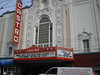
Search flickr for Harvey Milk Movie to find lots of cool pictures of the filming.
Search flickr for Harvey Milk Movie to find lots of cool pictures of the filming.
Friday, February 01, 2008
Myung-Whun Chung's Mahler Mishap
I didn't witness this one myself, but Myung-Whun Chung actually had to have a do-over of the final bars of the 1st movement of Mahler 1 at his recent SF Symphony concert. Very surprising considering that this is a pretty standard part of the repertoire nowadays. Joshua Kosman's review describes an under-rehearsed performance. Civic Center blog, however, loved it, miscue included.
Tuesday, January 29, 2008
American Bach Soloists: Christmas Oratorio
Sunday night I heard the American Bach Soloists perform Bach's Christmas Oratorio at St. Mark's Lutheran Church. This light & airy venue could hardly be more appropriate for this concert.
I have to confess that initially I had my doubts, since the Christmas Oratorio is really 6 separate cantatas intended to be performed on different days from Christmas to Epiphany. I didn't even know you could perform them all in one program. It's a lot of notes! The concert took 3 hours, but it was great. First of all, this is some of the most optimistic, positive & healthy music ever written. The performance itself was technically very clean, with some outstanding soloists. One had a sense of this being a gathering of very fine virtuosi.
There was only 1 instrumentalist per part, so it's a very small ensemble. 4 female singers faced off against 4 male singers on either side of the orchestra. The soprano Abigail Hanes Lennox has a high shimmering voice & is an effective actress. She made every one of her numbers into a complete dramatic scene. The soprano Yulia Van Doren makes a large, liquid sound. Mezzo Sonia Gariaeff also has a large, solid voice.
Tenor Derek Chester should have brought down the house with his terrific breath control & exactness in the thrilling coloratura aria "Frohe Hirten, eilt". Tenor Aaron Sheehan did an amazing job as a clear-toned Evangelist. He had no problem with all those high A's, & he topped it all by taking on the final tenor aria "Num mögt ihr stolzen Feinde schreken". This angular & pointed aria must be taxing, especially after all that declamatory singing, but Sheehan dispatched it with seeming ease. I also got to hear my favorite singer from the previous concert, baritone Jesse Blumberg, who makes a beautiful, large & clear sound.
I liked Debra Nagy, playing both oboe & oboe d'amore. She's a very musical performer & makes a nice sound on these extremely nasal instruments. John Thiessen gave a completely confident & clean reading of the virtuoso trumpet part.
Oddly, I never felt like I got a good sense of Jeffrey Thomas's personality as a conductor. I liked that his tempos were not uniformly brisk, as is often the case with HIP groups. But he often seemed to be doing little more than directing traffic & making ritards at the ends of numbers. Perhaps his talent is bring together talented musicians & allowing them to do their best.
It was also a pleasure to be with such an appreciative audience. The house was full, & because of all the colds going around, I was prepared to hear a lot of coughing. Incredibly, this attentive audience never coughed or displayed restlessness. You could feel that people were really listening to the music. There was only applause after the 1st half & at the very end. This respectful attitude of the audience, as much as the fine performance, made this a very satisfying evening.
I have to confess that initially I had my doubts, since the Christmas Oratorio is really 6 separate cantatas intended to be performed on different days from Christmas to Epiphany. I didn't even know you could perform them all in one program. It's a lot of notes! The concert took 3 hours, but it was great. First of all, this is some of the most optimistic, positive & healthy music ever written. The performance itself was technically very clean, with some outstanding soloists. One had a sense of this being a gathering of very fine virtuosi.
There was only 1 instrumentalist per part, so it's a very small ensemble. 4 female singers faced off against 4 male singers on either side of the orchestra. The soprano Abigail Hanes Lennox has a high shimmering voice & is an effective actress. She made every one of her numbers into a complete dramatic scene. The soprano Yulia Van Doren makes a large, liquid sound. Mezzo Sonia Gariaeff also has a large, solid voice.
Tenor Derek Chester should have brought down the house with his terrific breath control & exactness in the thrilling coloratura aria "Frohe Hirten, eilt". Tenor Aaron Sheehan did an amazing job as a clear-toned Evangelist. He had no problem with all those high A's, & he topped it all by taking on the final tenor aria "Num mögt ihr stolzen Feinde schreken". This angular & pointed aria must be taxing, especially after all that declamatory singing, but Sheehan dispatched it with seeming ease. I also got to hear my favorite singer from the previous concert, baritone Jesse Blumberg, who makes a beautiful, large & clear sound.
I liked Debra Nagy, playing both oboe & oboe d'amore. She's a very musical performer & makes a nice sound on these extremely nasal instruments. John Thiessen gave a completely confident & clean reading of the virtuoso trumpet part.
Oddly, I never felt like I got a good sense of Jeffrey Thomas's personality as a conductor. I liked that his tempos were not uniformly brisk, as is often the case with HIP groups. But he often seemed to be doing little more than directing traffic & making ritards at the ends of numbers. Perhaps his talent is bring together talented musicians & allowing them to do their best.
It was also a pleasure to be with such an appreciative audience. The house was full, & because of all the colds going around, I was prepared to hear a lot of coughing. Incredibly, this attentive audience never coughed or displayed restlessness. You could feel that people were really listening to the music. There was only applause after the 1st half & at the very end. This respectful attitude of the audience, as much as the fine performance, made this a very satisfying evening.
Tom Dolby at Books Inc.
I dropped into the Books Inc. on Market Street (formerly A Clean Well-Lighted Place for Books) for the advertised "Book Launch Party" for Tom Dolby's new novel The Sixth Form. I actually had read his first novel, The Trouble Boy. This first book totally fed into my fantasies about living & working in New York, though the world it describes is totally different from the kind of life I would imagine for myself.
Anyway, Dolby knows how to throw a book party. I snagged a generous glass of white wine & ate some hors d'oeuvres. & since he is the son of local rich guy Ray Dolby, I was in very prosperous company for about an hour. It reminded me very much of the crowd round the bar at Davies Hall just before a performance.
Anyway, Dolby knows how to throw a book party. I snagged a generous glass of white wine & ate some hors d'oeuvres. & since he is the son of local rich guy Ray Dolby, I was in very prosperous company for about an hour. It reminded me very much of the crowd round the bar at Davies Hall just before a performance.
Thursday, January 24, 2008
Sudhir Venkatesh at Stacey's
I spent part of my lunch at Stacey's Bookstore & saw Sundhir Venkatesh talk about his new book Gang Leader for a Day. He's a sociology professor who's written a couple of books about a 5 year period he spent hanging out with a street gang in a Chicago housing project. He had a lot of interesting things to say. To
him, the underground economy he was studying is a real "free market". There's no enforceable contracts, government regulations or corporate bailouts. It's actually rational for his subjects not to plan for the future. There are a lot of angles to what he's doing. He has a quiet but strong physical presence. I wished the event were longer so that he could talk more.
him, the underground economy he was studying is a real "free market". There's no enforceable contracts, government regulations or corporate bailouts. It's actually rational for his subjects not to plan for the future. There are a lot of angles to what he's doing. He has a quiet but strong physical presence. I wished the event were longer so that he could talk more.
Wednesday, January 16, 2008
Thin is In; Science is a Bust
I got an exhibits pass for the MacWorld Expo at Moscone Center just so I could handle the absurdly thin MacBook Air. Yet another object of desire from Apple. It's very light, & the edges taper, making it seem even sleeker. Its lack of an optical drive would seem to limit its practicality, but I think this is the way of the future. No need for CDs or DVDs; everything is available from the cloud. With the Time Capsule backup appliance, you even backup wirelessly.
After the show, I took Muni out to Potrero Hill, hoping to check out the Ask a Scientist event at the Axis Cafe. However, even though I got there a good 20 minutes before the official start of the event, the place was already turning into a zoo. Clearly, all the seats had been staked out way ahead of time. People were standing around 2 or 3 deep, the line for food & drinks was out the door, & more people were continuing to arrive. I decided to bail on this one, even though I think the concept is excellent.
After the show, I took Muni out to Potrero Hill, hoping to check out the Ask a Scientist event at the Axis Cafe. However, even though I got there a good 20 minutes before the official start of the event, the place was already turning into a zoo. Clearly, all the seats had been staked out way ahead of time. People were standing around 2 or 3 deep, the line for food & drinks was out the door, & more people were continuing to arrive. I decided to bail on this one, even though I think the concept is excellent.
Sunday, December 30, 2007
Best of 2007
Looking back on the past year, here's the stuff that I would have really regretted missing: First & foremost would be the production of Intimate Exchanges at the Brits Off Broadway festival in New York. I read about this wacky multiple-paths play many years ago, but I never thought that I'd actually get an opportunity to see it. Gustavo Dudamel & The Simón Bolívar Youth Orchestra of Venezuela lived up to the hype & then some. I could have seen The Simpsons Movie any time & now on DVD, but seeing it with an opening night audience made it a true event. & exciting for me personally was going to Berkeley to see Alex Ross & have him sign my copy of his much-anticipated book.
I felt very fortunate that the SF MOMA had the comprehensive Joseph Cornell exhibit. I'm now at a new level of appreciation for this reticent artist. I was also very glad to see & hear 2 of my favorite performers, Radu Lupu & Emmanual Pahud, in top form. Then there was Susan Graham's powerful performance in Iphigénie. I got introduced to 2 performers new to me & whom I look forward to hearing again: András Schiff & Marino Formenti.
& since we're still sort of in the holiday mood, I have to say that I still grin when I think about Mark Morris's dancing snowflakes.
I felt very fortunate that the SF MOMA had the comprehensive Joseph Cornell exhibit. I'm now at a new level of appreciation for this reticent artist. I was also very glad to see & hear 2 of my favorite performers, Radu Lupu & Emmanual Pahud, in top form. Then there was Susan Graham's powerful performance in Iphigénie. I got introduced to 2 performers new to me & whom I look forward to hearing again: András Schiff & Marino Formenti.
& since we're still sort of in the holiday mood, I have to say that I still grin when I think about Mark Morris's dancing snowflakes.
Wednesday, December 19, 2007
SF Opera at the Movies
SF Opera is going to be following the Met into movie theaters: S.F. Opera productions headed to movie screens
Tuesday, December 18, 2007
The Hard Nut
Every year at this time, I read rave reviews about Mark Morris's version of The Nutcracker ballet. It's been a regular event at Cal Performances for several years now. So this year I finally broke down & decided to check it out this past Saturday night.
When you go the SF Ballet's Nutcracker, there are lots of parents with little girls all dressed up. I didn't see any children at this performance, but there must be have been some. There were plenty of restless adults, however. It took the audience quite a while to settle down. During the overture, there was lots of talking & lots of sushing. The woman next to me started yawning as soon as the lights went down, then snored intermittently during the entire 1st act. Surprisingly, she came back for the 2nd act. I guess she had rested up by then.
The production reminds me of the Matthew Bourne versions of classic ballets that I've seen. The music is intact, but the action has been replaced by a modern story that still references the original scenario. There is a strong sense of parody. The Christmas party of the 1st scene takes place in a comic strip version of the 1960s. The opening image is of kids watching cartoons on TV. There's an artificial tree, a hostess on tranquillizers & guests doing the limbo.
The party scene is more acting then dancing, & there is more going on than you can follow. The dancers are all great actors as well. One of the guests was a hilarious would-be lothario with curly hair & long sideburns. I discovered in a review I read later that this was Mark Morris himself.
The Dance of the Snow Flakes that ends the 1st act is the highlight of the show & worth the price of admission by itself. Instead of ballerinas doing wispy pirouettes while fake snow wafts down from the rafters, the corps de ballet provides its own snow storm by tossing handfuls of confetti in choreographed patterns while executing athletic leaps. The result is like a fireworks show. I actually let out a whoop at the climax. It's such a clever idea that you wonder why no one has ever done this before.
This number is choreographed for both male & female dancers, dressed identically & doing the same steps. This exemplified the gender-fluid casting of the show in general. It was only during the intermission that I finally convinced myself that Mrs. Stahlbaum was danced by a man. The female dancer playing the spoiled little brother was also completely convincing.
A truly nice touch was the children's choir that appeared at the side of the stage for the Dance of Snow Flakes to provide the vocal line. I believe that even the SF Ballet uses recorded voices for this.
This finale was so good that during the intermission I was pretty much expecting that the rest of the evening would be a let-down. Fortunately, the 2nd act has a counterpart in the Waltz of the Flowers that was equally fun & joyful, as well as a little bit obscene. Now I know what all the raves are about.
When you go the SF Ballet's Nutcracker, there are lots of parents with little girls all dressed up. I didn't see any children at this performance, but there must be have been some. There were plenty of restless adults, however. It took the audience quite a while to settle down. During the overture, there was lots of talking & lots of sushing. The woman next to me started yawning as soon as the lights went down, then snored intermittently during the entire 1st act. Surprisingly, she came back for the 2nd act. I guess she had rested up by then.
The production reminds me of the Matthew Bourne versions of classic ballets that I've seen. The music is intact, but the action has been replaced by a modern story that still references the original scenario. There is a strong sense of parody. The Christmas party of the 1st scene takes place in a comic strip version of the 1960s. The opening image is of kids watching cartoons on TV. There's an artificial tree, a hostess on tranquillizers & guests doing the limbo.
The party scene is more acting then dancing, & there is more going on than you can follow. The dancers are all great actors as well. One of the guests was a hilarious would-be lothario with curly hair & long sideburns. I discovered in a review I read later that this was Mark Morris himself.
The Dance of the Snow Flakes that ends the 1st act is the highlight of the show & worth the price of admission by itself. Instead of ballerinas doing wispy pirouettes while fake snow wafts down from the rafters, the corps de ballet provides its own snow storm by tossing handfuls of confetti in choreographed patterns while executing athletic leaps. The result is like a fireworks show. I actually let out a whoop at the climax. It's such a clever idea that you wonder why no one has ever done this before.
This number is choreographed for both male & female dancers, dressed identically & doing the same steps. This exemplified the gender-fluid casting of the show in general. It was only during the intermission that I finally convinced myself that Mrs. Stahlbaum was danced by a man. The female dancer playing the spoiled little brother was also completely convincing.
A truly nice touch was the children's choir that appeared at the side of the stage for the Dance of Snow Flakes to provide the vocal line. I believe that even the SF Ballet uses recorded voices for this.
This finale was so good that during the intermission I was pretty much expecting that the rest of the evening would be a let-down. Fortunately, the 2nd act has a counterpart in the Waltz of the Flowers that was equally fun & joyful, as well as a little bit obscene. Now I know what all the raves are about.
Friday, December 14, 2007
Persepolis Preview at the Kabuki
Wednesday night I was privileged to attend a special San Francisco Film Society screening of Persepolis. A big part of the event was the chance to check out the remodeled Kabuki Theater. It's actually pretty much the same, except that there are now fancy bars on the 2nd & 3rd floors. On the 3rd floor, there is just barely a view of the city lights over the rooftops of the neighboring buildings. I guess the idea is that you can see a movie then adjourn to the bar with your friends to discuss it. It's not clear to me if you have to buy a movie ticket in order to get into the bars, though.
The event was sold out, so naturally the bar was completely overwhelmed. It took a really long time for me to get a glass of Spanish red wine, for which they charged me $6. Not unreasonable.
Before the screening, there was a brief on-stage interview with Marjane Satrapi & Vincent Paronnaud, the directors. The movie is based on Satrapi's Persepolis memoir. Satrapi's appearance was the highlight of the evening. She is a very smart & a very funny woman. There was a comic opposition between her outgoing, out-spoken personality & her co-director's reserved & silent demeanor. Among the concepts she threw out in her answers to questions:
The event was sold out, so naturally the bar was completely overwhelmed. It took a really long time for me to get a glass of Spanish red wine, for which they charged me $6. Not unreasonable.
Before the screening, there was a brief on-stage interview with Marjane Satrapi & Vincent Paronnaud, the directors. The movie is based on Satrapi's Persepolis memoir. Satrapi's appearance was the highlight of the evening. She is a very smart & a very funny woman. There was a comic opposition between her outgoing, out-spoken personality & her co-director's reserved & silent demeanor. Among the concepts she threw out in her answers to questions:
- She dislikes the label "graphic novel" to describe her books, "novel" being a far too bourgeois art form.
- We usually stop drawing by the time we're 10, so we think of drawing as something that belongs to childhood. We can talk about how poetry or music has meaning, but we have no way of talking about how a drawing has meaning. Yet drawing is prior to writing.
- When we think of animation, we tend to think of cartoon rabbits, but animation is not a genre, it's a medium.
- Fanatics know how to push the buttons of people's emotions. They get people to start yelling or be fearful. Any artistic work (which is about asking questions, not providing answers) or intellectual work, therefore, is a work against fanaticism.
- When asked how she had the courage to tell this story, she said that Italo Calinvo says, "I write to express myself without getting interrupted."
Sunday, December 09, 2007
The Great Dictator at the PFA
I'm going to miss the Castro's screening of Chaplin's The Great Dictator this coming Wednesday, but I really wanted to see it, so I went to Berkeley this afternoon for the showing at the PFA. The 1st time I saw this movie many years ago, I enjoyed it much more than I expected to, so I wanted to see if my reaction was still the same, & it pretty much was. Much of the movie is dated & a bit embarrassing now, primarily the scenes with Paulette Godard, & especially the final close-up of her which caps Chaplin's anti-climactic oration.
On the other hand, I think all the funny parts are still really funny. Of course there are the famous back-to-back set pieces of Chaplin dancing with the balloon earth, followed by Chaplin as the barber shaving his customer to Brahms's Hungarian Rhapsody. But right at the start, the opening battle scene is full of great gags: Chaplin's Little Fellow operating a giant cannon & an anti-aircraft gun, then losing an armed grenade down his shirt-sleeve, finally ending up flying upside-down in the cockpit of a crashing plane. Chaplin's first appearance as Hynkel, delivering his faux-German speech, is worth half the price of admission already.
There's plenty of classic slapstick humor at the expense of Hitler & Mussolini, which is funny it itself, though I sometimes have to remind myself that at the time the full horrors of the war were not yet widely known. It is interesting, though, that the movie is very explicit in stating that Hitler's anti-Jewish rhetoric was a way to distract the general population from economic problems.
The turnout at the FPA was not as large as I would have thought. The theater was perhaps a 3rd full. But we were a good audience & laughed at all the right places & were politely quiet through the worst bits.
On the other hand, I think all the funny parts are still really funny. Of course there are the famous back-to-back set pieces of Chaplin dancing with the balloon earth, followed by Chaplin as the barber shaving his customer to Brahms's Hungarian Rhapsody. But right at the start, the opening battle scene is full of great gags: Chaplin's Little Fellow operating a giant cannon & an anti-aircraft gun, then losing an armed grenade down his shirt-sleeve, finally ending up flying upside-down in the cockpit of a crashing plane. Chaplin's first appearance as Hynkel, delivering his faux-German speech, is worth half the price of admission already.
There's plenty of classic slapstick humor at the expense of Hitler & Mussolini, which is funny it itself, though I sometimes have to remind myself that at the time the full horrors of the war were not yet widely known. It is interesting, though, that the movie is very explicit in stating that Hitler's anti-Jewish rhetoric was a way to distract the general population from economic problems.
The turnout at the FPA was not as large as I would have thought. The theater was perhaps a 3rd full. But we were a good audience & laughed at all the right places & were politely quiet through the worst bits.
Saturday, December 08, 2007
Justin Hall at the Cartoon Art Museum
I dropped into the Cartoon Art Museum again to see the local phenomenon that is Justin Hall, who was "cartoonist-in-residence" today. I'm still a bit unclear on the concept, but I'm sure that Justin is just the man for the job. He loves to share his knowledge of comics, & he's a guy who can talk with anyone.
Manga Conquers America
Thursday night the Cartoon Art Museum sponsored a talk by Jason Thompson on the publishing history of manga in the U.S. It was a promotional event for his book Manga: The Complete Guide.
The talk got started a half-hour late, & the museum staff was unable to get the speaker's laptop to work with their projector, so Mr. Thompson resorted to flashing his slides at us from this laptop. This technical snafu made the event a bit lame.
Mr. Thompson had quite a long, fact-filled talk. It ran to almost an hour & a half. I'm not a manga reader myself, so this was really too much information for me. However, Mr. Thompson clearly has complete command of his subject area. If the book parallels this talk, then it has some interesting commentary on the manga publishing industry.
This is not to imply that the talk was boring. The history of manga publishing is apparently filled with characters at the margins of social trends. We heard about furries, new age hippies, & adult-movie stars who also draw. I learned that Barefoot Gen, which I've read & admired, was the 1st manga translated into English. It was put out by an anti-war group, not by a comic or manga publisher.
In Thompson's view, the practice of printing manga unflopped, in the right-to-left reading order of Japanese, is more a matter of reducing production costs than preserving artistic integrity.
There was a small group of about 20 who showed up for this event. Many of them seemed to be associates of the speaker. There were also a lot of touchy-feely couples, so maybe this was also your classic cheap date.
The talk got started a half-hour late, & the museum staff was unable to get the speaker's laptop to work with their projector, so Mr. Thompson resorted to flashing his slides at us from this laptop. This technical snafu made the event a bit lame.
Mr. Thompson had quite a long, fact-filled talk. It ran to almost an hour & a half. I'm not a manga reader myself, so this was really too much information for me. However, Mr. Thompson clearly has complete command of his subject area. If the book parallels this talk, then it has some interesting commentary on the manga publishing industry.
This is not to imply that the talk was boring. The history of manga publishing is apparently filled with characters at the margins of social trends. We heard about furries, new age hippies, & adult-movie stars who also draw. I learned that Barefoot Gen, which I've read & admired, was the 1st manga translated into English. It was put out by an anti-war group, not by a comic or manga publisher.
In Thompson's view, the practice of printing manga unflopped, in the right-to-left reading order of Japanese, is more a matter of reducing production costs than preserving artistic integrity.
There was a small group of about 20 who showed up for this event. Many of them seemed to be associates of the speaker. There were also a lot of touchy-feely couples, so maybe this was also your classic cheap date.
Friday, December 07, 2007
Berlioz at the SF Symphony
Berlioz Lélio
Berlioz Symphonie fantastique
Michael Tilson Thomas, conductor
Stanford Olsen, tenor 1
Shawn Mathey, tenor 2
Dwayne Croft, baritone
SFS Chorus
Went to this concert Wednesday night, solely for Lélio, which I had never heard before. Even though Berlioz billed this as a sequel to the Symphonie fantastique, it was programmed first, probably because it is a lighter work overall. In fact, it felt more like a collection of 6 separate pieces rather than a large cohesive work. No matter. The individual pieces were each satisfying on their own.
It starts off charmingly with a tenor soloist accompanied only by the piano. We could be in a 19th century salon. Later, the strings come in with the idée fixe from the Symphonie fantastique, making the linkage explicit. It is a sweet-sounding but sinister song about a siren. Stanford Olsen sang this from within the orchestra, standing next to the piano. The tessitura is pretty high, but I think he hit every note.
Varied movements follow: An eerie chorus; a wild brigands' song; another tenor sings from within the orchestra, this time with harp accompaniment; an orchestral interlude; a choral fantasy, minus bass voices, addressing characters from Shakespeare's The Tempest. It's definitely a mashup, but each piece kept my interest.
There was a sense of uncertainty to the proceedings, as if the performers weren't always sure what was going to happen next. At one point the chorus took several moments to reach a consensus as to whether they were going to sit or stand.
The confusion carried out into the intermission. When I emerged from the auditorium, I was sorely disappointed to discover that none of the reserved drink orders, mine included, had been prepared yet. The harried bartender apologized, explaining that he had been told we weren't going to be let out until 9:00. The short first half let out around 8:45.
The performance of the Symphonie fantastique occupying the 2nd half was recorded live as part of the Keeping Score series. Perhaps 10 cameras were stationed around the orchestra. A long boom camera extended from the terrace directly over the orchestra. Most notable were 2 robotic cameras, one on a vertical stand at the back of the orchestra & the other on a track running along the front of the stage. This one could go back & forth & also rise up to the eye level of the musicians.
During the performance there was plenty of distracting movement from all these devices, though it was also kind of cool to watch. It was clear that there were going to be a lot of motion shots in the finished broadcast. It must be especially difficult for the musicians to pretend to ignore the cameras. The robotic camera in front could maneuver itself to within a couple of feet of a musician's head.
Under this scrutiny, the orchestra sounded like a completely different band in the 2nd half. It was obviously well-rehearsed, & everyone knew exactly what was going to happen next. The sound was brilliant & concise. There was a lot of detail. The bassoon solo in the 4th movement really popped out. I was also impressed by the strong flute solos. They captured a clean performance with a lot of surface sheen.
Berlioz Symphonie fantastique
Michael Tilson Thomas, conductor
Stanford Olsen, tenor 1
Shawn Mathey, tenor 2
Dwayne Croft, baritone
SFS Chorus
Went to this concert Wednesday night, solely for Lélio, which I had never heard before. Even though Berlioz billed this as a sequel to the Symphonie fantastique, it was programmed first, probably because it is a lighter work overall. In fact, it felt more like a collection of 6 separate pieces rather than a large cohesive work. No matter. The individual pieces were each satisfying on their own.
It starts off charmingly with a tenor soloist accompanied only by the piano. We could be in a 19th century salon. Later, the strings come in with the idée fixe from the Symphonie fantastique, making the linkage explicit. It is a sweet-sounding but sinister song about a siren. Stanford Olsen sang this from within the orchestra, standing next to the piano. The tessitura is pretty high, but I think he hit every note.
Varied movements follow: An eerie chorus; a wild brigands' song; another tenor sings from within the orchestra, this time with harp accompaniment; an orchestral interlude; a choral fantasy, minus bass voices, addressing characters from Shakespeare's The Tempest. It's definitely a mashup, but each piece kept my interest.
There was a sense of uncertainty to the proceedings, as if the performers weren't always sure what was going to happen next. At one point the chorus took several moments to reach a consensus as to whether they were going to sit or stand.
The confusion carried out into the intermission. When I emerged from the auditorium, I was sorely disappointed to discover that none of the reserved drink orders, mine included, had been prepared yet. The harried bartender apologized, explaining that he had been told we weren't going to be let out until 9:00. The short first half let out around 8:45.
The performance of the Symphonie fantastique occupying the 2nd half was recorded live as part of the Keeping Score series. Perhaps 10 cameras were stationed around the orchestra. A long boom camera extended from the terrace directly over the orchestra. Most notable were 2 robotic cameras, one on a vertical stand at the back of the orchestra & the other on a track running along the front of the stage. This one could go back & forth & also rise up to the eye level of the musicians.
During the performance there was plenty of distracting movement from all these devices, though it was also kind of cool to watch. It was clear that there were going to be a lot of motion shots in the finished broadcast. It must be especially difficult for the musicians to pretend to ignore the cameras. The robotic camera in front could maneuver itself to within a couple of feet of a musician's head.
Under this scrutiny, the orchestra sounded like a completely different band in the 2nd half. It was obviously well-rehearsed, & everyone knew exactly what was going to happen next. The sound was brilliant & concise. There was a lot of detail. The bassoon solo in the 4th movement really popped out. I was also impressed by the strong flute solos. They captured a clean performance with a lot of surface sheen.
Chaplin at the Castro
This past Tuesday night I saw 2 programs of Charlie Chaplin films at the Castro. To me, The Kid is Chaplin's first masterpiece. It's a marvel how much emotion he packs into this short film. There's an incredible cinematic moment where The Mother, on her charity rounds, sits on a stoop, cradling a baby. It's clear that she is thinking of the baby that she abandoned at the beginning of the story. Then the door opens behind her & Jackie Coogan appears & then sits down at the opposite side of the screen. At first neither character sees the other, yet each of them is the other's dream. It's a moment rooted in a physical reality, yet it also expresses each character's deep psychological desires. It's such a beautiful moment that it almost always chokes me up. One of the few movie scenes I prefer to watch alone!
I don't think I'd ever seen The Pilgram before. It was surprising that Chaplin does not appear in his Little Tramp guise through most of the movie. Lots of great stuff in this one. The church service must be a classic set piece, as well as the tea party with the incredibly obnoxious child. I recently saw the famous clip of W.C. Fields kicking a little kid, but I had no idea that Chaplin did this gag first! The ending was another terrific surprise, with Chaplin walking off into the distance while straddling the U.S./Mexico border. Politically, times haven't changed.
The final film of the evening was The Gold Rush. Again I was impressed but how many places this movie goes emotionally. It mixes the old-fashion histrionics of the Big Jim character with the realistic & somewhat cynical portrait of Georgia's flirtatious relationship with Jack. The treatment of the Little Tramp by the dance hall girls is just plain cruel. There's a fantastic cinematic moment when Chaplin first appears at the dance hall. He stands in the foreground, with his back to us, while the middle ground & the background are filled with light that shines on dancing, happy people. Visually the scene is beautiful, yet the Little Tramp's isolation is poignant by contrast. & this little scene is capped with the gag of the pretty girl walking warmly towards him, but only to get to her boyfriend behind him.
I'm a big Chaplin fan, so I was very excited to see this show & very disappointed at the sparse turn-out & the very low-key reaction of the audience. Perhaps Chaplin's brand of humanism isn't in sync with our times right now.
I don't think I'd ever seen The Pilgram before. It was surprising that Chaplin does not appear in his Little Tramp guise through most of the movie. Lots of great stuff in this one. The church service must be a classic set piece, as well as the tea party with the incredibly obnoxious child. I recently saw the famous clip of W.C. Fields kicking a little kid, but I had no idea that Chaplin did this gag first! The ending was another terrific surprise, with Chaplin walking off into the distance while straddling the U.S./Mexico border. Politically, times haven't changed.
The final film of the evening was The Gold Rush. Again I was impressed but how many places this movie goes emotionally. It mixes the old-fashion histrionics of the Big Jim character with the realistic & somewhat cynical portrait of Georgia's flirtatious relationship with Jack. The treatment of the Little Tramp by the dance hall girls is just plain cruel. There's a fantastic cinematic moment when Chaplin first appears at the dance hall. He stands in the foreground, with his back to us, while the middle ground & the background are filled with light that shines on dancing, happy people. Visually the scene is beautiful, yet the Little Tramp's isolation is poignant by contrast. & this little scene is capped with the gag of the pretty girl walking warmly towards him, but only to get to her boyfriend behind him.
I'm a big Chaplin fan, so I was very excited to see this show & very disappointed at the sparse turn-out & the very low-key reaction of the audience. Perhaps Chaplin's brand of humanism isn't in sync with our times right now.
Jeff Wall, Olafur Eliasson at SF MOMA
This past Saturday I got to go back to the SF MOMA to see the 2 exhibits I missed on my last visit. Jeff Wall's huge light box photos fill several rooms. Simply by their huge size, they reference the tradition of history painting. Most of the photos are distinctly unsettling. His scene of the grave filled with tide pool creatures is both creepy & beautiful. One gets the sense that there is a lot going on behind each image. Part of the fascination is just trying out how they are done. Is the pictures of wind blowing away a woman's papers staged or constructed?
The Olafur Eliasson installations on the top floor were still fun on a second viewing. The Notion motion, which appears to be an interactive video projection, turn out to be pleasantly low-tech once you are allowed to peek behind the curtain. In the 360º room for all colors, people were tripping themselves out by standing inches from the wall so that their entire field of vision was filled by the glowing wall of color. How can I get a room like this for myself?
The Olafur Eliasson installations on the top floor were still fun on a second viewing. The Notion motion, which appears to be an interactive video projection, turn out to be pleasantly low-tech once you are allowed to peek behind the curtain. In the 360º room for all colors, people were tripping themselves out by standing inches from the wall so that their entire field of vision was filled by the glowing wall of color. How can I get a room like this for myself?
Subscribe to:
Posts (Atom)