Saturday evening I attended the Bayreuth Festival's new Siegfried. In a direct steal from Francesca Zambello's staging of The Ring for San Francisco Opera, Mime & Siegfried live in an Airstream, here parked beneath giant stone heads of Marx, Lenin, Stalin & Mao. Siegfried has no bear but instead has the motel attendant from Rheingold tied to the end of a rope. In act 2 the enormous set rotates to reveal the world clock & subway station at Alexanderplatz. As in the previous operas, we also saw live & pre-taped video segments.
Director Frank Castorf's staging is busy & never boring, but it is also willfully incompetent & has almost nothing to do with the libretto. Inane antics in act 3 included Wotan & Erda sharing a spaghetti dinner, Wotan receiving a blow job from a prostitute, Siegfried & Brünnhilde leaving the stage during their love scene, & crocodiles crawling on stage & humping. In act 2 Siegfried kills Fafner with an AK-47, & the sound of the machine gun fire caused someone in the audience to scream. A notice was posted at the theater assuring the audience that the sound effect would not affect their hearing. Basically Mr. Castorf is punking the festival & has embarrassed its directors, Katharina Wagner & Eva Wagner-Pasquier.
Tenor Lance Ryan as Siegfried sometimes made a bright, ringing sound & at other times sounded wobbly or squeezed. He moved actively on stage & never tired. Tenor Burkhard Ulrich acted the role of Mime more than sang it & gave an enthusiastic & animated performance. Bass-baritone Wolfgang Koch as The Wanderer sang with expressiveness & authority, even though the production had him looking like a seedy clown. Bass-baritone Sorin Coliban was fittingly heavy & gruff as Fafner. He never appeared in the form of a dragon, though a crocodile was onstage for part of his scene. Bass-baritone Martin Winkler was an impassioned & snarling Alberich.
Soprano Mirella Hagen indeed sounded warbly & bird-like as the Forest Bird. She was onstage in act 2 looking like a cross between a Vegas show girl & a Hopi Indian. She returned in act 3, only to be swallowed by a crocodile. Her costume was ungainly, & during her curtain calls she nearly knocked Alberich over & had to shuffle sideways to get offstage. Mezzo Nadine Weissmann had a soft & sultry voice as Erda. I really enjoyed soprano Catherine Foster's lissom, warm, & pretty voice for Brünnhilde. Her singing fit the act 3 music beautifully.
The orchestra under Kirill Petrenko continues to sound great, playing with suppleness & agility. The strings & harp sounded gorgeous in the music depicting Brünnhilde's awakening. Somehow it seemed like the horn soloist in act 2 was not playing the right notes. There were boos for each act, & at the end the audience unanimously directed loud boos & whistles at the production. The principals took curtain calls after each act, & their performances were applauded appreciatively, though Mr. Ryan received a few boos. The final curtain call lasted 5 minutes.
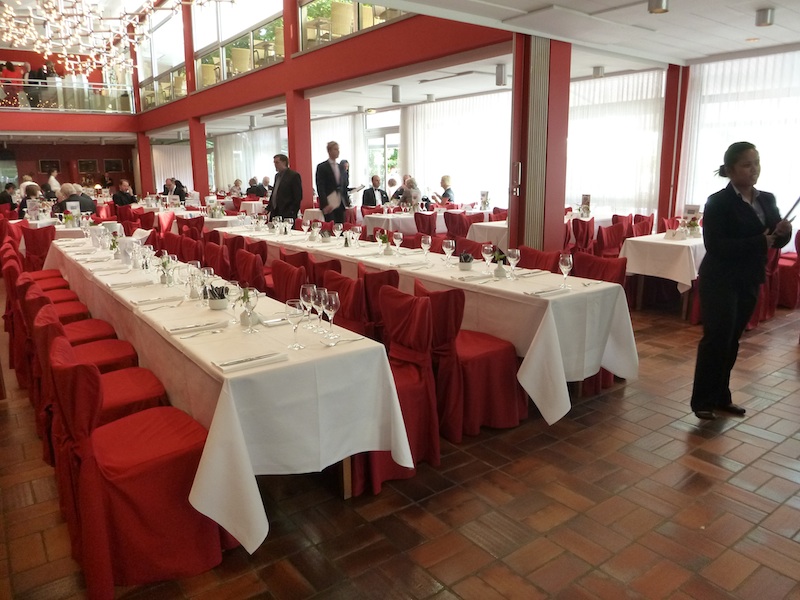
Since this staging had no bear, I was grateful that Die Oper Tratscherin attended in this bear-inspired ensemble. Since it also happened to be my birthday, we ate fancy appetizers & desserts in the Festspielrestaurant.
§ Siegfried
Bayreuther Festspiele 2013
Musikalische Leitung, Kirill Petrenko
Regie, Frank Castorf
Bühnenbild, Aleksandar Denić
Kostüme, Adriana Braga Peretzki
Licht, Rainer Casper
Video, Andreas Deinert & Jens Crull
Siegfried, Lance Ryan
Mime, Burkhard Ulrich
Der Wanderer, Wolfgang Koch
Alberich, Martin Winkler
Fafner, Sorin Coliban
Erda, Nadine Weissmann
Brünnhilde, Catherine Foster
Waldvogel, Mirella Hagen
Samstag, 17. August, 16:00 Uhr
Sunday, August 18, 2013
Saturday, August 17, 2013
Das Festspielhaus
The real reason to hear a performance in the Festspielhaus is the unique acoustic which bounces the orchestra's sound onto the stage & then into the auditorium. The sound seems to emerge from middair on the stage, & it has a palpable, 3-dimensional presence. This is particularly effective for The Ring, & there are startling moments when the motives ring out from over the singers' heads. The orchestral texture is transparent, vivid & clear.
The proscenium has a strange shape, squarish & tall.
The discomfort in the hall is extreme. The audience is packed as closely as possible. The seats are usually directly in front of one another instead of being staggered.
These 2 wooden slats are all you get for a seat, which is why Bayreuth veterans, like the Opera Tattler here, arrive with their own seat cushions. There's no climate control, so it can be swelteringly hot inside. So far this summer we've been lucky. It's been generally cool, & I'm truly grateful.
Performances start at 4p for 3 act operas. Intermissions last about an hour, so most performances finish before 10p. One-act operas begin at 6p. The theater has no lobby, so the audience promenades outside the building & in surrounding parks during the breaks.
For the full experience you eat at the ridiculously fancy restaurant next to the theater, where you order in advance for each intermission & receive your food timed to the performance.
Many attendees spend the intermissions reading the libretto. The Opera Tattler has a very cool one in the form of an old book from around 1912. Relevant motives are listed in the margins of the text, keyed to musical examples on tipped-in pages that fold out so you can look at the music without having to flip pages.
The proscenium has a strange shape, squarish & tall.
The discomfort in the hall is extreme. The audience is packed as closely as possible. The seats are usually directly in front of one another instead of being staggered.
These 2 wooden slats are all you get for a seat, which is why Bayreuth veterans, like the Opera Tattler here, arrive with their own seat cushions. There's no climate control, so it can be swelteringly hot inside. So far this summer we've been lucky. It's been generally cool, & I'm truly grateful.
Performances start at 4p for 3 act operas. Intermissions last about an hour, so most performances finish before 10p. One-act operas begin at 6p. The theater has no lobby, so the audience promenades outside the building & in surrounding parks during the breaks.
For the full experience you eat at the ridiculously fancy restaurant next to the theater, where you order in advance for each intermission & receive your food timed to the performance.
Many attendees spend the intermissions reading the libretto. The Opera Tattler has a very cool one in the form of an old book from around 1912. Relevant motives are listed in the margins of the text, keyed to musical examples on tipped-in pages that fold out so you can look at the music without having to flip pages.
Bamberg
Friday there was no Ring opera, so I took a day trip to nearby Bamberg with Die Oper Tatlerin. Bamberg is a picturesque town with well-preserved buildings going back to the Medieval period. The cute streets lined with tall buildings made me feel I was in Disneyland.
Die Oper Tatlerin only wanted to see the botanical paintings at the Kloster St. Michael, but we climbed the Michaelsberg only to discover that it was of course closed due to construction. The city's famous Dom was open but covered with scaffolding as well.
Klein Venedig looks nothing like Venice, but the view, which includes swans, is charming.
Midget Wagner followed us to Bamberg. Die Tatlerin cannily tried to lose me on the return train to Bayreuth by leading me onto the wrong carriage, where I got stuck behind a girl with ungainly luggage. Half the residents of our hotel seemed to be on the train as well.
Die Oper Tatlerin only wanted to see the botanical paintings at the Kloster St. Michael, but we climbed the Michaelsberg only to discover that it was of course closed due to construction. The city's famous Dom was open but covered with scaffolding as well.
Klein Venedig looks nothing like Venice, but the view, which includes swans, is charming.
Midget Wagner followed us to Bamberg. Die Tatlerin cannily tried to lose me on the return train to Bayreuth by leading me onto the wrong carriage, where I got stuck behind a girl with ungainly luggage. Half the residents of our hotel seemed to be on the train as well.
Die Walküre
Thursday night I attended the Bayreuth Festival's new staging of Die Walküre by Frank Castorf. The opera is set at an oil well in a remote area of the Soviet Union. The huge unit set has multitple levels & includes a cavernous shed & a tall tower for the oil drill. The staging is unrelated to the previous night's Rheingold, except that again the entire set rotates, & videos are projected on the set. In act 1, a live video feed shows in cartoonish detail how Sieglinde goes about drugging Hunding's drink.
Mr. Castorf's staging is lazy or just unfinished. It's fragmentary, disregards the libretto & has no internal consistency. Though most of the characters look Russian, Fricka is dressed as a Central Asian princess. Act 1 confusingly takes place outdoors. During the end of the act, we see a film of Erda eating a whole cake with her hands, answering the telephone, resting the receiver on the cake, then sloppily putting on a dress. Sieglinde & Siegmund don't run away but simply go into the shed. Wotan has a long beard in act 2 but none in act 3. In act 3 an oil derrick emerges from the shed, extends threateningly over the lip of the stage & starts pumping up & down. After a few minutes it's withdrawn, all for no apparent reason. There was real fire on stage for the closing moments, but coming from a giant oil barrel that was nowhere near the sleeping Brünnhilde.
The singing was uniformly fine. Tenor Johan Botha sang a lyrical Siegmund, & his high notes were bright & secure & had a nice tension. Soprano Anja Kampe sounded strong yet sweet as Sieglinde, & she went full out for her "Du hehrstes Wunder!" Bass Franz-Josef Selig was a gentlemanly & cultivated Hunding, who enters wearing a stove pipe hat. Soprano Catherine Foster as Brünnhilde has a light & pretty voice which is easy to listen to. Bass-baritone Wolfgang Koch sang Wotan with a focused voice & a wide dynamic range, but the staging was so static that his act 2 monologue was a bore & did not establish any sort of relationship with father & daughter. Brünnhilde went about a bunch of distracting stage business instead of listening to him. Mezzo Claudia Mahnke sang with fluidity & was a sympathetic Fricka.
Kirill Petrenko's conducting continues to be pleasingly light-footed & springy. The orchestra sounds great, & its clarity is astounding. The valkyries are on multiple levels of the set for the opening of act 3, & this is probably the most airy & transparent Ride of the Valkyries I'll ever hear. There were curtain calls for the principals after each act, & the final curtain call ran just under 10 minutes. The audience stomped their feet especially for Ms. Kampe, who looked grateful.
Die Oper Tatlerin wore this festive outfit to the Festspielhaus this evening, & many people photographed her surreptitiously, though she was perfectly happy to pose when a nice woman asked to take her picture at the end of the performance.
§ Die Walküre
Bayreuther Festspeiele 2013
Conductor, Kirill Petrenko
Director, Frank Castorf
Stage design, Aleksandar Denić
Costumes, Adriana Braga Peretzki
Lighting, Rainer Casper
Video, Andreas Deinert & Jens Crull
Siegmund, Johan Botha
Hunding, Franz-Josef Selig
Wotan, Wolfgang Koch
Sieglinde, Anja Kampe
Brünnhilde, Catherine Foster
Fricka, Claudia Mahnke
Gerhilde, Allison Oakes
Ortlinde, Dara Hobbs
Waltraute, Claudia Mahnke
Schwertleite, Nadine Weissmann
Helmwige, Christiane Kohl
Siegrune, Julia Rutigliano
Grimgerde, Geneviève King
Rossweisse, Alexandra Petersamer
Thursday 15. August, 04:00 PM
Mr. Castorf's staging is lazy or just unfinished. It's fragmentary, disregards the libretto & has no internal consistency. Though most of the characters look Russian, Fricka is dressed as a Central Asian princess. Act 1 confusingly takes place outdoors. During the end of the act, we see a film of Erda eating a whole cake with her hands, answering the telephone, resting the receiver on the cake, then sloppily putting on a dress. Sieglinde & Siegmund don't run away but simply go into the shed. Wotan has a long beard in act 2 but none in act 3. In act 3 an oil derrick emerges from the shed, extends threateningly over the lip of the stage & starts pumping up & down. After a few minutes it's withdrawn, all for no apparent reason. There was real fire on stage for the closing moments, but coming from a giant oil barrel that was nowhere near the sleeping Brünnhilde.
The singing was uniformly fine. Tenor Johan Botha sang a lyrical Siegmund, & his high notes were bright & secure & had a nice tension. Soprano Anja Kampe sounded strong yet sweet as Sieglinde, & she went full out for her "Du hehrstes Wunder!" Bass Franz-Josef Selig was a gentlemanly & cultivated Hunding, who enters wearing a stove pipe hat. Soprano Catherine Foster as Brünnhilde has a light & pretty voice which is easy to listen to. Bass-baritone Wolfgang Koch sang Wotan with a focused voice & a wide dynamic range, but the staging was so static that his act 2 monologue was a bore & did not establish any sort of relationship with father & daughter. Brünnhilde went about a bunch of distracting stage business instead of listening to him. Mezzo Claudia Mahnke sang with fluidity & was a sympathetic Fricka.
Kirill Petrenko's conducting continues to be pleasingly light-footed & springy. The orchestra sounds great, & its clarity is astounding. The valkyries are on multiple levels of the set for the opening of act 3, & this is probably the most airy & transparent Ride of the Valkyries I'll ever hear. There were curtain calls for the principals after each act, & the final curtain call ran just under 10 minutes. The audience stomped their feet especially for Ms. Kampe, who looked grateful.
Die Oper Tatlerin wore this festive outfit to the Festspielhaus this evening, & many people photographed her surreptitiously, though she was perfectly happy to pose when a nice woman asked to take her picture at the end of the performance.
§ Die Walküre
Bayreuther Festspeiele 2013
Conductor, Kirill Petrenko
Director, Frank Castorf
Stage design, Aleksandar Denić
Costumes, Adriana Braga Peretzki
Lighting, Rainer Casper
Video, Andreas Deinert & Jens Crull
Siegmund, Johan Botha
Hunding, Franz-Josef Selig
Wotan, Wolfgang Koch
Sieglinde, Anja Kampe
Brünnhilde, Catherine Foster
Fricka, Claudia Mahnke
Gerhilde, Allison Oakes
Ortlinde, Dara Hobbs
Waltraute, Claudia Mahnke
Schwertleite, Nadine Weissmann
Helmwige, Christiane Kohl
Siegrune, Julia Rutigliano
Grimgerde, Geneviève King
Rossweisse, Alexandra Petersamer
Thursday 15. August, 04:00 PM
Friday, August 16, 2013
Das Rheingold
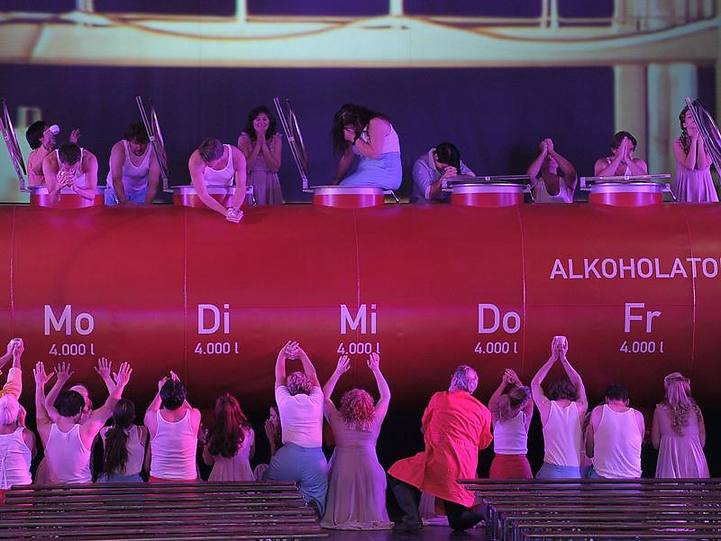
Though I'd sat through 3 Wagner operas this week already, they were just the warm-up for Wednesday evening, the 1st night of Bayreuth's new Ring staged by Frank Castorf. The opera has an impressive, hyper-realistic set that represents a motel, gas station & soda fountain on Route 66 in Texas. The characters seem drawn from American movies & TV, but there is no story arc, & the action is fragmentary & unrelated to what the characters are singing. The Rheinmaidens are 3 floozies hanging around the pool, their underwear hanging out to dry. Alberich behaves like a child, squirting mustard on himself & taking a shower while eating a long sausage. The Nibelheim scene begins with Alberich & Mime tied to poles & being humiliated by Wotan & Loge & is particularly unrelated to the text. There are no Nibelungen. The staging includes several mute characters, including an unfortunate man who does all the jobs around the motel. Occasionally something fit the libretto. I like that the giants, 2 thugs, are completely differentiated characters. Fafner kills Fasolt by clubbing him with a gold bar. When Erda emerges out of a door in Wotan's motel room, Fricka jealously runs into the room to check out this new woman.
I was more engaged by the mechanics of the production. The entire set rotates & works from all sides. A car drives up to the gas pump, & later an Airstream is placed on stage to represent the home of Mime & Alberich. A video screen atop the set, rotating independently, shows a live feed of the action, shot by multiple videographers on stage with the singers. This allows us to see closeups & things taking place out of our sight. Alberich's transformations are lamely handled by video cuts. Perhaps Mr. Castorf wanted to make a Quentin Tarentino movie instead.
The entire cast gave committed & convincing acting performances. I liked the offhandedness & naturalism of tenor Norbert Ernst's Loge, as well as his easy delivery. Tenor Burkhard Ulrich was an animated & strangely endearing Mime. When Alberich is captured, Mime lovingly caresses the Airstream that is now his & then lowers the Texas flag on a nearby flagpole & replaces it with a rainbow flag. Bass Günther Groissböck sung Fasolt expressively & with a virile sound. Bass-baritone Sorin Coliban as Fafner had a deep, strong voice, but his painted-on beard did not stand up to the scrutiny of the video cameras.
Bass-baritone Wolfgang Koch sang Wotan with authority, focus & a nice dynamic range, but the staging unfortunately gives his character no where to develop. Bass-baritone Martin Winkler sounded gruff & grounded as Alberich. As Fricka, mezzo Claudia Mahnke made an attractive & connected sound. The Freia of soprano Elisabet Strid was fearful & intense. Mezzo Nadine Weissmann's Erda was surprisingly airy & sultry.
The festival orchestra sounded great under conductor Kirill Petrenko, who led a springy, even light, performance. The orchestral sound has a physical presence in the Festspielhaus, & it was stunning to hear the high violin solo for Freia seem to materialize onstage. The harps sounded like they were being plucked right in front of my face, & I could not figure out where the voices of the off-stage Rheinmaidens were coming from. There were only a few token boos when the curtain came down, & the audience applauded enthusiastically, stomping their feet particularly for Mr. Groissböck, Mr. Winkler & Maestro Petrenko. The curtain calls ran 10 minutes.
Die Oper Tatlerin wore a marine-themed outfit for the evening & had to contend with an uptight German who mistakenly thought she was in his seat.
§ Das Rheingold
Bayreuther Festspiele2013
Conductor, Kirill Petrenko
Director, Frank Castorf
Stage design, Aleksandar Denić
Costumes, Adriana Braga Peretzki
Lighting, Rainer Casper
Video, Andreas Deinert & Jens Crull
Wotan, Wolfgang Koch
Donner, Oleksandr Pushniak
Froh, Lothar Odinius
Loge, Norbert Ernst
Fricka, Claudia Mahnke
Freia, Elisabet Strid
Erda, Nadine Weissmann
Alberich, Martin Winkler
Mime, Burkhard Ulrich
Fasolt, Günther Groissböck
Fafner, Sorin Coliban
Woglinde, Mirella Hagen
Wellgunde, Julia Rutigliano
Floßhilde, Okka von der Damerau
Wednesday 14. August, 06:00 PM
I was more engaged by the mechanics of the production. The entire set rotates & works from all sides. A car drives up to the gas pump, & later an Airstream is placed on stage to represent the home of Mime & Alberich. A video screen atop the set, rotating independently, shows a live feed of the action, shot by multiple videographers on stage with the singers. This allows us to see closeups & things taking place out of our sight. Alberich's transformations are lamely handled by video cuts. Perhaps Mr. Castorf wanted to make a Quentin Tarentino movie instead.
The entire cast gave committed & convincing acting performances. I liked the offhandedness & naturalism of tenor Norbert Ernst's Loge, as well as his easy delivery. Tenor Burkhard Ulrich was an animated & strangely endearing Mime. When Alberich is captured, Mime lovingly caresses the Airstream that is now his & then lowers the Texas flag on a nearby flagpole & replaces it with a rainbow flag. Bass Günther Groissböck sung Fasolt expressively & with a virile sound. Bass-baritone Sorin Coliban as Fafner had a deep, strong voice, but his painted-on beard did not stand up to the scrutiny of the video cameras.The festival orchestra sounded great under conductor Kirill Petrenko, who led a springy, even light, performance. The orchestral sound has a physical presence in the Festspielhaus, & it was stunning to hear the high violin solo for Freia seem to materialize onstage. The harps sounded like they were being plucked right in front of my face, & I could not figure out where the voices of the off-stage Rheinmaidens were coming from. There were only a few token boos when the curtain came down, & the audience applauded enthusiastically, stomping their feet particularly for Mr. Groissböck, Mr. Winkler & Maestro Petrenko. The curtain calls ran 10 minutes.
Die Oper Tatlerin wore a marine-themed outfit for the evening & had to contend with an uptight German who mistakenly thought she was in his seat.
§ Das Rheingold
Bayreuther Festspiele2013
Conductor, Kirill Petrenko
Director, Frank Castorf
Stage design, Aleksandar Denić
Costumes, Adriana Braga Peretzki
Lighting, Rainer Casper
Video, Andreas Deinert & Jens Crull
Wotan, Wolfgang Koch
Donner, Oleksandr Pushniak
Froh, Lothar Odinius
Loge, Norbert Ernst
Fricka, Claudia Mahnke
Freia, Elisabet Strid
Erda, Nadine Weissmann
Alberich, Martin Winkler
Mime, Burkhard Ulrich
Fasolt, Günther Groissböck
Fafner, Sorin Coliban
Woglinde, Mirella Hagen
Wellgunde, Julia Rutigliano
Floßhilde, Okka von der Damerau
Wednesday 14. August, 06:00 PM
Wednesday, August 14, 2013
Der fliegende Holländer
Tuesday evening I attended the Bayreuth Festival performance of Die fliegende Holländer. The production recasts the characters as employees of Daland's electric fan company. The act 1 set is dark, with high walls covered with Tron-like flashing lights. Daland & his steersman, dressed as traveling salesmen, sleep in a tiny row boat, though this turns out to be the staging's only nod to the original setting. In a nice transition, the walls move aside, & the chorus of sailors, dressed identically as more businessmen, come from the back & progress the full depth of the stage to the lip. Behind them comes a huge curtain, which they later pull down to reveal the female chorus, packaging fans in Daland's factory. Mary is a corporate manager & Erik a lowly maintenance man whom the women make fun of as he goes about his duties.
Bass Franz-Josef Selig was a comical Daland, his gestures communicating a self-assured corporate personality. Tenor Benjamin Bruns was a similarly good actor, playing the Steersman as Daland's yes-man & leading the male chorus in a jolly company sing-along in act 3. Bass-baritone Samuel Youn has an engaging stage presence & flexible voice & was a young & genial Dutchman. Soprano Ricarda Merbeth was an outgoing, happy Senta. Her singing was forceful & her high notes loud but perhaps pitchless. This Dutchman & Senta looked & behaved like a young romantic couple & were mutually joyful when they discovered they would die together. Tenor Tomislav Muzek was a sympathetic Erik. His voice was high, clear & clean.
All the choral numbers had lively choreography, & the chorus was terrific, sounding unified & spirited & moving together like dancers. They were perhaps the real stars of the show. There was a spectacular use of fire when the Dutchman's sailors appear in act 3. The curtain seems to come down prematurely at the end but then rises to reveal a cynical epilogue in which the lovers' final gesture is turned into a kitschy commodity.
Conductor Christian Theilemann made his presence known from the 1st sharp attack of the overture. He led a taut, powerfully controlled performance. Even though in a covered pit, the orchestra's sound was dominant. It was unreal hearing the harp coming from a space in the air on the left of the stage. The woodwinds & cellos also sounded amazingly vivid. The audience responded enthusiastically & stamped their feet especially for the chorus, Mr. Youn & Maestro Theilemann, though a single detractor booed both Mr. Youn & Ms. Merbeth. The ovation ran about 10 minutes.
Die Oper Tatlerin's Dutch-themed attire for the performance included a dress adorned with a tulip design, though she forgot her seat cushion.
§ Der fliegende Holländer
Bayreuther Festspiele 2013
Conductor, Christian Thielemann
Director, Jan Philipp Gloger
Stage design, Christof Hetzer
Costumes, Karin Jud
Lighting, Urs Schönebaum
Video, Martin Eidenberger
Dramaturgy, Sophie Becker
Choral Conducting, Eberhard Friedrich
Daland, Franz-Josef Selig
Senta, Ricarda Merbeth
Erik, Tomislav Muzek
Mary, Christa Mayer
Der Steuermann, Benjamin Bruns
Der Holländer, Samuel Youn
Tuesday 13. August, 06:00 PM
Bass Franz-Josef Selig was a comical Daland, his gestures communicating a self-assured corporate personality. Tenor Benjamin Bruns was a similarly good actor, playing the Steersman as Daland's yes-man & leading the male chorus in a jolly company sing-along in act 3. Bass-baritone Samuel Youn has an engaging stage presence & flexible voice & was a young & genial Dutchman. Soprano Ricarda Merbeth was an outgoing, happy Senta. Her singing was forceful & her high notes loud but perhaps pitchless. This Dutchman & Senta looked & behaved like a young romantic couple & were mutually joyful when they discovered they would die together. Tenor Tomislav Muzek was a sympathetic Erik. His voice was high, clear & clean.
All the choral numbers had lively choreography, & the chorus was terrific, sounding unified & spirited & moving together like dancers. They were perhaps the real stars of the show. There was a spectacular use of fire when the Dutchman's sailors appear in act 3. The curtain seems to come down prematurely at the end but then rises to reveal a cynical epilogue in which the lovers' final gesture is turned into a kitschy commodity.
Conductor Christian Theilemann made his presence known from the 1st sharp attack of the overture. He led a taut, powerfully controlled performance. Even though in a covered pit, the orchestra's sound was dominant. It was unreal hearing the harp coming from a space in the air on the left of the stage. The woodwinds & cellos also sounded amazingly vivid. The audience responded enthusiastically & stamped their feet especially for the chorus, Mr. Youn & Maestro Theilemann, though a single detractor booed both Mr. Youn & Ms. Merbeth. The ovation ran about 10 minutes.Die Oper Tatlerin's Dutch-themed attire for the performance included a dress adorned with a tulip design, though she forgot her seat cushion.
§ Der fliegende Holländer
Bayreuther Festspiele 2013
Conductor, Christian Thielemann
Director, Jan Philipp Gloger
Stage design, Christof Hetzer
Costumes, Karin Jud
Lighting, Urs Schönebaum
Video, Martin Eidenberger
Dramaturgy, Sophie Becker
Choral Conducting, Eberhard Friedrich
Daland, Franz-Josef Selig
Senta, Ricarda Merbeth
Erik, Tomislav Muzek
Mary, Christa Mayer
Der Steuermann, Benjamin Bruns
Der Holländer, Samuel Youn
Tuesday 13. August, 06:00 PM
Tannhäuser
Monday night I attended Sebastian Baumgarten's annoying staging of Tannhäuser at the Bayreuth Festival. The opera is set in a busy factory with 3 levels, & the curtain is already up when the audience enters. There is constant activity on stage, but none of it seems related to the opera itself. For me it was all just a distracting muddle. The Venusburg is a circular cage that rises from the floor. Its denizens include ape-like creatures & dancers in giant tadpole costumes. Wolfram & the other troubadours are factory workers. In act 2 the chorus sat on benches for the Entry of the Guests instead of entering while singing. Wofram peels a potato while jealously eying Tannhäuser & Elsa's meeting in act 2, & in act 3 Wolfram kills Elisabeth by sealing her in a tank labelled "Biogas." He then waltzes with Venus while singing "O du, mein holder Abendstern."
There are 3 screens for projections that include a lot of non-Wagnerian texts, though the main screen is behind an aerial walkway on the set, so it was not possible to see it clearly from our seat. Additional members of the audience were seated on the stage, watching the action from the sides. People in the row in front of us seemed to be among those taking turns being on stage.
The cast was consistent, & I was especially grateful for baritone Michael Nagy, who was a committed actor as Wolfram, no matter what silliness he had to do. He sang a velvety & dreamy "O du, mein holder Abendstern." Tenor Torsten Kerl did a fine job in the title role, pacing himself well & expressing gritty passion & anger in the Rome Narrative. Bass Günther Groissböck was a hunky Landgraf & sang characterfully & with power. Mezzo Michelle Breedt was a weirdly unsexy Venus, & I found soprano Camilla Nylund a bit strident as Elisabeth. Soprano Katja Stuber sang the shepherd boy with a stunningly beautiful, ethereal voice that was almost non-human, & she managed to do it while lurching around like a stumbling drunk. The conducting of Axel Kober was bland & lacked momentum.
Someone applauded after the overture, which was clearly an offense to the rest of the audience. Before the 3rd act, the chorus performs a kind of mass, complete with call & response & much stage business. As they exited, some of the audience applauded, then another contingent responded by booing. At the end of the opera, there were both boos & applause, though the audience gave positive ovations for all the individual performers. The curtain calls lasted about 5 minutes.
Die Oper Tatlerin attended wearing an outfit with hearts, in honor of the opera's Venus. She also had the unsettling experience of having an audience member faint on her.
§ Tannhäuser
Bayreuther Festspiele 2013
Conductor, Axel Kober
Director, Sebastian Baumgarten
Stage design, Joep van Lieshout
Costumes, Nina von Mechow
Lighting, Franck Evin
Video, Christopher Kondek
Dramaturgy, Carl Hegemann
Choral Conducting, Eberhard Friedrich
Landgraf Hermann, Günther Groissböck
Tannhäuser, Torsten Kerl
Wolfram von Eschenbach, Michael Nagy
Walther von der Vogelweide, Lothar Odinius
Biterolf, Thomas Jesatko
Heinrich der Schreiber, Stefan Heibach
Reinmar von Zweter, Martin Snell
Elisabeth, Camilla Nylund
Venus, Michelle Breedt
Ein junger Hirt, Katja Stuber
Monday 12. August, 06:00 PM
There are 3 screens for projections that include a lot of non-Wagnerian texts, though the main screen is behind an aerial walkway on the set, so it was not possible to see it clearly from our seat. Additional members of the audience were seated on the stage, watching the action from the sides. People in the row in front of us seemed to be among those taking turns being on stage.
The cast was consistent, & I was especially grateful for baritone Michael Nagy, who was a committed actor as Wolfram, no matter what silliness he had to do. He sang a velvety & dreamy "O du, mein holder Abendstern." Tenor Torsten Kerl did a fine job in the title role, pacing himself well & expressing gritty passion & anger in the Rome Narrative. Bass Günther Groissböck was a hunky Landgraf & sang characterfully & with power. Mezzo Michelle Breedt was a weirdly unsexy Venus, & I found soprano Camilla Nylund a bit strident as Elisabeth. Soprano Katja Stuber sang the shepherd boy with a stunningly beautiful, ethereal voice that was almost non-human, & she managed to do it while lurching around like a stumbling drunk. The conducting of Axel Kober was bland & lacked momentum.
Someone applauded after the overture, which was clearly an offense to the rest of the audience. Before the 3rd act, the chorus performs a kind of mass, complete with call & response & much stage business. As they exited, some of the audience applauded, then another contingent responded by booing. At the end of the opera, there were both boos & applause, though the audience gave positive ovations for all the individual performers. The curtain calls lasted about 5 minutes.
Die Oper Tatlerin attended wearing an outfit with hearts, in honor of the opera's Venus. She also had the unsettling experience of having an audience member faint on her.
§ Tannhäuser
Bayreuther Festspiele 2013
Conductor, Axel Kober
Director, Sebastian Baumgarten
Stage design, Joep van Lieshout
Costumes, Nina von Mechow
Lighting, Franck Evin
Video, Christopher Kondek
Dramaturgy, Carl Hegemann
Choral Conducting, Eberhard Friedrich
Landgraf Hermann, Günther Groissböck
Tannhäuser, Torsten Kerl
Wolfram von Eschenbach, Michael Nagy
Walther von der Vogelweide, Lothar Odinius
Biterolf, Thomas Jesatko
Heinrich der Schreiber, Stefan Heibach
Reinmar von Zweter, Martin Snell
Elisabeth, Camilla Nylund
Venus, Michelle Breedt
Ein junger Hirt, Katja Stuber
Monday 12. August, 06:00 PM
Tuesday, August 13, 2013
Lohengrin
On Sunday afternoon I saw Lohengrin at the Bayreuth Festival in a production by Hans Neuenfels. The chorus are dressed as lab rats, in costumes with rat heads & over-sized floppy hands & feet. It is both funny & a bit creepy. Mr. Neuenfels had inventive ideas for every scene. During the overture Lohengrin pushes a huge wall from the front of the stage to the back & creates an open space for the action. Elsa enters in act 1 with a bunch of arrows sticking out of her back. Lohengrin enters walking in front of a taxidermy swan carried in a bathtub-like appliance. During the duel a screen is lowered so we watch a cartoon that schematically represents the human characters as fighting rats. Men in blue hazmat suits occasionally came out to harass various characters.
Act 2 opens with the rats looting a horse-drawn carriage & squabbling comically, & then Ortrud & Telramund are revealed to be in disguise in their midst. In the 2nd scene, I liked the female rats wearing brightly colored hats & dresses. Their tails stick out behind them & are caressed lovingly by their male partners. Combined with Wagner's romantic music, the scene actually made me teary-eyed. Elsa wears a huge gown of white swan feathers & is confronted by Ortrud in a matching gown of black feathers.
In act 3, the bridal bed is surrounded by a velvet rope, & in the final scene a giant egg is revealed, inside of which is a horrific fetus, who stands up & rips off his umbilical chord. Then everybody dies. The staging does not seem to be related to the opera itself, but it all fit with the music & was somehow very enjoyable.
The cast was consistent. Tenor Klaus Florian Vogt has a distinctive, bright sound that was appropriately other-worldly, though his singing lacked variety. Bass-baritone Samuel Youn had great hair as the Harald, & both he & bass Wilhelm Schwinghammer as King Henry sounded authoritative. Mezzo Petra Lang sang Ortrud with intensity. Soprano Annette Dasch was a strong-voiced yet vulnerable Elsa. I liked that baritone Thomas J. Mayer portrayed a manly & independent Telramund.
The chorus was terrific, singing & moving together smoothly. The orchestra, led by Andris Nelsons, played beautifully, & it was stunning to hear the individual sections of the orchestra so transparently & their sound emerging from the air over the singers' heads. The overtures & choruses were especially effective in the theater's amazing acoustic. The audience enthusiastically applauded each act & gave all the performers a big ovation. They could make even more noise by stamping their feet on the auditorium's uncarpeted wooden floor. The curtain calls lasted a good 15 minutes.
§ Lohengrin
Bayreuther Festspiele 2013
Conductor, Andris Nelsons
Director, Hans Neuenfels
Stage design, Reinhard von der Thannen
Costumes, Reinhard von der Thannen
Lighting, Franck Evin
Video, Björn Verloh
Dramaturgy, Henry Arnold
Choral Conducting, Eberhard Friedrich
Heinrich der Vogler, Wilhelm Schwinghammer
Lohengrin, Klaus Florian Vogt
Elsa von Brabant, Annette Dasch
Friedrich von Telramund, Thomas J. Mayer
Ortrud, Petra Lang
Der Heerrufer des Königs, Samuel Youn
1. Edler, Stefan Heibach
2. Edler, Willem Van der Heyden
3. Edler, Rainer Zaun
4. Edler, Christian Tschelebiew
Sunday 11. August, 04:00 PM
Act 2 opens with the rats looting a horse-drawn carriage & squabbling comically, & then Ortrud & Telramund are revealed to be in disguise in their midst. In the 2nd scene, I liked the female rats wearing brightly colored hats & dresses. Their tails stick out behind them & are caressed lovingly by their male partners. Combined with Wagner's romantic music, the scene actually made me teary-eyed. Elsa wears a huge gown of white swan feathers & is confronted by Ortrud in a matching gown of black feathers.In act 3, the bridal bed is surrounded by a velvet rope, & in the final scene a giant egg is revealed, inside of which is a horrific fetus, who stands up & rips off his umbilical chord. Then everybody dies. The staging does not seem to be related to the opera itself, but it all fit with the music & was somehow very enjoyable.
The cast was consistent. Tenor Klaus Florian Vogt has a distinctive, bright sound that was appropriately other-worldly, though his singing lacked variety. Bass-baritone Samuel Youn had great hair as the Harald, & both he & bass Wilhelm Schwinghammer as King Henry sounded authoritative. Mezzo Petra Lang sang Ortrud with intensity. Soprano Annette Dasch was a strong-voiced yet vulnerable Elsa. I liked that baritone Thomas J. Mayer portrayed a manly & independent Telramund.
The chorus was terrific, singing & moving together smoothly. The orchestra, led by Andris Nelsons, played beautifully, & it was stunning to hear the individual sections of the orchestra so transparently & their sound emerging from the air over the singers' heads. The overtures & choruses were especially effective in the theater's amazing acoustic. The audience enthusiastically applauded each act & gave all the performers a big ovation. They could make even more noise by stamping their feet on the auditorium's uncarpeted wooden floor. The curtain calls lasted a good 15 minutes.
§ Lohengrin
Bayreuther Festspiele 2013
Conductor, Andris Nelsons
Director, Hans Neuenfels
Stage design, Reinhard von der Thannen
Costumes, Reinhard von der Thannen
Lighting, Franck Evin
Video, Björn Verloh
Dramaturgy, Henry Arnold
Choral Conducting, Eberhard Friedrich
Heinrich der Vogler, Wilhelm Schwinghammer
Lohengrin, Klaus Florian Vogt
Elsa von Brabant, Annette Dasch
Friedrich von Telramund, Thomas J. Mayer
Ortrud, Petra Lang
Der Heerrufer des Königs, Samuel Youn
1. Edler, Stefan Heibach
2. Edler, Willem Van der Heyden
3. Edler, Rainer Zaun
4. Edler, Christian Tschelebiew
Sunday 11. August, 04:00 PM
Ankunft
I'm staying at a hotel conveniently located 2 blocks from the train station, just a 17 minute walk to the Festspielhaus.
The path is also helpfully marked with Wagner Walk stencils.
Midget Wagner statues are scattered around the grounds of the Festspielhaus. Though an abomination, they are irresistible photo ops for visitors.
The theater has no lobby, so attendees mill around outside before the performance & during the breaks. I'm really grateful that so far the weather has not been too hot. The exterior is being renovated & is actually covered by huge photographs. From a distance it's not obvious that this is not the real facade.
2013 is Wagner's 200th birthday, so one feels especially lucky to be at the festival this year. Even Die Oper Tatlerin has graced the festival with her presence. Here she is posing in front of one of the giant photographs hiding the exterior renovations. You can tell she's ready to hear Lohengrin because she's wearing a brooch with a picture of a swan.
Brass fanfares call the audience into the theater at 15, 10 & 5 minutes to curtain.
Wednesday, August 07, 2013
Maruyama Ōkyo at AAM
Asian Art Museum to admire the outrageous fineness of Larry Ellison's gorgeous Japanese art collection. Afterwards I wandered upstairs to find a docent (but not SFMike's Divine Docent) standing in front of a Japanese screen depicting a vibrant winter scene by Maruyama Ōkyo. The docent noted that Ōkyo is Ellison's favorite artist. There are 4 works by Ōkyo in the downstairs galleries, such as the magnificent tiger above, & he's perhaps the show's break-out artist.
§ In the Moment: Japanese Art from the Larry Ellison Collection
Asian Art Museum
Jun 28 - Sept 22, 2013
§ In the Moment: Japanese Art from the Larry Ellison Collection
Asian Art Museum
Jun 28 - Sept 22, 2013
Monday, August 05, 2013
Japantown Happenings
This past weekend Japantown hosted yet another street fair, the nearly rote Nihonmachi Street Fair. It was positively low-key compared to last weekend's J-Pop Summi
Even Hello Kitty was having a problem drawing a crowd.
Still, I noticed several people walking around Japantown in costumes & discovered they were attendees at GaymerX, which was touted as being the first gaming convention specifically for the LGBT community. I think of gaming as being a male-dominated activity, but there seemed to be many women conventioneers.
I'm annoyed to miss this coming weekend's Origami-Palooza, but Bayreuth calls.
§ 40th Annual Nihonmachi Street Fair
San Francisco Japantown
August 3 & 4, 2013, 11am - 6pm
§ GaymerX
The first LGBT gaming conve ntion focused on the queer geek culture.
August 3 - 4, 2013
San Francisco
§ Origami-Palooza
August 10, 2013, 1:00-5:00pm
Japan Center Malls
San Francisco Japantown
Still, I noticed several people walking around Japantown in costumes & discovered they were attendees at GaymerX, which was touted as being the first gaming convention specifically for the LGBT community. I think of gaming as being a male-dominated activity, but there seemed to be many women conventioneers.
I'm annoyed to miss this coming weekend's Origami-Palooza, but Bayreuth calls.
§ 40th Annual Nihonmachi Street Fair
San Francisco Japantown
August 3 & 4, 2013, 11am - 6pm
§ GaymerX
The first LGBT gaming conve ntion focused on the queer geek culture.
August 3 - 4, 2013
San Francisco
§ Origami-Palooza
August 10, 2013, 1:00-5:00pm
Japan Center Malls
San Francisco Japantown
Le nozze di Figaro
![]() |
| The cast of Le nozze di Figaro Photo by Kristen Loken |
Last Thursday evening I saw Merola Opera's The Marriage of Figaro. The cast wore handsome 18th century costumes, & the staging was traditional, with no odd surprises. 5 large wardrobes, which the cast rearranged between acts, formed the set & represented closets & doors. The cast's singing & acting were uniformly clean, strong & enthused. Bass-baritone John Arnold portrayed an angry Figaro. Soprano Maria Valdes was a solid, slightly aloof, Susanna. Baritone Joseph Lattanzi is an exuberant actor. His Count was appropriately arrogant, sneering & a bit suave. Mezzo Rihab Chaieb flirted playfully with the audience & was a beguiling, if not particularly masculine, Cherubino. Since the set had no windows, she ran off the stage into the auditorium to get out of the Countess's room. Soprano Jacqueline Piccolino as the Countess has a richly-colored voice & sang with a nicely connected line. Her 2 arias held me rapt. She was a committed actor, & I liked how the staging played up the attraction between her & Cherubino.
![]() |
| L to R: Daryl Freedman (Marcellina), Thomas Richards (Dr. Bartolo), John Arnold (Figaro), Matthew Newlin (Don Curzio) and Joseph Lattanzi (Count Almaviva) Photo by Kristen Loken |
Tenor Casey Finnigan was hilarious as a lightly mincing Don Basilio. His voice was clear & penetrating. It would have been fun to hear him do Basilio's traditionally cut aria. As Marcellina, mezzo Daryl Freedman's voice sounded fittingly broad & matronly. Bass-baritone Thomas Richards made a stout, weighty sound as Bartolo, & his "La Vendetta" aria was nicely musical. The audience laughed at his goofy dancing during the wedding scene.
Conductor Xian Zhang led an orchestra of about 30, placed in the auditorium in front of the stage. Tempos were generally quick, & the orchestra & singers were occasionally not in sync. The orchestra sounded prominent. I liked the flute & clarinet solos. The harpsichord accompaniment was emphatic in the 1st half. During act 3, the lights went off on the music stands in the right of the orchestra, & a technician had to wade in among the musicians to fix it.
§ Le nozze di Figaro
Merola Opera Program
Xian Zhang, conductor
Robin Guarino, director
Figaro: John Arnold
Susanna: Maria Valdes
Dr. Bartolo: Thomas Richards
Marcellina: Daryl Freedman
Cherubino: Rihab Chaieb
Count Almaviva: Joseph Lattanzi
Don Basilio: Casey Finnigan
Countess Almaviva: Jacqueline Piccolino
Antonio: Rhys Lloyd Talbot
Don Curzio: Matthew Newlin
Barbarina: Alisa Jordheim
Thursday, August 1 at 7:30 PM
Everett Auditorium at Everett Middle School
Subscribe to:
Posts (Atom)