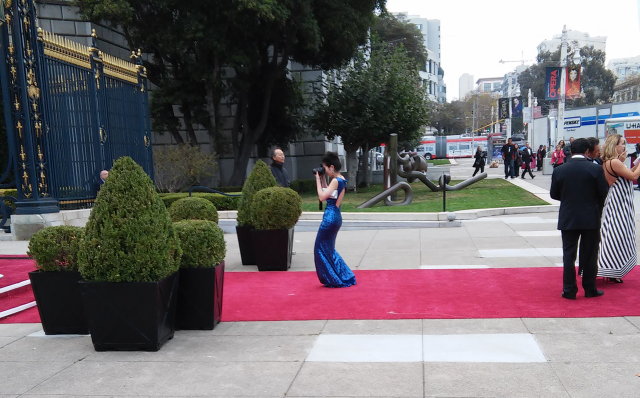
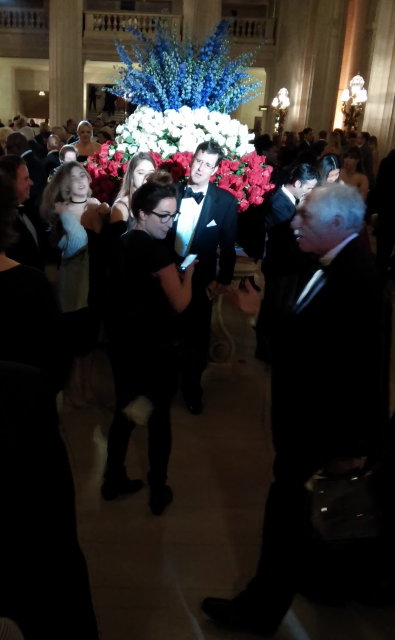
The 41st Frameline Film Festival starts his week, running June 15-25 at the Castro, Roxie & Victoria Theatres, as well the Elmwood in Berkeley & the Piedmond in Oakland. Last month, I attended the festival's convivial launch party, as a friend's plus-one. Frances Wallace, Executive Director, announced that this year's festival has 147 films, 40% of them by women directors. Ms. Wallace & programmers Peter Stein, Des Buford, Harry Vaughn & Kevin Schaub were joyful as they presented a quick run-through of some festival highlights.
Opening night is the new documentary The Untold Tales of Armistead Maupin, with Mr. Maupin in attendance. Closing night is the drama After Louie, starring Alan Cumming, who will be present to receive the festival's Frameline Award. The centerpiece film in world cinema is I Dream in Another Language (Sueño en Otrea Idioma), an art film about a linguist who tracks down the last 2 speakers of a dying language, only to find that they won't talk to each other. I was intrigued by mention of Apricot Groves, a film in Armenian & Farsi, about a young Armenian-Iranian man, raised in the US, who travels to Armenia to make a marriage proposal.
One of the programmers was genuinely enthusiastic about My Friend Dahmer, a movie portrait of the teenage Jeffrey Dahmer. Ross Lynch, who portrays Dahmer, is expected to attend the screening. The programmers also touted the festival's Episodic category, comprising multi-part series originally intended for on-line or TV viewing.
The event attendees were a friendly crowd, & I enjoyed learning about Gay Days at Disneyland & chatting briefly with one of the programmers, who discussed the trickiness of making selections for a San Francisco audience.
§ Frameline 41 Festival Launch Party
Tuesday, May 23, 5:30PM
The Oasis
§ Frameline 41
San Francisco International
LGBTQ Film Festival
June 15-25, 2017
Castro Theatre, Roxie Theater, Victoria Theatre
Rialto Cinemas Elmwood, Landmark Theatres Piedmond
Showing posts with label better late than never. Show all posts
Thursday, June 15, 2017
Tuesday, June 13, 2017
SF Silent Film Festival - Day 3 - Continued
The afternoon of the 3rd day of the San Francisco Silent Film Festival, I stuck around for Tod Browning's 1920 Outside the Law, a film noir with a touch of domestic comedy. The demotic Eddie Muller, a last-minute replacement for Leonard Maltin, introduced the program. He expressed his admiration for the film's female lead, Priscilla Dean. Called "The Queen of Crookdom", she was supposedly as tough in real life as on-screen. The story is set in San Francisco's Chinatown, & Mr. Muller speculated that Dashiell Hammett must have seen it.
The suspenseful plot involves double-crossing mobsters & changes of heart, & I was easily caught up in the story. Ms. Dean's gutsy character comes across vividly, as does a scene-stealing child who remains irresistibly cute whether bawling his eyes out or toting an ax. Even though the Chinese are the good guys, I did not appreciate seeing white actors in yellowface, especially Lon Chaney grotesquely made up as a slit-eyed Chinaman. It was fun to spot Old St. Mary's in an exterior shot. It's a pity that the film image is badly deteriorated in the climactic fight sequence.
Pianist Stephen Horne & percussionist Frank Bockius accompanied with music that evoked the period & underscored the action. I enjoyed the sultry jazz theme they played for Ms. Dean's character. The duo resorted to oriental motifs & a gong for the Chinatown scenes. Somehow Mr. Horne also played the zither, flute or accordion at the same time as the piano. The audience laughed at an intertitle referring to San Francisco's "Knob Hill."
I came back at night for A Page of Madness, a 1926 avant-garde film from Japan that I'd been wanting to see for years. It is famously set in a madhouse & infamously lacks intertitles & a definitive scenario. The film has also not survived complete. Serge Bromberg got us in the mood for bafflement by beginning his introduction to the film in French. He admitted that he's seen it many times but never understands anything.
The director Teinosuke Kinugasa makes dazzling use of multiple exposure, rapid-fire montage & tracking shots, & every shot forms a striking composition. The actors are intense without being overly hysterical. I was impressed by the staging of the mob scenes. The movie triggered a lot of primal emotions, & I was especially freaked out by a scene in which the inmates put on masks.
The show was accompanied by the three-man Alloy Orchestra, playing electronic instruments and a large array of percussion. They made creepy use of harp, clarinet & theremin. The score was often loud & punishing & matched the movie's atmosphere of frenzy & menace.
During the breaks it was fun to catch up with Patrick, who I believe saw all 6 programs that day, & to see The Civic Center, who was a man on the go.
§ Outside the Law
Directed by Tod Browning | 1920 | USA | 76 min
Live musical accompaniment by Stephen Horne & Frank Bockius
San Francisco Silent Film Festival 2017
Saturday, June 3, 5:00pm
Castro Theatre
§ A Page of Madness (Kurutta Ichipeiji)
Directed by Teinosuke Kinugasa | 1926 | Japan | 70 min
Live musical accompaniment by Alloy Orchestra
San Francisco Silent Film Festival 2017
Saturday, June 3, 9:30pm
Castro Theatre
The suspenseful plot involves double-crossing mobsters & changes of heart, & I was easily caught up in the story. Ms. Dean's gutsy character comes across vividly, as does a scene-stealing child who remains irresistibly cute whether bawling his eyes out or toting an ax. Even though the Chinese are the good guys, I did not appreciate seeing white actors in yellowface, especially Lon Chaney grotesquely made up as a slit-eyed Chinaman. It was fun to spot Old St. Mary's in an exterior shot. It's a pity that the film image is badly deteriorated in the climactic fight sequence.
Pianist Stephen Horne & percussionist Frank Bockius accompanied with music that evoked the period & underscored the action. I enjoyed the sultry jazz theme they played for Ms. Dean's character. The duo resorted to oriental motifs & a gong for the Chinatown scenes. Somehow Mr. Horne also played the zither, flute or accordion at the same time as the piano. The audience laughed at an intertitle referring to San Francisco's "Knob Hill."
I came back at night for A Page of Madness, a 1926 avant-garde film from Japan that I'd been wanting to see for years. It is famously set in a madhouse & infamously lacks intertitles & a definitive scenario. The film has also not survived complete. Serge Bromberg got us in the mood for bafflement by beginning his introduction to the film in French. He admitted that he's seen it many times but never understands anything.
The director Teinosuke Kinugasa makes dazzling use of multiple exposure, rapid-fire montage & tracking shots, & every shot forms a striking composition. The actors are intense without being overly hysterical. I was impressed by the staging of the mob scenes. The movie triggered a lot of primal emotions, & I was especially freaked out by a scene in which the inmates put on masks.
The show was accompanied by the three-man Alloy Orchestra, playing electronic instruments and a large array of percussion. They made creepy use of harp, clarinet & theremin. The score was often loud & punishing & matched the movie's atmosphere of frenzy & menace.
During the breaks it was fun to catch up with Patrick, who I believe saw all 6 programs that day, & to see The Civic Center, who was a man on the go.
§ Outside the Law
Directed by Tod Browning | 1920 | USA | 76 min
Live musical accompaniment by Stephen Horne & Frank Bockius
San Francisco Silent Film Festival 2017
Saturday, June 3, 5:00pm
Castro Theatre
§ A Page of Madness (Kurutta Ichipeiji)
Directed by Teinosuke Kinugasa | 1926 | Japan | 70 min
Live musical accompaniment by Alloy Orchestra
San Francisco Silent Film Festival 2017
Saturday, June 3, 9:30pm
Castro Theatre
Saturday, October 08, 2016
The Salesman
A couple of weeks ago I got to see a preview screening of The Salesman, Asghar Farhadi's taut new film about personal revenge. It plays at the Mill Valley Film Festival next week & then in Bay Area theaters in January. The story presents us with a cultured, well-educated husband & wife living in Tehran. They are about to star opposite each other in a production of Arthur Miller's Death of a Salesman. In the gripping opening scene, which is in one long take & appears to be an over-stated MacGuffin, they are forced to evacuate their apartment building. They move to another apartment, previously inhabited by an elusive woman who may be a prostitute. When the wife is alone in the apartment one evening, she is assaulted by an intruder. The specific details of attack are never made explicit, but the wife is too traumatized to talk to the police, & the husband, out of a chivalrous instinct, sets out to track down the assailant himself.
Though the plot is calculated & takes many contrived side trips, the movie has an immediacy & sense of urgency. I was never sure where scenes were headed, & I liked the way that things left unsaid or unseen loomed large. In the subplot involving Death of a Salesman, it's nice seeing realistic glimpses of the production, which appears quite faithful.
Farhadi often trails the characters with a hand-held camera, & always felt like I was right in the middle of the action. Shahab Hosseini as the husband Emad is a likable & charismatic actor. It is easy to keep identifying with Emad even as his behavior becomes increasingly disappointing. There's a stage-like quality to the tension underlying every scene, & the film is unsettling. Right through its last moments, I kept re-evaluating what I thought about its moral dilemmas.
§ Forushande (The Salesman) (2016)
Asghar Farhadi, dir.
Iran, France, 125 mins.
§ Mill Valley Film Festival 39
Rafael 1, Fri, Oct 7, 7:30 PM
Rafael 2, Wed, Oct 12, 12:00 PM
Though the plot is calculated & takes many contrived side trips, the movie has an immediacy & sense of urgency. I was never sure where scenes were headed, & I liked the way that things left unsaid or unseen loomed large. In the subplot involving Death of a Salesman, it's nice seeing realistic glimpses of the production, which appears quite faithful.
Farhadi often trails the characters with a hand-held camera, & always felt like I was right in the middle of the action. Shahab Hosseini as the husband Emad is a likable & charismatic actor. It is easy to keep identifying with Emad even as his behavior becomes increasingly disappointing. There's a stage-like quality to the tension underlying every scene, & the film is unsettling. Right through its last moments, I kept re-evaluating what I thought about its moral dilemmas.
§ Forushande (The Salesman) (2016)
Asghar Farhadi, dir.
Iran, France, 125 mins.
§ Mill Valley Film Festival 39
Rafael 1, Fri, Oct 7, 7:30 PM
Rafael 2, Wed, Oct 12, 12:00 PM
Friday, October 07, 2016
Dream of the Red Chamber at SF Opera
Back in the first week of the San Francisco Opera season, I attended the 2nd performance of Dream of the Red Chamber, the opera by Bright Sheng & David Henry Hwang receiving its world premiere here. I enjoyed the visual spectacle of the production. The opening chorus of beggars, emerging from a burning village, looks like a painting come to life. Dai Yu's boat trip at the beginning of the story & her climactic disappearance at the end are depicted simply but effectively using rippling blue fabrics. I liked the visual poetry of an interlude that illustrates the passing of the seasons with falling leaves of different colors.
Scene transitions had beautiful choreography. The grand hall of the Jia family is appropriately ostentatious, & as its multi-plane backdrop rose into place, I felt like I was floating above the landscape. The transformation of Granny Jia's deathbed into a funeral bier was efficient & clever. The costumes were opulent.
The cast was uniformly strong & ardent. Tenor Yijie Shi as Bao Yu sounded open & clarion & acted befittingly like a feckless teenager in act 1. Soprano Pureum Jo as his love interest Dai Yu sang with a consistent, solid sound & had nice soft notes. I liked mezzo Hyona Kim as the imperious Lady Wang. Her singing was expressive & emphatic. Soprano Irene Roberts was a pragmatic Bao Chai. Her sound was full, & she was impressively resolute in her act 2 monologue. Soprano Karen Chia-ling Ho was a rueful Princess Jia & sang confidently. The soloists are almost all high voices, so it was nice hearing the male voices of the chorus.
Mr. Sheng's music is atmospheric, with strong, irregular rhythms, chromatic harmonies, & shimmering orchestral colors. Chinese accents are provided by gongs at moments of urgency, & there is a prominent solo for the qin. The vocal lines often feel stretched, with long-held notes at the ends of phrases. The orchestra played alertly for conductor George Manahan, & the clarinet solos were especially lovely.
The choppy storyline includes elements of romance, domestic drama, politics & Buddhist philosophy. Mr. Hwang's English language libretto is prosaic & even bald, particularly in the erotic dream scene. Supertitles & program notes were accommodatingly provided in both English & Chinese, & there were definitely more Asian faces in the audience than I am used to seeing at the opera.
There was an open curtain during intermission, with director Stan Lai talking about the production & taking questions via Twitter. The audience seemed attentive. Mr. Sheng was present to take a curtain call at the end of the performance.
§ Dream of the Red Chamber
Music by Bright Sheng
Libretto by David Henry Hwang and Bright Sheng
San Francisco Opera
Conductor, George Manahan
Director, Stan Lai
Production Designer, Tim Yip
Lighting Designer, Gary Marder
Choreographer, Fang-Yi Sheu
Chorus Director, Ian Robertson
Fight Director, Dave Maier
Flower/Dai Yu, Pureum Jo
Stone/Bao Yu, Yijie Shi
Lady Wang, Hyona Kim
Bao Chai, Irene Roberts
Granny Jia, Qiulin Zhang
Princess Jia, Karen Chia-ling Ho
Aunt Xue, Yanyu Guo
The Monk/Dreamer, Randall Nakano
Lady-in-Waiting/Flower, Toni Marie Palmertree, Amina Edris, Zanda Švēde
Eunuch/Stone, Pene Pati, Alex Boyer, Edward Nelson
Tuesday 09/13/16 7:30PM
War Memorial Opera House
Scene transitions had beautiful choreography. The grand hall of the Jia family is appropriately ostentatious, & as its multi-plane backdrop rose into place, I felt like I was floating above the landscape. The transformation of Granny Jia's deathbed into a funeral bier was efficient & clever. The costumes were opulent.
The cast was uniformly strong & ardent. Tenor Yijie Shi as Bao Yu sounded open & clarion & acted befittingly like a feckless teenager in act 1. Soprano Pureum Jo as his love interest Dai Yu sang with a consistent, solid sound & had nice soft notes. I liked mezzo Hyona Kim as the imperious Lady Wang. Her singing was expressive & emphatic. Soprano Irene Roberts was a pragmatic Bao Chai. Her sound was full, & she was impressively resolute in her act 2 monologue. Soprano Karen Chia-ling Ho was a rueful Princess Jia & sang confidently. The soloists are almost all high voices, so it was nice hearing the male voices of the chorus.
Mr. Sheng's music is atmospheric, with strong, irregular rhythms, chromatic harmonies, & shimmering orchestral colors. Chinese accents are provided by gongs at moments of urgency, & there is a prominent solo for the qin. The vocal lines often feel stretched, with long-held notes at the ends of phrases. The orchestra played alertly for conductor George Manahan, & the clarinet solos were especially lovely.
The choppy storyline includes elements of romance, domestic drama, politics & Buddhist philosophy. Mr. Hwang's English language libretto is prosaic & even bald, particularly in the erotic dream scene. Supertitles & program notes were accommodatingly provided in both English & Chinese, & there were definitely more Asian faces in the audience than I am used to seeing at the opera.
There was an open curtain during intermission, with director Stan Lai talking about the production & taking questions via Twitter. The audience seemed attentive. Mr. Sheng was present to take a curtain call at the end of the performance.
§ Dream of the Red Chamber
Music by Bright Sheng
Libretto by David Henry Hwang and Bright Sheng
San Francisco Opera
Conductor, George Manahan
Director, Stan Lai
Production Designer, Tim Yip
Lighting Designer, Gary Marder
Choreographer, Fang-Yi Sheu
Chorus Director, Ian Robertson
Fight Director, Dave Maier
Flower/Dai Yu, Pureum Jo
Stone/Bao Yu, Yijie Shi
Lady Wang, Hyona Kim
Bao Chai, Irene Roberts
Granny Jia, Qiulin Zhang
Princess Jia, Karen Chia-ling Ho
Aunt Xue, Yanyu Guo
The Monk/Dreamer, Randall Nakano
Lady-in-Waiting/Flower, Toni Marie Palmertree, Amina Edris, Zanda Švēde
Eunuch/Stone, Pene Pati, Alex Boyer, Edward Nelson
Tuesday 09/13/16 7:30PM
War Memorial Opera House
Thursday, September 15, 2016
Lo and Behold
In the opening segment, Leonard Kleinrock, a chipper UCLA professor, enthusiastically shows off the 1st computer on the Internet, as the overture to Das Rheingold plays on the soundtrack, & the rest of the movie is similarly layered with ideas. I was delighted to see an interview with Ted Nelson, computer visionary & weirdo who invented an alternative version of hypertext decades before the World Wide Web. He is Herzog's kind of guy.
I had no idea that fabled hacker Kevin Mitnick would be so cheerful & such a terrific story teller. His talent for social engineering might be more dangerous than his computer skills. I felt I needed to learn more about the story of cybersleuth Shawn Carpenter, who is far too casual describing how to get spyware onto someone's computer.
There are plenty of odd moments. I could not help staring at the pile of pastries in front of the pained Catsouras family, who describe the trauma caused by photos leaked onto the Internet. The sight of orange-robed monks checking their cellphones on the Chicago lakefront prompts Herzog to wonder, "Have the monks stopped meditating?" Elon Musk looks preoccupied & worried, even before Herzog volunteers to go to Mars in one of his spaceships.
Some of the ideas presented are highly speculative, but I love that Herzog gets provocative answers when he ask experts if the Internet dreams of itself. I am skeptical of the brain scientists' frightening claims to be able to read thoughts, but it seems quite valid for physicist Lawrence Krauss to ask, "Will our children's children's children need the companionship of humans, or will they have evolved in a world where that's not important?" It all adds up to a feeling that we are at a turning point in human consciousness.
§ Lo and Behold, Reveries of the Connected World (2016)
A film by Werner Herzog
98 min., USA
Andrea Chenier at SF Opera
Last Friday I heard Andrea Chénier at opening night of San Francisco Opera's 2016 - 17 season. The evening began with remarks by the new General Director Matthew Shilvock, President Keith Geeslin & Chairman of the Board John Gunn. They thanked sponsors & donors, & Mr. Gunn brought the event to a halt when he forgot the name of Music Director Nicola Luisotti for several long seconds.
Tenor Yonghoon Lee in the title role sounded reliably strong & projected bravery. He had a slightly dark timbre & shaded his drawn-out notes nicely. I enjoyed hearing soprano Anna Pirozzi as Maddelena. Her voice was agile & penetrating & had a pleasing friction. Her top notes emerged with seeming ease, & she sang "La mamma morta" with control & nice dynamic contrast. Baritone George Gagnidze as Gerard had an unwavering, weighty & consistent sound.
Smaller roles were all cast from strength. Mezzo Catherine Cook was a characterful & sneering Contessa di Coigny, & baritone Edward Nelson had a smooth & pretty voice as the dandy Fleville. Bass Robert Pomakov as Mathieu was fittingly boisterous & hearty, & the clear-voiced tenor Joel Sorensen was a lively Incredibile. Baritone David Pershall as Roucher made a firm & appealing sound.
Though Giordano's score is scintillating & often loud, from orchestra level standing room the orchestra seemed subdued & cushioned. Maestro Luisotti's tempos did not feel too hurried. I liked the clarinet & violin solos, & the harp was assertive. Director David McVicar's production is attractive, & the scenes sometimes looked like neo-classical paintings. The period costumes had an authentic feel & looked easy to move in. The use of child supers in every act added liveliness to the staging, but it was an antiseptic picture of the French Revolution overall. The set changes with the curtain down after acts I & III were long.
Considering that this was opening night, there was surprisingly little audience attrition after intermission, though a pod of young people in tuxedos & gowns exited the orchestra level in the pause after act III. Competition for standing room was light, & 2 of our opera companions were offered seats before the end of the performance.
§ Andrea Chénier
Music by Umberto Giordano | Libretto by Luigi Illica
San Francisco Opera
Conductor, Nicola Luisotti
Director, David McVicar
Chorus Director, Ian Robertson
Carlo Gérard, George Gagnidze
Major-Domo, Anders Fröhlich
An Old Gardener, Charlie Lichtman
Maddalena di Coigny, Anna Pirozzi
Bersi, J’Nai Bridges
Contessa di Coigny, Catherine Cook
Pietro Fléville, Edward Nelson
Flando Fiorinelli, Matthew Erikson
Andrea Chénier, Yonghoon Lee
The Abbé, Alex Boyer
Shepherdess, Laura Alexich
Shepherd, Michael Levine
Mathieu, Robert Pomakov
L'Incredibile, Joel Sorensen
Roucher, David Pershall
Madelon, Jill Grove
Madelon's Grandson, Graham Isom
Fouquier-Tinville, Matthew Stump
Dumas, Brad Walker
Gravier de Vergennes, Charlie Lichtman
Laval-Montmorency, Susan Anderson-Norby
Idia Legray, Tatiana Bookbinder
Schmidt, Anthony Reed
Friday, 09/09/16, 8:00PM
War Memorial Opera House
Tenor Yonghoon Lee in the title role sounded reliably strong & projected bravery. He had a slightly dark timbre & shaded his drawn-out notes nicely. I enjoyed hearing soprano Anna Pirozzi as Maddelena. Her voice was agile & penetrating & had a pleasing friction. Her top notes emerged with seeming ease, & she sang "La mamma morta" with control & nice dynamic contrast. Baritone George Gagnidze as Gerard had an unwavering, weighty & consistent sound.
Smaller roles were all cast from strength. Mezzo Catherine Cook was a characterful & sneering Contessa di Coigny, & baritone Edward Nelson had a smooth & pretty voice as the dandy Fleville. Bass Robert Pomakov as Mathieu was fittingly boisterous & hearty, & the clear-voiced tenor Joel Sorensen was a lively Incredibile. Baritone David Pershall as Roucher made a firm & appealing sound.
Though Giordano's score is scintillating & often loud, from orchestra level standing room the orchestra seemed subdued & cushioned. Maestro Luisotti's tempos did not feel too hurried. I liked the clarinet & violin solos, & the harp was assertive. Director David McVicar's production is attractive, & the scenes sometimes looked like neo-classical paintings. The period costumes had an authentic feel & looked easy to move in. The use of child supers in every act added liveliness to the staging, but it was an antiseptic picture of the French Revolution overall. The set changes with the curtain down after acts I & III were long.
Considering that this was opening night, there was surprisingly little audience attrition after intermission, though a pod of young people in tuxedos & gowns exited the orchestra level in the pause after act III. Competition for standing room was light, & 2 of our opera companions were offered seats before the end of the performance.
§ Andrea Chénier
Music by Umberto Giordano | Libretto by Luigi Illica
San Francisco Opera
Conductor, Nicola Luisotti
Director, David McVicar
Chorus Director, Ian Robertson
Carlo Gérard, George Gagnidze
Major-Domo, Anders Fröhlich
An Old Gardener, Charlie Lichtman
Maddalena di Coigny, Anna Pirozzi
Bersi, J’Nai Bridges
Contessa di Coigny, Catherine Cook
Pietro Fléville, Edward Nelson
Flando Fiorinelli, Matthew Erikson
Andrea Chénier, Yonghoon Lee
The Abbé, Alex Boyer
Shepherdess, Laura Alexich
Shepherd, Michael Levine
Mathieu, Robert Pomakov
L'Incredibile, Joel Sorensen
Roucher, David Pershall
Madelon, Jill Grove
Madelon's Grandson, Graham Isom
Fouquier-Tinville, Matthew Stump
Dumas, Brad Walker
Gravier de Vergennes, Charlie Lichtman
Laval-Montmorency, Susan Anderson-Norby
Idia Legray, Tatiana Bookbinder
Schmidt, Anthony Reed
Friday, 09/09/16, 8:00PM
War Memorial Opera House
Monday, August 29, 2016
Merola Grand Finale 2016
I was remiss in not keeping up with the Merolini this summer, but last weekend I did attend the Merola Grand Finale & heard all of them in one go, in a program of 19 opera excerpts, a sort of graduation exercise for all 29 participants. The concert was semi-staged, with just a few props & pieces of furniture on a bare stage, plus occasional lighting changes.
The performances were uniformly forthright & extroverted. Mezzo Tara Curtis received a shout of "Brava!" for her solemn interpretation of Cassandra's monologue from Les Troyens. Her voice was weighty & often penetrating, & it felt like she had even more in reserve. I probably spent too much time, though, wondering why she popped a balloon full of confetti at the beginning of the scene.
Countertenor Aryeh Nussbaum Cohen sounded steadfast & neat in "Che farò senza Euridice?" & ornamented the repeats tastefully. His Orfeo was frustrated rather than sorrowful. Soprano Chelsey Geeting's voice was full & warbling as well as a bit dusky in Antonia's song from The Tales of Hoffman, & her rendition felt aptly remote.
In a duet from Berlioz's Béatrice et Bénédict, tenor Amitai Pati was a dapper Bénédict. He has a pleasing, smooth voice & an appealing stage presence. Soprano Alexandra Schenck as Béatrice sounded bright & youthful. Bass Matthew Anchel sang his prayer scene from Nabucco standing on a couch & sounded soft-edged & benign.
The audience applauded loudly for bass-baritones Josh Quinn & Nicholas Boragno in a duet from La Cenerentola, in which both characters acted clownishly. I liked Mr. Boragno's hearty singing & acting & Mr. Quinn's tight, clear patter. The audience also clearly enjoyed Mr. Pati & baritone Andrew G. Manea in "Au fond du temple saint" from The Pearl Fishers. Mr. Pati's voice was lyric & dreamy, & Mr. Manea's had a nice grittiness & masculinity.
A 3 tier wedding cake was brought on stage right before the scene from Anna Bolena featuring soprano Mary Evelyn Hangley & mezzo Taylor Raven. Ms. Hangley's voice was muscular & solid, & it was nice to hear her sing high notes both loudly & softly. Ms. Raven had a distinctive, somewhat metallic, sound that was open & consistent throughout her range. Their performance was loud & dramatic & received enthusiastic applause.
Soprano Yelena Dyachek sang "Letzte Rose, wie magst du" from Martha with a substantial & commanding sound. Soprano Sarah Cambidge was an aggressive Donna Anna, with an ear-filling voice & big high notes in "Don Ottavio, son morta!"
In Rienzi's prayer scene, tenor Kyle van Schoonhoven's clear & open high notes were immediately striking, & his voice had unusual timbres. He was accompanied by a silent chorus line of women who promenaded behind his back then posed themselves on either side of him. I'm sure bass-baritone Cody Quattlebaum sang his strutting aria from Trouble in Tahiti wonderfully, but all I can remember is that he flamboyantly unwound his man bun during it.
Soprano Teresa Castillo & tenor Josh Lovell had good ensemble in a bubbly duet from Le Comte Ory. Ms. Castillo's singing was pretty, sparkling & precise, & Mr. Lovell's high notes were controlled & secure. He agilely bounded around the stage, & the wedding cake finally came into play when Ms. Castillo lifted its top tier & smashed it in her partner's face.
During the final ensemble for the entire cast, it was very cute to see photos of them taken throughout the summer projected on stage. Conductor Rory Macdonald led with lively gestures, but the orchestra sounded slack & there were synchronization problems between stage & pit. The audience applauded each number supportively, & many gave the performers a standing ovation at the end. The 3-hour show had a start time of 7:30pm, but the lights didn't go down until past 7:40pm, & people were still being seated during the overture.
§ Merola Grand Finale 2016
Conductor - Rory Macdonald
Stage Director - Aria Umezawa
Musical Preparation - Jonathan Brandani, John Elam, Noah Palmer, Nicolò Sbuelz, Jennifer Szeto
French Diction - Patricia Kristof Moy
Italian Diction - Alessandra Cattani
Overture from Die Fledermaus by J. Strauss
Orchestra
"Quando avran fine omai ... Padre, germani, addio!" from Idomeneo by Mozart
Ilia - Shannon Jennings
Fortepiano - Jonathan Brandani
"Linda! Linda! ... Da qual di che t'incontrai" from Linda di Chamounix by Donizetti
Linda - Adelaide Boedecker
Carlo - Isaac Frishman
"Les Grecs ont disparu! ... Malheureux roi! Dans l'éternelle nuit" from Les Troyens by Berlioz
Cassandre - Tara Curtis
"Ecco novel tormento! ... Che farò senza Euridice?" from Orfeo ed Euridice by Gluck
Euridice - Teresa Castillo
Orfeo - Aryeh Nussbaum Cohen
Fortepiano - Nicolò Sbuelz
"Elle a fui, la tourterelle!" from Les Contes d'Hoffmann by Offenbach
Antonia - Chelsey Geeting
"Comment Ie Dédain pourrait-il mourir?" from Béatrice et Bénédict by Berlioz
Béatrice - Alexandra Schenck
Bénédict - Amitai Pati
"Vieni, o Levita! ... Tu sul labbro de' veggenti" from Nabucco by Verdi
Zaccaria - Matthew Anchel
"Se all' impero" from La Clemenza di Tito by Mozart
Tito - Boris Van Druff
"Ma dunque io sono un ex ... Un segreto d'importanza" from La Cenerentola by Rossini
Dandini - Josh Quinn
Don Magnifico - Nicholas Boragno
Fortepiano - John Elam
"C'est toi, toi qu'enfin je revois ... Au fond du temple saint" from Les Pêcheurs de Perles by Bizet
Nadir - Amitai Pati
Zurga -Andrew G. Manea
"Durch Zärtlichkeit und Schmeicheln ... Ich gehe doch rate ich dir" from Die Entführung aus dem Serail by Mozart
Blonde - Jana McIntyre
Osmin - Matthew Anchel
"Dio, che mi vedi in core ... Sul suo capo aggravi un Dio" from Anna Bolena by Donizetti
Anna Bolena - Mary Evelyn Hangley
Giovanna Seymour - Taylor Raven
"Or dove fuggo io mai? ... Ah, per sempre io ti perdei" from I Puritani by Bellini
Riccardo - Josh Quinn
"Nancy! Julia! Verweile! ... Letzte Rose, wie magst du" from Martha by Flotow
Lady Harriet - Yelena Dyachek
Lionel - Brian Michael Moore
"Don Ottavio, son morta! ... Or sai chi l'onore" from Don Giovanni by Mozart
Donna Anna - Sarah Cambidge
Don Ottavio - Isaac Frishman
Fortepiano - Noah Palmer
"Allmächt'ger Vater, blick' herab" from Rienzi by Wagner
Rienzi - Kyle van Schoonhoven
"There's a law" from Trouble in Tahiti by Bernstein
Sam - Cody Quattlebaum
''Ah, quel respect madame pour vos vertus m'enflamme" from Le Comte Ory by Rossini
La Comtesse Adèle - Teresa Castillo
Le Comte Ory - Josh Lovell
"Herr Chevalier, ich grüsse sie! ... Brüderlein, Brüderlein und Schwesterlein" from Die Fledermaus by J. Strauss
Eisenstein - Kyle van Schoonhoven
Frank - Cody Quattlebaum
Rosalinde - Mary Evelyn Hangley
Adele - Jana McIntyre
Ida - Teresa Castillo
Orlofsky - Taylor Raven
Falke - Andrew G. Manea
Chorus - tutti Merolini
Saturday, August 20th
War Memorial Opera House
The performances were uniformly forthright & extroverted. Mezzo Tara Curtis received a shout of "Brava!" for her solemn interpretation of Cassandra's monologue from Les Troyens. Her voice was weighty & often penetrating, & it felt like she had even more in reserve. I probably spent too much time, though, wondering why she popped a balloon full of confetti at the beginning of the scene.
Countertenor Aryeh Nussbaum Cohen sounded steadfast & neat in "Che farò senza Euridice?" & ornamented the repeats tastefully. His Orfeo was frustrated rather than sorrowful. Soprano Chelsey Geeting's voice was full & warbling as well as a bit dusky in Antonia's song from The Tales of Hoffman, & her rendition felt aptly remote.
In a duet from Berlioz's Béatrice et Bénédict, tenor Amitai Pati was a dapper Bénédict. He has a pleasing, smooth voice & an appealing stage presence. Soprano Alexandra Schenck as Béatrice sounded bright & youthful. Bass Matthew Anchel sang his prayer scene from Nabucco standing on a couch & sounded soft-edged & benign.
The audience applauded loudly for bass-baritones Josh Quinn & Nicholas Boragno in a duet from La Cenerentola, in which both characters acted clownishly. I liked Mr. Boragno's hearty singing & acting & Mr. Quinn's tight, clear patter. The audience also clearly enjoyed Mr. Pati & baritone Andrew G. Manea in "Au fond du temple saint" from The Pearl Fishers. Mr. Pati's voice was lyric & dreamy, & Mr. Manea's had a nice grittiness & masculinity.
A 3 tier wedding cake was brought on stage right before the scene from Anna Bolena featuring soprano Mary Evelyn Hangley & mezzo Taylor Raven. Ms. Hangley's voice was muscular & solid, & it was nice to hear her sing high notes both loudly & softly. Ms. Raven had a distinctive, somewhat metallic, sound that was open & consistent throughout her range. Their performance was loud & dramatic & received enthusiastic applause.
Soprano Yelena Dyachek sang "Letzte Rose, wie magst du" from Martha with a substantial & commanding sound. Soprano Sarah Cambidge was an aggressive Donna Anna, with an ear-filling voice & big high notes in "Don Ottavio, son morta!"
In Rienzi's prayer scene, tenor Kyle van Schoonhoven's clear & open high notes were immediately striking, & his voice had unusual timbres. He was accompanied by a silent chorus line of women who promenaded behind his back then posed themselves on either side of him. I'm sure bass-baritone Cody Quattlebaum sang his strutting aria from Trouble in Tahiti wonderfully, but all I can remember is that he flamboyantly unwound his man bun during it.
Soprano Teresa Castillo & tenor Josh Lovell had good ensemble in a bubbly duet from Le Comte Ory. Ms. Castillo's singing was pretty, sparkling & precise, & Mr. Lovell's high notes were controlled & secure. He agilely bounded around the stage, & the wedding cake finally came into play when Ms. Castillo lifted its top tier & smashed it in her partner's face.
During the final ensemble for the entire cast, it was very cute to see photos of them taken throughout the summer projected on stage. Conductor Rory Macdonald led with lively gestures, but the orchestra sounded slack & there were synchronization problems between stage & pit. The audience applauded each number supportively, & many gave the performers a standing ovation at the end. The 3-hour show had a start time of 7:30pm, but the lights didn't go down until past 7:40pm, & people were still being seated during the overture.
§ Merola Grand Finale 2016
Conductor - Rory Macdonald
Stage Director - Aria Umezawa
Musical Preparation - Jonathan Brandani, John Elam, Noah Palmer, Nicolò Sbuelz, Jennifer Szeto
French Diction - Patricia Kristof Moy
Italian Diction - Alessandra Cattani
Overture from Die Fledermaus by J. Strauss
Orchestra
"Quando avran fine omai ... Padre, germani, addio!" from Idomeneo by Mozart
Ilia - Shannon Jennings
Fortepiano - Jonathan Brandani
"Linda! Linda! ... Da qual di che t'incontrai" from Linda di Chamounix by Donizetti
Linda - Adelaide Boedecker
Carlo - Isaac Frishman
"Les Grecs ont disparu! ... Malheureux roi! Dans l'éternelle nuit" from Les Troyens by Berlioz
Cassandre - Tara Curtis
"Ecco novel tormento! ... Che farò senza Euridice?" from Orfeo ed Euridice by Gluck
Euridice - Teresa Castillo
Orfeo - Aryeh Nussbaum Cohen
Fortepiano - Nicolò Sbuelz
"Elle a fui, la tourterelle!" from Les Contes d'Hoffmann by Offenbach
Antonia - Chelsey Geeting
"Comment Ie Dédain pourrait-il mourir?" from Béatrice et Bénédict by Berlioz
Béatrice - Alexandra Schenck
Bénédict - Amitai Pati
"Vieni, o Levita! ... Tu sul labbro de' veggenti" from Nabucco by Verdi
Zaccaria - Matthew Anchel
"Se all' impero" from La Clemenza di Tito by Mozart
Tito - Boris Van Druff
"Ma dunque io sono un ex ... Un segreto d'importanza" from La Cenerentola by Rossini
Dandini - Josh Quinn
Don Magnifico - Nicholas Boragno
Fortepiano - John Elam
"C'est toi, toi qu'enfin je revois ... Au fond du temple saint" from Les Pêcheurs de Perles by Bizet
Nadir - Amitai Pati
Zurga -Andrew G. Manea
"Durch Zärtlichkeit und Schmeicheln ... Ich gehe doch rate ich dir" from Die Entführung aus dem Serail by Mozart
Blonde - Jana McIntyre
Osmin - Matthew Anchel
"Dio, che mi vedi in core ... Sul suo capo aggravi un Dio" from Anna Bolena by Donizetti
Anna Bolena - Mary Evelyn Hangley
Giovanna Seymour - Taylor Raven
"Or dove fuggo io mai? ... Ah, per sempre io ti perdei" from I Puritani by Bellini
Riccardo - Josh Quinn
"Nancy! Julia! Verweile! ... Letzte Rose, wie magst du" from Martha by Flotow
Lady Harriet - Yelena Dyachek
Lionel - Brian Michael Moore
"Don Ottavio, son morta! ... Or sai chi l'onore" from Don Giovanni by Mozart
Donna Anna - Sarah Cambidge
Don Ottavio - Isaac Frishman
Fortepiano - Noah Palmer
"Allmächt'ger Vater, blick' herab" from Rienzi by Wagner
Rienzi - Kyle van Schoonhoven
"There's a law" from Trouble in Tahiti by Bernstein
Sam - Cody Quattlebaum
''Ah, quel respect madame pour vos vertus m'enflamme" from Le Comte Ory by Rossini
La Comtesse Adèle - Teresa Castillo
Le Comte Ory - Josh Lovell
"Herr Chevalier, ich grüsse sie! ... Brüderlein, Brüderlein und Schwesterlein" from Die Fledermaus by J. Strauss
Eisenstein - Kyle van Schoonhoven
Frank - Cody Quattlebaum
Rosalinde - Mary Evelyn Hangley
Adele - Jana McIntyre
Ida - Teresa Castillo
Orlofsky - Taylor Raven
Falke - Andrew G. Manea
Chorus - tutti Merolini
Saturday, August 20th
War Memorial Opera House
Friday, December 25, 2015
ABS: Weihnachts-Oratorium
Earlier this month, I heard the American Bach Soloists perform Bach's Christmas Oratorio in St. Ignatius Church on the USF campus. In his introductory remarks, conductor Jeffrey Thomas told us this was the 1st ABS performance here. The large interior was well-lit & decorated with garlands, so the setting felt especially grand & festive. Performance forces were minimal: 4 soloists, 16 choristers, in a widely spaced row behind the orchestra, & about 20 instrumentalists, mostly one per part. The sound was not as muddy as I had expected, but it did seem to dissipate into the cavernous space rather than fill it.
Everyone gave punctilious, scrupulously consistent performances. Maestro Thomas's tempos were often fleet, but his beat was always perfectly regular & so never felt rushed. Tenor Kyle Stegall had a wonderfully bright, flexible voice & very clear diction. He sang his recitatives expressively, & his virtuoso arias sounded fluent & agile. He seemed to take breaths in comfortable places. I enjoyed the firm yet easeful voice of baritone Jesse Blumberg. He singing was athletic & elegant, & his high notes warm & open.
Soprano Hélène Brunet's voice was high, warbling & youthful & appropriately angelic. Mezzo Agnes Vojtko made a grounded, sustained sound. She executed long phrases efficiently, without seeming to take breaths, & was steadfast. The choristers were secure & dispatched their contrapuntal choruses pristinely. The soloists joined in the chorales, which were stately.
Individual orchestra members stood when they had obbligato parts, & there were many excellent solos. The trumpet's trills were impressively rapid & even. The tone of the flute was pleasingly pure & without breathiness. Debra Nagy's oboe playing is beautifully liquid, & her accompaniment to "Flößt, mein Heiland" was flowing & had clear-cut dynamics. The aria's off-stage echo voice always came in neatly on time. The strings played vigorously, & leader Elizabeth Blumenstock gave a vivid, wave-like motion to her part in "Ach, wenn wird die Zeit erscheinen." The horns struggled to be in tune.
The concert was well attended, & the sober-minded audience refrained from applauding between the separate cantatas, though many stood enthusiastically for the performers at the end. There were long lines for restrooms, even if one ventured outside to a nearby building. Late-comers squeezed themselves into a non-existent seat next to my concert companion, not realizing that they were in the wrong pew.
§ Bach's Christmas Oratorio
American Bach Soloists
American Bach Choir
Hélène Brunet, soprano
Agnes Vojtko, alto
Kyle Stegall, tenor
Jesse Blumberg, baritone
Jeffrey Thomas, conductor
Saturday December 12 2015 7:30 pm
Saint Ignatius Church, San Francisco
Everyone gave punctilious, scrupulously consistent performances. Maestro Thomas's tempos were often fleet, but his beat was always perfectly regular & so never felt rushed. Tenor Kyle Stegall had a wonderfully bright, flexible voice & very clear diction. He sang his recitatives expressively, & his virtuoso arias sounded fluent & agile. He seemed to take breaths in comfortable places. I enjoyed the firm yet easeful voice of baritone Jesse Blumberg. He singing was athletic & elegant, & his high notes warm & open.
Soprano Hélène Brunet's voice was high, warbling & youthful & appropriately angelic. Mezzo Agnes Vojtko made a grounded, sustained sound. She executed long phrases efficiently, without seeming to take breaths, & was steadfast. The choristers were secure & dispatched their contrapuntal choruses pristinely. The soloists joined in the chorales, which were stately.
Individual orchestra members stood when they had obbligato parts, & there were many excellent solos. The trumpet's trills were impressively rapid & even. The tone of the flute was pleasingly pure & without breathiness. Debra Nagy's oboe playing is beautifully liquid, & her accompaniment to "Flößt, mein Heiland" was flowing & had clear-cut dynamics. The aria's off-stage echo voice always came in neatly on time. The strings played vigorously, & leader Elizabeth Blumenstock gave a vivid, wave-like motion to her part in "Ach, wenn wird die Zeit erscheinen." The horns struggled to be in tune.
The concert was well attended, & the sober-minded audience refrained from applauding between the separate cantatas, though many stood enthusiastically for the performers at the end. There were long lines for restrooms, even if one ventured outside to a nearby building. Late-comers squeezed themselves into a non-existent seat next to my concert companion, not realizing that they were in the wrong pew.
§ Bach's Christmas Oratorio
American Bach Soloists
American Bach Choir
Hélène Brunet, soprano
Agnes Vojtko, alto
Kyle Stegall, tenor
Jesse Blumberg, baritone
Jeffrey Thomas, conductor
Saturday December 12 2015 7:30 pm
Saint Ignatius Church, San Francisco
Thursday, September 10, 2015
Origami-Palooza
Last month Japantown hosted the 3rd annual Origami-Palooza, a sort of origami open house, where people are invited to sit down & learn how to fold something out of a square of colored paper. It was well-attended, & you needed to hover a bit in order to snag a free seat.
My favorite was Trevor Mead's life-sized sheep, apparently constructed from 2 huge sheets of paper, supported by a metal frame. I'd never seen anything like it before.
A paper airplane contest was held in the plaza, though subjecting contestants to the vagaries of the wind did not seem fair.
The contest was emceed by John Collins, who holds the record for the longest flight of a paper airplane.
I liked figuring out how to fold a paper airplane at this table by seeing a sample of each step, but when I launched my finished plane, it shot across the room & smacked a little girl in the side of the face.
§ Origami-Palooza
Sunday, August 23, 2015, 1-5pm
East Japan Center Mall
It's obviously a perfect family activity, ...
--- but really people of all ages were getting into it.
Expert folders brought models to enter into a competition.
Their entries were amusing ...
... and astonishing.
My favorite was Trevor Mead's life-sized sheep, apparently constructed from 2 huge sheets of paper, supported by a metal frame. I'd never seen anything like it before.
A paper airplane contest was held in the plaza, though subjecting contestants to the vagaries of the wind did not seem fair.
The contest was emceed by John Collins, who holds the record for the longest flight of a paper airplane.
I liked figuring out how to fold a paper airplane at this table by seeing a sample of each step, but when I launched my finished plane, it shot across the room & smacked a little girl in the side of the face.
§ Origami-Palooza
Sunday, August 23, 2015, 1-5pm
East Japan Center Mall
Monday, August 24, 2015
ABS: Sémélé
![]() |
| Rebecca Myers Hoke (Sémélé) and Sara LeMesh (Juno). Photo: Gas Lamp Productions. |
The performance was impeccably well-prepared. The orchestra played cleanly, with detailed articulation, & never tired over the 3-hour evening. Concertmaster Robert Mealy made a sweet sound, & the violins were perfectly synchronized even in very rapid passages. The extended trumpet solo in the Prologue was impressively secure & in tune, & the Fourth Air was exceptionally graceful. I liked the soft timbres of the woodwinds, & the flute solos were clear & smooth. The percussion had a cheerful bounciness. The low, heavy sound the strings made to depict an earthquake was striking. It was nice having the continuo harpsichord in front of the orchestra, where it was easier to hear.
The youthful cast were even & well-matched. Soprano Grace Srinivasan displayed a light, pretty voice as a Priestess & a shepherdess, & baritone Ben Kazez got a laugh for his wide-eyed exit as the drunken High Priest. This opera's Sémélé constantly worries about her predicament, & soprano Rebecca Myers Hoke was a tormented & even grieving Sémélé from the start, her voice sounding dark & mature. I liked soprano Chelsea Morris's beautifully sustained sound & gliding high notes as the confidante Dorine. Tenor Steven Brennfleck portrayed a stylish Adraste, & his phrasing was expressive & conversational. Bass Christopher Besch had a compressed sound & conveyed in authoritarian Jupiter. Mezzo Sara LeMesh was an appropriately stern Juno, her singing strong & vivid.
The chorus was satisfyingly proficient, & I enjoyed listening to their wonderfully balanced, polished sound. Conductor Jeffrey Thomas kept to regular, squared-up tempos & did a good job keeping everything consistent & together. The computer running the supertitles misbehaved several times during the show, resulting in the audience seeing the OS X desktop instead of the words. The audience was generally attentive, though there was some attrition after intermission. Each half of the concert received enthusiastic applause & cheers, & there was a partial standing ovation.
During the intermission I was introduced to journalist Chloe Veltman. I do not bake much, so I was unreasonable excited that the lemon yogurt cake I brought to share got good reviews. I found the recipe here, but to make it Sémélé Intermission Lemon Cake, use 2 lemons supplied by Patrick from his garden.
§ Sémélé (1709)
Composed by Marin Marais (1656-1728)
American Bach Soloists Academy Orchestra
American Bach Choir
Jeffrey Thomas, conductor
The Grand Priestess of Bacchus:
The Grand Priest of Bacchus: Ben Kazez, baritone
Apollon: Matthew Hill, tenor
Cadmus: Corbin Phillips, baritone
Sémélé: Rebecca Myers Hoke, soprano
Dorine: Chelsea Morris, soprano
Adraste: Steven Brennfleck, tenor
Mercure (Arbate): David Rugger, baritone
Jupiter (ldas): Christopher Besch, bass
Junon: Sara LeMesh, mezzo-soprano
Shepherd: Ryan Strand, tenor
First shepherdess: Hannah De Priest, soprano
Second shepherdess: Grace Srinivasan, soprano
2015 American Bach Soloists Festival & Academy
Thursday August 13, 8p
San Francisco Conservatory of Music
Tuesday, February 24, 2015
Scott McCloud at Books Inc.
Earlier this month I saw cartoonist Scott McCloud on the San Francisco stop of his book tour for The Sculptor, his new 500-page graphic novel. Mr. McCloud became a darling of web & interactive designers in the 1990s, when Understanding Comics, his book about sequential art, came out. Author Robin Sloan moderated the event, interviewing Mr. McCloud, then conducting a Q&A with the audience.
Extra chairs had to be brought out for the SRO crowd of around 75 people. They were of varying ages & most seemed to be fans. Mr. McCloud is a cheerful speaker & had fun discussing ideas brought up by the audience. Regarding digital platforms, he told us to "design for the device" rather than reformat the same information for different devices. He replied eagerly to questions about the "longevity of value" & "text as object." He also explicated the conceptual difference between Japanese manga, which puts the reader inside the action, & European comics, which are based on theater & whose characters never turn their backs to the audience.
I didn't learn much about the new book, other than that it explores themes related to art & artistic creation. A projector was set up, but it was only used to show one page of the book & a photo of Mr. McCloud's late father-in-law, who was a model for one of the story's characters.
§ Scott McCloud with Robin Sloan at Books Inc. Opera Plaza
Monday, February 9, 2015 - 7:00pm
Extra chairs had to be brought out for the SRO crowd of around 75 people. They were of varying ages & most seemed to be fans. Mr. McCloud is a cheerful speaker & had fun discussing ideas brought up by the audience. Regarding digital platforms, he told us to "design for the device" rather than reformat the same information for different devices. He replied eagerly to questions about the "longevity of value" & "text as object." He also explicated the conceptual difference between Japanese manga, which puts the reader inside the action, & European comics, which are based on theater & whose characters never turn their backs to the audience.
I didn't learn much about the new book, other than that it explores themes related to art & artistic creation. A projector was set up, but it was only used to show one page of the book & a photo of Mr. McCloud's late father-in-law, who was a model for one of the story's characters.
§ Scott McCloud with Robin Sloan at Books Inc. Opera Plaza
Monday, February 9, 2015 - 7:00pm
Ernst Ostertag, Röbi Rapp and Der Kreis
Earlier this month, I attended an appearance at the Main Library by Ernst Ostertag & Röbi Rapp, the real-life couple whose story was told in Der Kreis, a charming Swiss film about the gay emancipation association Der Kreis, active in the 1950s & 1960s. Historian Gerard Koskovich interviewed the 2 men, who both spoke elegant English, exuded warmth & seemed very at much ease. The 2 came from very different social backgrounds & were very frank in relating details of their early lives. We learned that the social events hosted by Der Kreis, such as Christmas parties & an annual ball, were extremely important for the members, who basically all led double lives & were often socially isolated. Even at these gatherings, people were referred to by aliases or membership numbers & rarely by their real names. Messrs. Ostertag & Rapp are still activists & told us how diversity in hiring is currently an issue for Swiss companies. Mr. Ostertag asserted that parents' acceptance of a gay child needs to start while it is in the womb.
The event took place in a small circular room with a Baroque-style mural depicting figures climbing toward the sky. There were around 40 people in attendance, mostly baby boomers, & it felt like an intimate gathering. A few people used the Q&A to share personal stories & got a bit emotional during the telling.
§ The Circle: An Evening of Conversation with Ernst Ostertag & Röbi Rapp
Gerard Koskovich, interviewer
Gay & Lesbian Center, Main Library
Tuesday, 2/10/2015, 6:00p
The event took place in a small circular room with a Baroque-style mural depicting figures climbing toward the sky. There were around 40 people in attendance, mostly baby boomers, & it felt like an intimate gathering. A few people used the Q&A to share personal stories & got a bit emotional during the telling.
§ The Circle: An Evening of Conversation with Ernst Ostertag & Röbi Rapp
Gerard Koskovich, interviewer
Gay & Lesbian Center, Main Library
Tuesday, 2/10/2015, 6:00p
Friday, February 20, 2015
Opera Parallèle: An Evening with Sister Helen Prejean
Last month, as part of the run-up to Opera Parallèle's performances of Dead Man Walking this weekend, Temple Emanu-El hosted an evening of discussion & music with Sister Helen Prejean & composer Jake Heggie. The event did a good job priming audiences for the themes of the opera.
Mezzo Frederica von Stade set a solemn, introspective mood with a song by Mr. Heggie on a text by Sister Prejean, accompanied by Mr. Heggie on the piano & flutist Julie McKenzie. In the 1st discussion panel, lawyer Elisabeth Semel brought up the link between race & the death penalty, specifically regarding the race of the victim versus the perpetrator. Jeanne Woodford, a former warden of San Quentin who oversaw 4 executions, questioned the effectiveness of the death penalty & brought up the high cost of pursing death penalty cases.
Sister Prejean might have an unassuming appearance, but she is an eloquent speaker & a determined personality. She is very supportive of art & literature taking social issues to the public & immediately welcomed the idea of turning Dead Man Walking into an opera. We heard that in her 1st phone call to Jake Heggie, she told the composer, "I don't know boo-skat about opera!" She also wanted to be sure that he didn't write "any of that twelve-tone stuff." She sees the opera ultimately as a story of redemption.
The event had a large turn out, & the audience was especially still & quiet for the "Forgiveness" duet from the opera performed by sopranos Kristin Clayton & Nicolle Foland, who both communicated the text clearly. We also heard mezzo Catherine Cook's earthy, grounded sound in another short excerpt. The 90-minute event concluded with Cantor Roslyn Barak performing Ravel's "Kaddish." She sang with control & colored her voice nicely. I wished there could have been more music.
§ Dead Man Walking: Art & Social Justice
Welcome: Cantor Roslyn Barak
Heggie/Prejean "Primary Colors" from The Deepest Desire
Frederica von Stade, Mezzo-Soprano; Julie Mckenzie, flute,
Jake Heggie, piano
PART ONE: Dead Man Walking and the death penalty
Speakers: Sister Helen Prejean, Elisabeth Semel, Jeanne Woodford
Heggie/McNally "Forgiveness" from Dead Man Walking
Kristin Clayton, Nicolle Foland, Sopranos; Jake Heggie, piano
PART TWO: Dead Man Walking and the arts community
Moderated by Brian Staufenbiel
Sister Helen Prejean, Frederica Von Stade, Catherine Cook, Jake Heggie, Nicole Paiement
Heggie/McNally "Don't Say A Word" from Dead Man Walking
Catherine Cook, mezzo-soprano; Jake Heggie, piano
PART THREE: Questions from the Audience
Moderated by Brian Staufenbiel
Closing: Rabbi Jonathan Singer
Ravel "Kaddish" from Deux Melodies Hebraiques
Roslyn Barak, soprano; Jake Heggie, piano
Temple Emmanu-El, San Francisco
7 p.m. January 21, 2015
Mezzo Frederica von Stade set a solemn, introspective mood with a song by Mr. Heggie on a text by Sister Prejean, accompanied by Mr. Heggie on the piano & flutist Julie McKenzie. In the 1st discussion panel, lawyer Elisabeth Semel brought up the link between race & the death penalty, specifically regarding the race of the victim versus the perpetrator. Jeanne Woodford, a former warden of San Quentin who oversaw 4 executions, questioned the effectiveness of the death penalty & brought up the high cost of pursing death penalty cases.
Sister Prejean might have an unassuming appearance, but she is an eloquent speaker & a determined personality. She is very supportive of art & literature taking social issues to the public & immediately welcomed the idea of turning Dead Man Walking into an opera. We heard that in her 1st phone call to Jake Heggie, she told the composer, "I don't know boo-skat about opera!" She also wanted to be sure that he didn't write "any of that twelve-tone stuff." She sees the opera ultimately as a story of redemption.
The event had a large turn out, & the audience was especially still & quiet for the "Forgiveness" duet from the opera performed by sopranos Kristin Clayton & Nicolle Foland, who both communicated the text clearly. We also heard mezzo Catherine Cook's earthy, grounded sound in another short excerpt. The 90-minute event concluded with Cantor Roslyn Barak performing Ravel's "Kaddish." She sang with control & colored her voice nicely. I wished there could have been more music.
§ Dead Man Walking: Art & Social Justice
Welcome: Cantor Roslyn Barak
Heggie/Prejean "Primary Colors" from The Deepest Desire
Frederica von Stade, Mezzo-Soprano; Julie Mckenzie, flute,
Jake Heggie, piano
PART ONE: Dead Man Walking and the death penalty
Speakers: Sister Helen Prejean, Elisabeth Semel, Jeanne Woodford
Heggie/McNally "Forgiveness" from Dead Man Walking
Kristin Clayton, Nicolle Foland, Sopranos; Jake Heggie, piano
PART TWO: Dead Man Walking and the arts community
Moderated by Brian Staufenbiel
Sister Helen Prejean, Frederica Von Stade, Catherine Cook, Jake Heggie, Nicole Paiement
Heggie/McNally "Don't Say A Word" from Dead Man Walking
Catherine Cook, mezzo-soprano; Jake Heggie, piano
Moderated by Brian Staufenbiel
Closing: Rabbi Jonathan Singer
Ravel "Kaddish" from Deux Melodies Hebraiques
Roslyn Barak, soprano; Jake Heggie, piano
Temple Emmanu-El, San Francisco
7 p.m. January 21, 2015
Subscribe to:
Posts (Atom)