Showing posts with label Bayreuther Festspiele. Show all posts

Wednesday, August 21, 2013

Mehr Bayreuth

A few more pictures from Bayreuth to share. Besides Midget Wagners at the Festspielhaus, these life-size statues of appeared at various businesses around town,

..including the lobby of our hotel, where Wagner promoted a fortifying pre-performance Kaffee & Kuchen.

I saw a fair amount of Wagner kitsch, such as this window display of a swan & chocolate busts of Wagner.

Even restroom signs were Ring-related.

This beautiful dog was at the theater every performance.

At least a couple of optimistic Suche Karte people are outside the hall at every intermission, meaning they spend all afternoon there for the possibility of seeing just one act.

At the 1st intermission of Götterdämmerung I saw this fellow, who seemed awfully young for a Wagnerite.

Tuesday, August 20, 2013

Götterdämmerung

Monday evening I ended my Bayreuth Festival experience at the new production of Götterdämmerung. Its huge rotating unit set, taller than the stage, is impressive. There are sidewalks, many stairs, a huge neon sign for an East German chemical company, & a huge wrapped facade which is revealed to be the New York Stock Exchange. We also see videos, some shot live by cameramen on stage with the performers.

Castorf's staging is a collection of gestures with no follow-through & no relationship to the libretto. Brünnhilde gives Siegfried a stuffed animal for his Rhine journey, then he sleeps in a fetal position during the scene transition. The motel attendant from Rheingold appears again. He falls down stairs, gets punched in the face & noisily spills a baby carriage full of potatoes down a staircase during the revenge trio. The audience gasped when the opening of act 3 showed the Rhinemaidens had callously run him over in their car. In the immolation scene Brünnhilde splashes gasoline on the set & the Rhinemaidens hold out lighters, but the set rotates the tableaux out of sight, & no hint of a conflagration of any kind of catastrophe occurs.

The chorus sounded terrific in act 2, singing as one & creating a powerful wall of sound. The horn calls coming from the sides of the stage at the beginning of their scene were eerie & thrilling. As Brünnhilde, soprano Catherine Foster had easily soaring high notes, though her low notes sometimes disappeared. Tenor Lance Ryan as Siegfried had an unpredictable voice, sometimes sounding fine, at other times less clean, but he moves athletically & communicates youthful energy. He used a strange falsetto when singing the Forest Bird's music in act 3.

Mezzo Claudia Mahnke did double duty as a Norn & a distraught Waltraute, her singing radiant & nicely connected. The staging for the Waltraute scene was effective & engaging, since the characters sang to each other & interacted like real sisters.

Baritone Alejandro Marco-Buhrmester had a muscular voice & his Gunther had a strong characterization as a tough urban immigrant running a döner stand. He looked handsome even in video close-ups. Bass Attila Jun, sporting a spiky mohawk, was a stolid & heavy-voiced Hagen. Siegfried's Funeral March is accompanied by a video of him walking through a forest pensively, but the sheet lowered as a screen for the video caught on something & did not unfurl properly. Soprano Allison Oakes was an out-going & fun-loving Gutrune. Bass-baritone Martin Winkler distractingly wore no pants during Hagen's dream.

Something must have gone wrong with the horn solo in Siegfried's Rhine Journey, since it sounded recessed & barely audible. The horn call at the beginning of act 3 rang out vividly, however. Conductor Kirill Petrenko has led a humane Ring with a supple & transparent texture. The music flowed lightly without rough edges or pushing up to big climaxes. I loved the way Siegfried's Funeral March lingered over the quiet scene for Gutrune that followed.

Surprisingly there were almost no boos, though there was a brief protest after the house lights went up. The cast took curtain calls after each act, & the final curtain call lasted under 10 minutes. Maestro Petronko received the loudest ovation, & Mr. Ryan received some boos. The production is an embarrassment for the festival, especially since there were so many elements there to make it a great Ring.

Perhaps because they knew this was their last chance, attendees were more brazen in taking photographs of Die Oper Tratscherin. Her glittery pink dress had pictures of cupcakes, ice cream & rainbows, which she interpreted as a depiction of an apocalypse. There was a heavy rainstorm before the performance, & I got soaked on the walk to the Festspielhaus, even with the help of Die Tratscherin's umbrella. We discovered that in case of rain, the brass band plays the pre-act fanfares in the doorway beneath their usual balcony.

The evening felt too short. Even though it seems a long time since I saw the lab rat Lohengrin, I'm stunned that my Bayreuth visit is already over.

§ Götterdämmerung
Bayreuther Festspiele 2013

Conductor, Kirill Petrenko
Director, Frank Castorf
Stage design, Aleksandar Denić
Costumes, Adriana Braga Peretzki
Lighting, Rainer Casper
Video, Andreas Deinert & Jens Crull
Choral Conducting, Eberhard Friedrich

Siegfried, Lance Ryan
Gunther, Alejandro Marco-Buhrmester
Alberich, Martin Winkler
Hagen, Attila Jun
Brünnhilde, Catherine Foster
Gutrune, Allison Oakes
Waltraute, Claudia Mahnke
1. Norn, Okka von der Damerau
2. Norn, Claudia Mahnke
3. Norn, Christiane Kohl
Woglinde, Mirella Hagen
Wellgunde, Julia Rutigliano
Floßhilde, Okka von der Damerau

Montag 19. August, 04:00 PM

Monday, August 19, 2013

Wagnerstadt

The town of Bayreuth itself is small & has many well-preserved Baroque buildings...

...thanks to the 18th century patronage of Markgräfin Wilhelmine.

You can see everything & more in a walk of a couple of hours.

For Wagner pilgrims a must-see is Haus Wahnfried, the Wagner family home on the edge of the city center. It's currently undergoing a major renovation that will surround it with a Wagner museum complex. There is no direct access this summer, but it is still open.

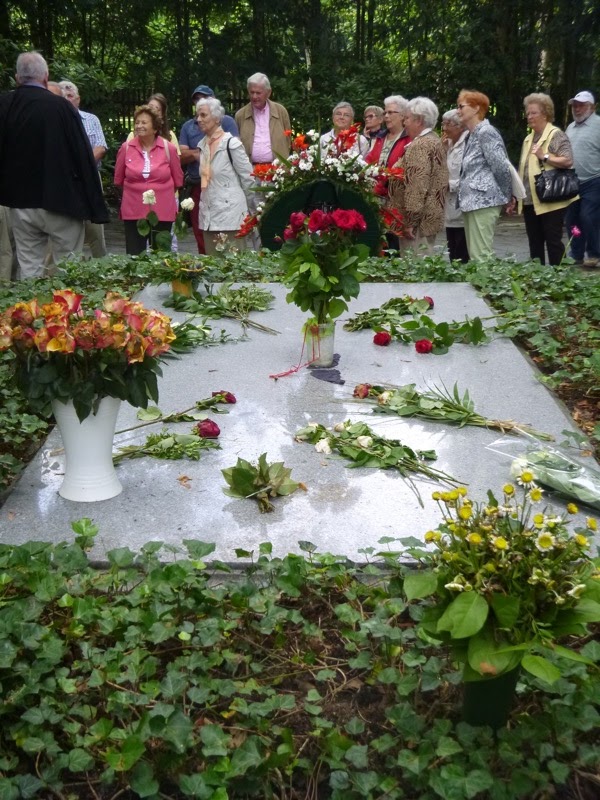
Wagner's grave is behind the house & has easy access, though.

Wagner's dog Russ is buried there too.

The Hofgarten which runs behind the house is tranquil & a good place for quiet walks between performances.

Sunday, August 18, 2013

Siegfried

Saturday evening I attended the Bayreuth Festival's new Siegfried. In a direct steal from Francesca Zambello's staging of The Ring for San Francisco Opera, Mime & Siegfried live in an Airstream, here parked beneath giant stone heads of Marx, Lenin, Stalin & Mao. Siegfried has no bear but instead has the motel attendant from Rheingold tied to the end of a rope. In act 2 the enormous set rotates to reveal the world clock & subway station at Alexanderplatz. As in the previous operas, we also saw live & pre-taped video segments.

Director Frank Castorf's staging is busy & never boring, but it is also willfully incompetent & has almost nothing to do with the libretto. Inane antics in act 3 included Wotan & Erda sharing a spaghetti dinner, Wotan receiving a blow job from a prostitute, Siegfried & Brünnhilde leaving the stage during their love scene, & crocodiles crawling on stage & humping. In act 2 Siegfried kills Fafner with an AK-47, & the sound of the machine gun fire caused someone in the audience to scream. A notice was posted at the theater assuring the audience that the sound effect would not affect their hearing. Basically Mr. Castorf is punking the festival & has embarrassed its directors, Katharina Wagner & Eva Wagner-Pasquier.

Tenor Lance Ryan as Siegfried sometimes made a bright, ringing sound & at other times sounded wobbly or squeezed. He moved actively on stage & never tired. Tenor Burkhard Ulrich acted the role of Mime more than sang it & gave an enthusiastic & animated performance. Bass-baritone Wolfgang Koch as The Wanderer sang with expressiveness & authority, even though the production had him looking like a seedy clown. Bass-baritone Sorin Coliban was fittingly heavy & gruff as Fafner. He never appeared in the form of a dragon, though a crocodile was onstage for part of his scene. Bass-baritone Martin Winkler was an impassioned & snarling Alberich.

Soprano Mirella Hagen indeed sounded warbly & bird-like as the Forest Bird. She was onstage in act 2 looking like a cross between a Vegas show girl & a Hopi Indian. She returned in act 3, only to be swallowed by a crocodile. Her costume was ungainly, & during her curtain calls she nearly knocked Alberich over & had to shuffle sideways to get offstage. Mezzo Nadine Weissmann had a soft & sultry voice as Erda. I really enjoyed soprano Catherine Foster's lissom, warm, & pretty voice for Brünnhilde. Her singing fit the act 3 music beautifully.

The orchestra under Kirill Petrenko continues to sound great, playing with suppleness & agility. The strings & harp sounded gorgeous in the music depicting Brünnhilde's awakening. Somehow it seemed like the horn soloist in act 2 was not playing the right notes. There were boos for each act, & at the end the audience unanimously directed loud boos & whistles at the production. The principals took curtain calls after each act, & their performances were applauded appreciatively, though Mr. Ryan received a few boos. The final curtain call lasted 5 minutes.

Since this staging had no bear, I was grateful that Die Oper Tratscherin attended in this bear-inspired ensemble. Since it also happened to be my birthday, we ate fancy appetizers & desserts in the Festspielrestaurant.

§ Siegfried
Bayreuther Festspiele 2013

Musikalische Leitung, Kirill Petrenko
Regie, Frank Castorf
Bühnenbild, Aleksandar Denić
Kostüme, Adriana Braga Peretzki
Licht, Rainer Casper
Video, Andreas Deinert & Jens Crull

Siegfried, Lance Ryan
Mime, Burkhard Ulrich
Der Wanderer, Wolfgang Koch
Alberich, Martin Winkler
Fafner, Sorin Coliban
Erda, Nadine Weissmann
Brünnhilde, Catherine Foster
Waldvogel, Mirella Hagen


Samstag, 17. August, 16:00 Uhr

Saturday, August 17, 2013

Das Festspielhaus

The real reason to hear a performance in the Festspielhaus is the unique acoustic which bounces the orchestra's sound onto the stage & then into the auditorium. The sound seems to emerge from middair on the stage, & it has a palpable, 3-dimensional presence. This is particularly effective for The Ring, & there are startling moments when the motives ring out from over the singers' heads. The orchestral texture is transparent, vivid & clear.

The proscenium has a strange shape, squarish & tall.

The discomfort in the hall is extreme. The audience is packed as closely as possible. The seats are usually directly in front of one another instead of being staggered.

These 2 wooden slats are all you get for a seat, which is why Bayreuth veterans, like the Opera Tattler here, arrive with their own seat cushions. There's no climate control, so it can be swelteringly hot inside. So far this summer we've been lucky. It's been generally cool, & I'm truly grateful.

Performances start at 4p for 3 act operas. Intermissions last about an hour, so most performances finish before 10p. One-act operas begin at 6p. The theater has no lobby, so the audience promenades outside the building & in surrounding parks during the breaks.

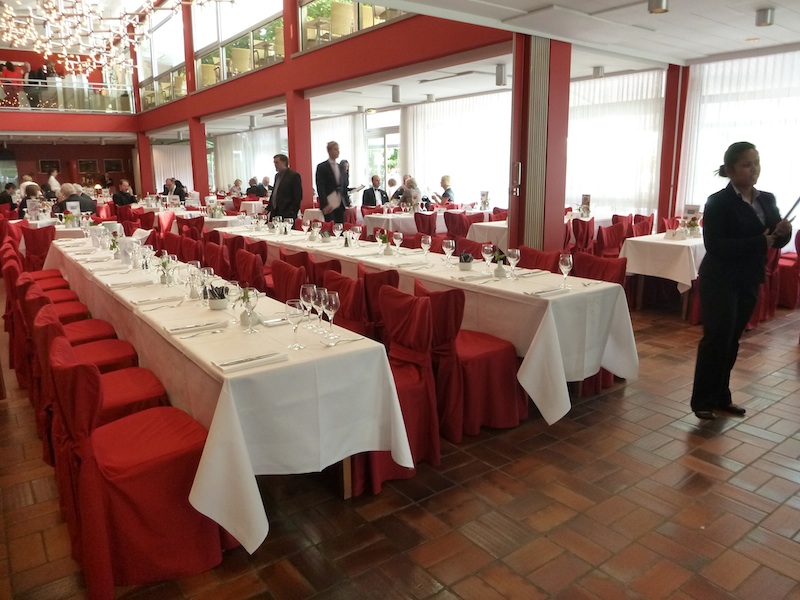
For the full experience you eat at the ridiculously fancy restaurant next to the theater, where you order in advance for each intermission & receive your food timed to the performance.

Many attendees spend the intermissions reading the libretto. The Opera Tattler has a very cool one in the form of an old book from around 1912. Relevant motives are listed in the margins of the text, keyed to musical examples on tipped-in pages that fold out so you can look at the music without having to flip pages.

Bamberg

Friday there was no Ring opera, so I took a day trip to nearby Bamberg with Die Oper Tatlerin. Bamberg is a picturesque town with well-preserved buildings going back to the Medieval period. The cute streets lined with tall buildings made me feel I was in Disneyland.

Die Oper Tatlerin only wanted to see the botanical paintings at the Kloster St. Michael, but we climbed the Michaelsberg only to discover that it was of course closed due to construction. The city's famous Dom was open but covered with scaffolding as well.

Klein Venedig looks nothing like Venice, but the view, which includes swans, is charming.

Midget Wagner followed us to Bamberg. Die Tatlerin cannily tried to lose me on the return train to Bayreuth by leading me onto the wrong carriage, where I got stuck behind a girl with ungainly luggage. Half the residents of our hotel seemed to be on the train as well.

Die Walküre

Thursday night I attended the Bayreuth Festival's new staging of Die Walküre by Frank Castorf. The opera is set at an oil well in a remote area of the Soviet Union. The huge unit set has multitple levels & includes a cavernous shed & a tall tower for the oil drill. The staging is unrelated to the previous night's Rheingold, except that again the entire set rotates, & videos are projected on the set. In act 1, a live video feed shows in cartoonish detail how Sieglinde goes about drugging Hunding's drink.


Mr. Castorf's staging is lazy or just unfinished. It's fragmentary, disregards the libretto & has no internal consistency. Though most of the characters look Russian, Fricka is dressed as a Central Asian princess. Act 1 confusingly takes place outdoors. During the end of the act, we see a film of Erda eating a whole cake with her hands, answering the telephone, resting the receiver on the cake, then sloppily putting on a dress. Sieglinde & Siegmund don't run away but simply go into the shed. Wotan has a long beard in act 2 but none in act 3. In act 3 an oil derrick emerges from the shed, extends threateningly over the lip of the stage & starts pumping up & down. After a few minutes it's withdrawn, all for no apparent reason. There was real fire on stage for the closing moments, but coming from a giant oil barrel that was nowhere near the sleeping Brünnhilde.

The singing was uniformly fine. Tenor Johan Botha sang a lyrical Siegmund, & his high notes were bright & secure & had a nice tension. Soprano Anja Kampe sounded strong yet sweet as Sieglinde, & she went full out for her "Du hehrstes Wunder!" Bass Franz-Josef Selig was a gentlemanly & cultivated Hunding, who enters wearing a stove pipe hat. Soprano Catherine Foster as Brünnhilde has a light & pretty voice which is easy to listen to. Bass-baritone Wolfgang Koch sang Wotan with a focused voice & a wide dynamic range, but the staging was so static that his act 2 monologue was a bore & did not establish any sort of relationship with father & daughter. Brünnhilde went about a bunch of distracting stage business instead of listening to him. Mezzo Claudia Mahnke sang with fluidity & was a sympathetic Fricka.

Kirill Petrenko's conducting continues to be pleasingly light-footed & springy. The orchestra sounds great, & its clarity is astounding. The valkyries are on multiple levels of the set for the opening of act 3, & this is probably the most airy & transparent Ride of the Valkyries I'll ever hear. There were curtain calls for the principals after each act, & the final curtain call ran just under 10 minutes. The audience stomped their feet especially for Ms. Kampe, who looked grateful.

Die Oper Tatlerin wore this festive outfit to the Festspielhaus this evening, & many people photographed her surreptitiously, though she was perfectly happy to pose when a nice woman asked to take her picture at the end of the performance.

§ Die Walküre
Bayreuther Festspeiele 2013

Conductor, Kirill Petrenko
Director, Frank Castorf
Stage design, Aleksandar Denić
Costumes, Adriana Braga Peretzki
Lighting, Rainer Casper
Video, Andreas Deinert & Jens Crull

Siegmund, Johan Botha
Hunding, Franz-Josef Selig
Wotan, Wolfgang Koch
Sieglinde, Anja Kampe
Brünnhilde, Catherine Foster
Fricka, Claudia Mahnke
Gerhilde, Allison Oakes
Ortlinde, Dara Hobbs
Waltraute, Claudia Mahnke
Schwertleite, Nadine Weissmann
Helmwige, Christiane Kohl
Siegrune, Julia Rutigliano
Grimgerde, Geneviève King
Rossweisse, Alexandra Petersamer

Thursday 15. August, 04:00 PM

Friday, August 16, 2013

Das Rheingold

Though I'd sat through 3 Wagner operas this week already, they were just the warm-up for Wednesday evening, the 1st night of Bayreuth's new Ring staged by Frank Castorf. The opera has an impressive, hyper-realistic set that represents a motel, gas station & soda fountain on Route 66 in Texas. The characters seem drawn from American movies & TV, but there is no story arc, & the action is fragmentary & unrelated to what the characters are singing. The Rheinmaidens are 3 floozies hanging around the pool, their underwear hanging out to dry. Alberich behaves like a child, squirting mustard on himself & taking a shower while eating a long sausage. The Nibelheim scene begins with Alberich & Mime tied to poles & being humiliated by Wotan & Loge & is particularly unrelated to the text. There are no Nibelungen. The staging includes several mute characters, including an unfortunate man who does all the jobs around the motel. Occasionally something fit the libretto. I like that the giants, 2 thugs, are completely differentiated characters. Fafner kills Fasolt by clubbing him with a gold bar. When Erda emerges out of a door in Wotan's motel room, Fricka jealously runs into the room to check out this new woman.

I was more engaged by the mechanics of the production. The entire set rotates & works from all sides. A car drives up to the gas pump, & later an Airstream is placed on stage to represent the home of Mime & Alberich. A video screen atop the set, rotating independently, shows a live feed of the action, shot by multiple videographers on stage with the singers. This allows us to see closeups & things taking place out of our sight. Alberich's transformations are lamely handled by video cuts. Perhaps Mr. Castorf wanted to make a Quentin Tarentino movie instead.

The entire cast gave committed & convincing acting performances. I liked the offhandedness & naturalism of tenor Norbert Ernst's Loge, as well as his easy delivery. Tenor Burkhard Ulrich was an animated & strangely endearing Mime. When Alberich is captured, Mime lovingly caresses the Airstream that is now his & then lowers the Texas flag on a nearby flagpole & replaces it with a rainbow flag. Bass Günther Groissböck sung Fasolt expressively & with a virile sound. Bass-baritone Sorin Coliban as Fafner had a deep, strong voice, but his painted-on beard did not stand up to the scrutiny of the video cameras.

Bass-baritone Wolfgang Koch sang Wotan with authority, focus & a nice dynamic range, but the staging unfortunately gives his character no where to develop. Bass-baritone Martin Winkler sounded gruff & grounded as Alberich. As Fricka, mezzo Claudia Mahnke made an attractive & connected sound. The Freia of soprano Elisabet Strid was fearful & intense. Mezzo Nadine Weissmann's Erda was surprisingly airy & sultry.

The festival orchestra sounded great under conductor Kirill Petrenko, who led a springy, even light, performance. The orchestral sound has a physical presence in the Festspielhaus, & it was stunning to hear the high violin solo for Freia seem to materialize onstage. The harps sounded like they were being plucked right in front of my face, & I could not figure out where the voices of the off-stage Rheinmaidens were coming from. There were only a few token boos when the curtain came down, & the audience applauded enthusiastically, stomping their feet particularly for Mr. Groissböck, Mr. Winkler & Maestro Petrenko. The curtain calls ran 10 minutes.

Die Oper Tatlerin wore a marine-themed outfit for the evening & had to contend with an uptight German who mistakenly thought she was in his seat.

§ Das Rheingold
Bayreuther Festspiele2013

Conductor, Kirill Petrenko
Director, Frank Castorf
Stage design, Aleksandar Denić
Costumes, Adriana Braga Peretzki
Lighting, Rainer Casper
Video, Andreas Deinert & Jens Crull

Wotan, Wolfgang Koch
Donner, Oleksandr Pushniak
Froh, Lothar Odinius
Loge, Norbert Ernst
Fricka, Claudia Mahnke
Freia, Elisabet Strid
Erda, Nadine Weissmann
Alberich, Martin Winkler
Mime, Burkhard Ulrich
Fasolt, Günther Groissböck
Fafner, Sorin Coliban
Woglinde, Mirella Hagen
Wellgunde, Julia Rutigliano
Floßhilde, Okka von der Damerau

Wednesday 14. August, 06:00 PM

Wednesday, August 14, 2013

Der fliegende Holländer

Tuesday evening I attended the Bayreuth Festival performance of Die fliegende Holländer. The production recasts the characters as employees of Daland's electric fan company. The act 1 set is dark, with high walls covered with Tron-like flashing lights. Daland & his steersman, dressed as traveling salesmen, sleep in a tiny row boat, though this turns out to be the staging's only nod to the original setting. In a nice transition, the walls move aside, & the chorus of sailors, dressed identically as more businessmen, come from the back & progress the full depth of the stage to the lip. Behind them comes a huge curtain, which they later pull down to reveal the female chorus, packaging fans in Daland's factory. Mary is a corporate manager & Erik a lowly maintenance man whom the women make fun of as he goes about his duties.

Bass Franz-Josef Selig was a comical Daland, his gestures communicating a self-assured corporate personality. Tenor Benjamin Bruns was a similarly good actor, playing the Steersman as Daland's yes-man & leading the male chorus in a jolly company sing-along in act 3. Bass-baritone Samuel Youn has an engaging stage presence & flexible voice & was a young & genial Dutchman. Soprano Ricarda Merbeth was an outgoing, happy Senta. Her singing was forceful & her high notes loud but perhaps pitchless. This Dutchman & Senta looked & behaved like a young romantic couple & were mutually joyful when they discovered they would die together. Tenor Tomislav Muzek was a sympathetic Erik. His voice was high, clear & clean.

All the choral numbers had lively choreography, & the chorus was terrific, sounding unified & spirited & moving together like dancers. They were perhaps the real stars of the show. There was a spectacular use of fire when the Dutchman's sailors appear in act 3. The curtain seems to come down prematurely at the end but then rises to reveal a cynical epilogue in which the lovers' final gesture is turned into a kitschy commodity.

Conductor Christian Theilemann made his presence known from the 1st sharp attack of the overture. He led a taut, powerfully controlled performance. Even though in a covered pit, the orchestra's sound was dominant. It was unreal hearing the harp coming from a space in the air on the left of the stage. The woodwinds & cellos also sounded amazingly vivid. The audience responded enthusiastically & stamped their feet especially for the chorus, Mr. Youn & Maestro Theilemann, though a single detractor booed both Mr. Youn & Ms. Merbeth. The ovation ran about 10 minutes.

Die Oper Tatlerin's Dutch-themed attire for the performance included a dress adorned with a tulip design, though she forgot her seat cushion.

§ Der fliegende Holländer
Bayreuther Festspiele 2013

Conductor, Christian Thielemann
Director, Jan Philipp Gloger
Stage design, Christof Hetzer
Costumes, Karin Jud
Lighting, Urs Schönebaum
Video, Martin Eidenberger
Dramaturgy, Sophie Becker
Choral Conducting, Eberhard Friedrich

Daland, Franz-Josef Selig
Senta, Ricarda Merbeth
Erik, Tomislav Muzek
Mary, Christa Mayer
Der Steuermann, Benjamin Bruns
Der Holländer, Samuel Youn

Tuesday 13. August, 06:00 PM