I dropped into the Books Inc. on Market Street (formerly A Clean Well-Lighted Place for Books) for the advertised "Book Launch Party" for Tom Dolby's new novel The Sixth Form. I actually had read his first novel, The Trouble Boy. This first book totally fed into my fantasies about living & working in New York, though the world it describes is totally different from the kind of life I would imagine for myself.
Anyway, Dolby knows how to throw a book party. I snagged a generous glass of white wine & ate some hors d'oeuvres. & since he is the son of local rich guy Ray Dolby, I was in very prosperous company for about an hour. It reminded me very much of the crowd round the bar at Davies Hall just before a performance.
Tuesday, January 29, 2008


Thursday, January 24, 2008
Sudhir Venkatesh at Stacey's
I spent part of my lunch at Stacey's Bookstore & saw Sundhir Venkatesh talk about his new book Gang Leader for a Day. He's a sociology professor who's written a couple of books about a 5 year period he spent hanging out with a street gang in a Chicago housing project. He had a lot of interesting things to say. To
him, the underground economy he was studying is a real "free market". There's no enforceable contracts, government regulations or corporate bailouts. It's actually rational for his subjects not to plan for the future. There are a lot of angles to what he's doing. He has a quiet but strong physical presence. I wished the event were longer so that he could talk more.
him, the underground economy he was studying is a real "free market". There's no enforceable contracts, government regulations or corporate bailouts. It's actually rational for his subjects not to plan for the future. There are a lot of angles to what he's doing. He has a quiet but strong physical presence. I wished the event were longer so that he could talk more.
Wednesday, January 16, 2008
Thin is In; Science is a Bust
I got an exhibits pass for the MacWorld Expo at Moscone Center just so I could handle the absurdly thin MacBook Air. Yet another object of desire from Apple. It's very light, & the edges taper, making it seem even sleeker. Its lack of an optical drive would seem to limit its practicality, but I think this is the way of the future. No need for CDs or DVDs; everything is available from the cloud. With the Time Capsule backup appliance, you even backup wirelessly.
After the show, I took Muni out to Potrero Hill, hoping to check out the Ask a Scientist event at the Axis Cafe. However, even though I got there a good 20 minutes before the official start of the event, the place was already turning into a zoo. Clearly, all the seats had been staked out way ahead of time. People were standing around 2 or 3 deep, the line for food & drinks was out the door, & more people were continuing to arrive. I decided to bail on this one, even though I think the concept is excellent.
After the show, I took Muni out to Potrero Hill, hoping to check out the Ask a Scientist event at the Axis Cafe. However, even though I got there a good 20 minutes before the official start of the event, the place was already turning into a zoo. Clearly, all the seats had been staked out way ahead of time. People were standing around 2 or 3 deep, the line for food & drinks was out the door, & more people were continuing to arrive. I decided to bail on this one, even though I think the concept is excellent.
Sunday, December 30, 2007
Best of 2007
Looking back on the past year, here's the stuff that I would have really regretted missing: First & foremost would be the production of Intimate Exchanges at the Brits Off Broadway festival in New York. I read about this wacky multiple-paths play many years ago, but I never thought that I'd actually get an opportunity to see it. Gustavo Dudamel & The Simón Bolívar Youth Orchestra of Venezuela lived up to the hype & then some. I could have seen The Simpsons Movie any time & now on DVD, but seeing it with an opening night audience made it a true event. & exciting for me personally was going to Berkeley to see Alex Ross & have him sign my copy of his much-anticipated book.
I felt very fortunate that the SF MOMA had the comprehensive Joseph Cornell exhibit. I'm now at a new level of appreciation for this reticent artist. I was also very glad to see & hear 2 of my favorite performers, Radu Lupu & Emmanual Pahud, in top form. Then there was Susan Graham's powerful performance in Iphigénie. I got introduced to 2 performers new to me & whom I look forward to hearing again: András Schiff & Marino Formenti.
& since we're still sort of in the holiday mood, I have to say that I still grin when I think about Mark Morris's dancing snowflakes.
I felt very fortunate that the SF MOMA had the comprehensive Joseph Cornell exhibit. I'm now at a new level of appreciation for this reticent artist. I was also very glad to see & hear 2 of my favorite performers, Radu Lupu & Emmanual Pahud, in top form. Then there was Susan Graham's powerful performance in Iphigénie. I got introduced to 2 performers new to me & whom I look forward to hearing again: András Schiff & Marino Formenti.
& since we're still sort of in the holiday mood, I have to say that I still grin when I think about Mark Morris's dancing snowflakes.
Wednesday, December 19, 2007
SF Opera at the Movies
SF Opera is going to be following the Met into movie theaters: S.F. Opera productions headed to movie screens
Tuesday, December 18, 2007
The Hard Nut
Every year at this time, I read rave reviews about Mark Morris's version of The Nutcracker ballet. It's been a regular event at Cal Performances for several years now. So this year I finally broke down & decided to check it out this past Saturday night.
When you go the SF Ballet's Nutcracker, there are lots of parents with little girls all dressed up. I didn't see any children at this performance, but there must be have been some. There were plenty of restless adults, however. It took the audience quite a while to settle down. During the overture, there was lots of talking & lots of sushing. The woman next to me started yawning as soon as the lights went down, then snored intermittently during the entire 1st act. Surprisingly, she came back for the 2nd act. I guess she had rested up by then.
The production reminds me of the Matthew Bourne versions of classic ballets that I've seen. The music is intact, but the action has been replaced by a modern story that still references the original scenario. There is a strong sense of parody. The Christmas party of the 1st scene takes place in a comic strip version of the 1960s. The opening image is of kids watching cartoons on TV. There's an artificial tree, a hostess on tranquillizers & guests doing the limbo.
The party scene is more acting then dancing, & there is more going on than you can follow. The dancers are all great actors as well. One of the guests was a hilarious would-be lothario with curly hair & long sideburns. I discovered in a review I read later that this was Mark Morris himself.
The Dance of the Snow Flakes that ends the 1st act is the highlight of the show & worth the price of admission by itself. Instead of ballerinas doing wispy pirouettes while fake snow wafts down from the rafters, the corps de ballet provides its own snow storm by tossing handfuls of confetti in choreographed patterns while executing athletic leaps. The result is like a fireworks show. I actually let out a whoop at the climax. It's such a clever idea that you wonder why no one has ever done this before.
This number is choreographed for both male & female dancers, dressed identically & doing the same steps. This exemplified the gender-fluid casting of the show in general. It was only during the intermission that I finally convinced myself that Mrs. Stahlbaum was danced by a man. The female dancer playing the spoiled little brother was also completely convincing.
A truly nice touch was the children's choir that appeared at the side of the stage for the Dance of Snow Flakes to provide the vocal line. I believe that even the SF Ballet uses recorded voices for this.
This finale was so good that during the intermission I was pretty much expecting that the rest of the evening would be a let-down. Fortunately, the 2nd act has a counterpart in the Waltz of the Flowers that was equally fun & joyful, as well as a little bit obscene. Now I know what all the raves are about.
When you go the SF Ballet's Nutcracker, there are lots of parents with little girls all dressed up. I didn't see any children at this performance, but there must be have been some. There were plenty of restless adults, however. It took the audience quite a while to settle down. During the overture, there was lots of talking & lots of sushing. The woman next to me started yawning as soon as the lights went down, then snored intermittently during the entire 1st act. Surprisingly, she came back for the 2nd act. I guess she had rested up by then.
The production reminds me of the Matthew Bourne versions of classic ballets that I've seen. The music is intact, but the action has been replaced by a modern story that still references the original scenario. There is a strong sense of parody. The Christmas party of the 1st scene takes place in a comic strip version of the 1960s. The opening image is of kids watching cartoons on TV. There's an artificial tree, a hostess on tranquillizers & guests doing the limbo.
The party scene is more acting then dancing, & there is more going on than you can follow. The dancers are all great actors as well. One of the guests was a hilarious would-be lothario with curly hair & long sideburns. I discovered in a review I read later that this was Mark Morris himself.
The Dance of the Snow Flakes that ends the 1st act is the highlight of the show & worth the price of admission by itself. Instead of ballerinas doing wispy pirouettes while fake snow wafts down from the rafters, the corps de ballet provides its own snow storm by tossing handfuls of confetti in choreographed patterns while executing athletic leaps. The result is like a fireworks show. I actually let out a whoop at the climax. It's such a clever idea that you wonder why no one has ever done this before.
This number is choreographed for both male & female dancers, dressed identically & doing the same steps. This exemplified the gender-fluid casting of the show in general. It was only during the intermission that I finally convinced myself that Mrs. Stahlbaum was danced by a man. The female dancer playing the spoiled little brother was also completely convincing.
A truly nice touch was the children's choir that appeared at the side of the stage for the Dance of Snow Flakes to provide the vocal line. I believe that even the SF Ballet uses recorded voices for this.
This finale was so good that during the intermission I was pretty much expecting that the rest of the evening would be a let-down. Fortunately, the 2nd act has a counterpart in the Waltz of the Flowers that was equally fun & joyful, as well as a little bit obscene. Now I know what all the raves are about.
Friday, December 14, 2007
Persepolis Preview at the Kabuki
Wednesday night I was privileged to attend a special San Francisco Film Society screening of Persepolis. A big part of the event was the chance to check out the remodeled Kabuki Theater. It's actually pretty much the same, except that there are now fancy bars on the 2nd & 3rd floors. On the 3rd floor, there is just barely a view of the city lights over the rooftops of the neighboring buildings. I guess the idea is that you can see a movie then adjourn to the bar with your friends to discuss it. It's not clear to me if you have to buy a movie ticket in order to get into the bars, though.
The event was sold out, so naturally the bar was completely overwhelmed. It took a really long time for me to get a glass of Spanish red wine, for which they charged me $6. Not unreasonable.
Before the screening, there was a brief on-stage interview with Marjane Satrapi & Vincent Paronnaud, the directors. The movie is based on Satrapi's Persepolis memoir. Satrapi's appearance was the highlight of the evening. She is a very smart & a very funny woman. There was a comic opposition between her outgoing, out-spoken personality & her co-director's reserved & silent demeanor. Among the concepts she threw out in her answers to questions:
The event was sold out, so naturally the bar was completely overwhelmed. It took a really long time for me to get a glass of Spanish red wine, for which they charged me $6. Not unreasonable.
Before the screening, there was a brief on-stage interview with Marjane Satrapi & Vincent Paronnaud, the directors. The movie is based on Satrapi's Persepolis memoir. Satrapi's appearance was the highlight of the evening. She is a very smart & a very funny woman. There was a comic opposition between her outgoing, out-spoken personality & her co-director's reserved & silent demeanor. Among the concepts she threw out in her answers to questions:
- She dislikes the label "graphic novel" to describe her books, "novel" being a far too bourgeois art form.
- We usually stop drawing by the time we're 10, so we think of drawing as something that belongs to childhood. We can talk about how poetry or music has meaning, but we have no way of talking about how a drawing has meaning. Yet drawing is prior to writing.
- When we think of animation, we tend to think of cartoon rabbits, but animation is not a genre, it's a medium.
- Fanatics know how to push the buttons of people's emotions. They get people to start yelling or be fearful. Any artistic work (which is about asking questions, not providing answers) or intellectual work, therefore, is a work against fanaticism.
- When asked how she had the courage to tell this story, she said that Italo Calinvo says, "I write to express myself without getting interrupted."
Sunday, December 09, 2007
The Great Dictator at the PFA
I'm going to miss the Castro's screening of Chaplin's The Great Dictator this coming Wednesday, but I really wanted to see it, so I went to Berkeley this afternoon for the showing at the PFA. The 1st time I saw this movie many years ago, I enjoyed it much more than I expected to, so I wanted to see if my reaction was still the same, & it pretty much was. Much of the movie is dated & a bit embarrassing now, primarily the scenes with Paulette Godard, & especially the final close-up of her which caps Chaplin's anti-climactic oration.
On the other hand, I think all the funny parts are still really funny. Of course there are the famous back-to-back set pieces of Chaplin dancing with the balloon earth, followed by Chaplin as the barber shaving his customer to Brahms's Hungarian Rhapsody. But right at the start, the opening battle scene is full of great gags: Chaplin's Little Fellow operating a giant cannon & an anti-aircraft gun, then losing an armed grenade down his shirt-sleeve, finally ending up flying upside-down in the cockpit of a crashing plane. Chaplin's first appearance as Hynkel, delivering his faux-German speech, is worth half the price of admission already.
There's plenty of classic slapstick humor at the expense of Hitler & Mussolini, which is funny it itself, though I sometimes have to remind myself that at the time the full horrors of the war were not yet widely known. It is interesting, though, that the movie is very explicit in stating that Hitler's anti-Jewish rhetoric was a way to distract the general population from economic problems.
The turnout at the FPA was not as large as I would have thought. The theater was perhaps a 3rd full. But we were a good audience & laughed at all the right places & were politely quiet through the worst bits.
On the other hand, I think all the funny parts are still really funny. Of course there are the famous back-to-back set pieces of Chaplin dancing with the balloon earth, followed by Chaplin as the barber shaving his customer to Brahms's Hungarian Rhapsody. But right at the start, the opening battle scene is full of great gags: Chaplin's Little Fellow operating a giant cannon & an anti-aircraft gun, then losing an armed grenade down his shirt-sleeve, finally ending up flying upside-down in the cockpit of a crashing plane. Chaplin's first appearance as Hynkel, delivering his faux-German speech, is worth half the price of admission already.
There's plenty of classic slapstick humor at the expense of Hitler & Mussolini, which is funny it itself, though I sometimes have to remind myself that at the time the full horrors of the war were not yet widely known. It is interesting, though, that the movie is very explicit in stating that Hitler's anti-Jewish rhetoric was a way to distract the general population from economic problems.
The turnout at the FPA was not as large as I would have thought. The theater was perhaps a 3rd full. But we were a good audience & laughed at all the right places & were politely quiet through the worst bits.
Saturday, December 08, 2007
Justin Hall at the Cartoon Art Museum
I dropped into the Cartoon Art Museum again to see the local phenomenon that is Justin Hall, who was "cartoonist-in-residence" today. I'm still a bit unclear on the concept, but I'm sure that Justin is just the man for the job. He loves to share his knowledge of comics, & he's a guy who can talk with anyone.
Manga Conquers America
Thursday night the Cartoon Art Museum sponsored a talk by Jason Thompson on the publishing history of manga in the U.S. It was a promotional event for his book Manga: The Complete Guide.
The talk got started a half-hour late, & the museum staff was unable to get the speaker's laptop to work with their projector, so Mr. Thompson resorted to flashing his slides at us from this laptop. This technical snafu made the event a bit lame.
Mr. Thompson had quite a long, fact-filled talk. It ran to almost an hour & a half. I'm not a manga reader myself, so this was really too much information for me. However, Mr. Thompson clearly has complete command of his subject area. If the book parallels this talk, then it has some interesting commentary on the manga publishing industry.
This is not to imply that the talk was boring. The history of manga publishing is apparently filled with characters at the margins of social trends. We heard about furries, new age hippies, & adult-movie stars who also draw. I learned that Barefoot Gen, which I've read & admired, was the 1st manga translated into English. It was put out by an anti-war group, not by a comic or manga publisher.
In Thompson's view, the practice of printing manga unflopped, in the right-to-left reading order of Japanese, is more a matter of reducing production costs than preserving artistic integrity.
There was a small group of about 20 who showed up for this event. Many of them seemed to be associates of the speaker. There were also a lot of touchy-feely couples, so maybe this was also your classic cheap date.
The talk got started a half-hour late, & the museum staff was unable to get the speaker's laptop to work with their projector, so Mr. Thompson resorted to flashing his slides at us from this laptop. This technical snafu made the event a bit lame.
Mr. Thompson had quite a long, fact-filled talk. It ran to almost an hour & a half. I'm not a manga reader myself, so this was really too much information for me. However, Mr. Thompson clearly has complete command of his subject area. If the book parallels this talk, then it has some interesting commentary on the manga publishing industry.
This is not to imply that the talk was boring. The history of manga publishing is apparently filled with characters at the margins of social trends. We heard about furries, new age hippies, & adult-movie stars who also draw. I learned that Barefoot Gen, which I've read & admired, was the 1st manga translated into English. It was put out by an anti-war group, not by a comic or manga publisher.
In Thompson's view, the practice of printing manga unflopped, in the right-to-left reading order of Japanese, is more a matter of reducing production costs than preserving artistic integrity.
There was a small group of about 20 who showed up for this event. Many of them seemed to be associates of the speaker. There were also a lot of touchy-feely couples, so maybe this was also your classic cheap date.
Friday, December 07, 2007
Berlioz at the SF Symphony
Berlioz Lélio
Berlioz Symphonie fantastique
Michael Tilson Thomas, conductor
Stanford Olsen, tenor 1
Shawn Mathey, tenor 2
Dwayne Croft, baritone
SFS Chorus
Went to this concert Wednesday night, solely for Lélio, which I had never heard before. Even though Berlioz billed this as a sequel to the Symphonie fantastique, it was programmed first, probably because it is a lighter work overall. In fact, it felt more like a collection of 6 separate pieces rather than a large cohesive work. No matter. The individual pieces were each satisfying on their own.
It starts off charmingly with a tenor soloist accompanied only by the piano. We could be in a 19th century salon. Later, the strings come in with the idée fixe from the Symphonie fantastique, making the linkage explicit. It is a sweet-sounding but sinister song about a siren. Stanford Olsen sang this from within the orchestra, standing next to the piano. The tessitura is pretty high, but I think he hit every note.
Varied movements follow: An eerie chorus; a wild brigands' song; another tenor sings from within the orchestra, this time with harp accompaniment; an orchestral interlude; a choral fantasy, minus bass voices, addressing characters from Shakespeare's The Tempest. It's definitely a mashup, but each piece kept my interest.
There was a sense of uncertainty to the proceedings, as if the performers weren't always sure what was going to happen next. At one point the chorus took several moments to reach a consensus as to whether they were going to sit or stand.
The confusion carried out into the intermission. When I emerged from the auditorium, I was sorely disappointed to discover that none of the reserved drink orders, mine included, had been prepared yet. The harried bartender apologized, explaining that he had been told we weren't going to be let out until 9:00. The short first half let out around 8:45.
The performance of the Symphonie fantastique occupying the 2nd half was recorded live as part of the Keeping Score series. Perhaps 10 cameras were stationed around the orchestra. A long boom camera extended from the terrace directly over the orchestra. Most notable were 2 robotic cameras, one on a vertical stand at the back of the orchestra & the other on a track running along the front of the stage. This one could go back & forth & also rise up to the eye level of the musicians.
During the performance there was plenty of distracting movement from all these devices, though it was also kind of cool to watch. It was clear that there were going to be a lot of motion shots in the finished broadcast. It must be especially difficult for the musicians to pretend to ignore the cameras. The robotic camera in front could maneuver itself to within a couple of feet of a musician's head.
Under this scrutiny, the orchestra sounded like a completely different band in the 2nd half. It was obviously well-rehearsed, & everyone knew exactly what was going to happen next. The sound was brilliant & concise. There was a lot of detail. The bassoon solo in the 4th movement really popped out. I was also impressed by the strong flute solos. They captured a clean performance with a lot of surface sheen.
Berlioz Symphonie fantastique
Michael Tilson Thomas, conductor
Stanford Olsen, tenor 1
Shawn Mathey, tenor 2
Dwayne Croft, baritone
SFS Chorus
Went to this concert Wednesday night, solely for Lélio, which I had never heard before. Even though Berlioz billed this as a sequel to the Symphonie fantastique, it was programmed first, probably because it is a lighter work overall. In fact, it felt more like a collection of 6 separate pieces rather than a large cohesive work. No matter. The individual pieces were each satisfying on their own.
It starts off charmingly with a tenor soloist accompanied only by the piano. We could be in a 19th century salon. Later, the strings come in with the idée fixe from the Symphonie fantastique, making the linkage explicit. It is a sweet-sounding but sinister song about a siren. Stanford Olsen sang this from within the orchestra, standing next to the piano. The tessitura is pretty high, but I think he hit every note.
Varied movements follow: An eerie chorus; a wild brigands' song; another tenor sings from within the orchestra, this time with harp accompaniment; an orchestral interlude; a choral fantasy, minus bass voices, addressing characters from Shakespeare's The Tempest. It's definitely a mashup, but each piece kept my interest.
There was a sense of uncertainty to the proceedings, as if the performers weren't always sure what was going to happen next. At one point the chorus took several moments to reach a consensus as to whether they were going to sit or stand.
The confusion carried out into the intermission. When I emerged from the auditorium, I was sorely disappointed to discover that none of the reserved drink orders, mine included, had been prepared yet. The harried bartender apologized, explaining that he had been told we weren't going to be let out until 9:00. The short first half let out around 8:45.
The performance of the Symphonie fantastique occupying the 2nd half was recorded live as part of the Keeping Score series. Perhaps 10 cameras were stationed around the orchestra. A long boom camera extended from the terrace directly over the orchestra. Most notable were 2 robotic cameras, one on a vertical stand at the back of the orchestra & the other on a track running along the front of the stage. This one could go back & forth & also rise up to the eye level of the musicians.
During the performance there was plenty of distracting movement from all these devices, though it was also kind of cool to watch. It was clear that there were going to be a lot of motion shots in the finished broadcast. It must be especially difficult for the musicians to pretend to ignore the cameras. The robotic camera in front could maneuver itself to within a couple of feet of a musician's head.
Under this scrutiny, the orchestra sounded like a completely different band in the 2nd half. It was obviously well-rehearsed, & everyone knew exactly what was going to happen next. The sound was brilliant & concise. There was a lot of detail. The bassoon solo in the 4th movement really popped out. I was also impressed by the strong flute solos. They captured a clean performance with a lot of surface sheen.
Chaplin at the Castro
This past Tuesday night I saw 2 programs of Charlie Chaplin films at the Castro. To me, The Kid is Chaplin's first masterpiece. It's a marvel how much emotion he packs into this short film. There's an incredible cinematic moment where The Mother, on her charity rounds, sits on a stoop, cradling a baby. It's clear that she is thinking of the baby that she abandoned at the beginning of the story. Then the door opens behind her & Jackie Coogan appears & then sits down at the opposite side of the screen. At first neither character sees the other, yet each of them is the other's dream. It's a moment rooted in a physical reality, yet it also expresses each character's deep psychological desires. It's such a beautiful moment that it almost always chokes me up. One of the few movie scenes I prefer to watch alone!
I don't think I'd ever seen The Pilgram before. It was surprising that Chaplin does not appear in his Little Tramp guise through most of the movie. Lots of great stuff in this one. The church service must be a classic set piece, as well as the tea party with the incredibly obnoxious child. I recently saw the famous clip of W.C. Fields kicking a little kid, but I had no idea that Chaplin did this gag first! The ending was another terrific surprise, with Chaplin walking off into the distance while straddling the U.S./Mexico border. Politically, times haven't changed.
The final film of the evening was The Gold Rush. Again I was impressed but how many places this movie goes emotionally. It mixes the old-fashion histrionics of the Big Jim character with the realistic & somewhat cynical portrait of Georgia's flirtatious relationship with Jack. The treatment of the Little Tramp by the dance hall girls is just plain cruel. There's a fantastic cinematic moment when Chaplin first appears at the dance hall. He stands in the foreground, with his back to us, while the middle ground & the background are filled with light that shines on dancing, happy people. Visually the scene is beautiful, yet the Little Tramp's isolation is poignant by contrast. & this little scene is capped with the gag of the pretty girl walking warmly towards him, but only to get to her boyfriend behind him.
I'm a big Chaplin fan, so I was very excited to see this show & very disappointed at the sparse turn-out & the very low-key reaction of the audience. Perhaps Chaplin's brand of humanism isn't in sync with our times right now.
I don't think I'd ever seen The Pilgram before. It was surprising that Chaplin does not appear in his Little Tramp guise through most of the movie. Lots of great stuff in this one. The church service must be a classic set piece, as well as the tea party with the incredibly obnoxious child. I recently saw the famous clip of W.C. Fields kicking a little kid, but I had no idea that Chaplin did this gag first! The ending was another terrific surprise, with Chaplin walking off into the distance while straddling the U.S./Mexico border. Politically, times haven't changed.
The final film of the evening was The Gold Rush. Again I was impressed but how many places this movie goes emotionally. It mixes the old-fashion histrionics of the Big Jim character with the realistic & somewhat cynical portrait of Georgia's flirtatious relationship with Jack. The treatment of the Little Tramp by the dance hall girls is just plain cruel. There's a fantastic cinematic moment when Chaplin first appears at the dance hall. He stands in the foreground, with his back to us, while the middle ground & the background are filled with light that shines on dancing, happy people. Visually the scene is beautiful, yet the Little Tramp's isolation is poignant by contrast. & this little scene is capped with the gag of the pretty girl walking warmly towards him, but only to get to her boyfriend behind him.
I'm a big Chaplin fan, so I was very excited to see this show & very disappointed at the sparse turn-out & the very low-key reaction of the audience. Perhaps Chaplin's brand of humanism isn't in sync with our times right now.
Jeff Wall, Olafur Eliasson at SF MOMA
This past Saturday I got to go back to the SF MOMA to see the 2 exhibits I missed on my last visit. Jeff Wall's huge light box photos fill several rooms. Simply by their huge size, they reference the tradition of history painting. Most of the photos are distinctly unsettling. His scene of the grave filled with tide pool creatures is both creepy & beautiful. One gets the sense that there is a lot going on behind each image. Part of the fascination is just trying out how they are done. Is the pictures of wind blowing away a woman's papers staged or constructed?
The Olafur Eliasson installations on the top floor were still fun on a second viewing. The Notion motion, which appears to be an interactive video projection, turn out to be pleasantly low-tech once you are allowed to peek behind the curtain. In the 360º room for all colors, people were tripping themselves out by standing inches from the wall so that their entire field of vision was filled by the glowing wall of color. How can I get a room like this for myself?
The Olafur Eliasson installations on the top floor were still fun on a second viewing. The Notion motion, which appears to be an interactive video projection, turn out to be pleasantly low-tech once you are allowed to peek behind the curtain. In the 360º room for all colors, people were tripping themselves out by standing inches from the wall so that their entire field of vision was filled by the glowing wall of color. How can I get a room like this for myself?
Wednesday, November 28, 2007
Harold & Maude at the Castro
Last night I went to see the showing of the cult classic Harold & Maude at the Castro. They are doing a series of Hal Ashby films. I missed the showing of Being There that went with this one. It was a pretty big crowd for a 9:30pm show on a weeknight. The trailers for Coming Home & Shampoo got a few snickers even before the feature started.
Of course I have seen Harold & Maude before, though this was the 1st time I'd seen it in a long time. I have to say that I remembered pretty much everything. I was glad to see that the movie has aged well. It's still funny & surprising & earnest in all the right places. There's a great moment when the 1st computer date rushes shrieking from the house, & then Harold shares his reaction with the audience. This got the biggest laugh & then applause.
Those 70's clothes & the flower motif are the main things that give away the movie's era. But otherwise I'm not sure that life has really moved on all that much. We're again at war, we've still got problems with conspicuous consumption, interactions with government & bureaucracy are a drag, & some of us sensitive souls are still looking for happiness.
Of course I have seen Harold & Maude before, though this was the 1st time I'd seen it in a long time. I have to say that I remembered pretty much everything. I was glad to see that the movie has aged well. It's still funny & surprising & earnest in all the right places. There's a great moment when the 1st computer date rushes shrieking from the house, & then Harold shares his reaction with the audience. This got the biggest laugh & then applause.
Those 70's clothes & the flower motif are the main things that give away the movie's era. But otherwise I'm not sure that life has really moved on all that much. We're again at war, we've still got problems with conspicuous consumption, interactions with government & bureaucracy are a drag, & some of us sensitive souls are still looking for happiness.
Monday, November 26, 2007
LA Phil "Lite"
A friend who frequents the LA Phil sent me this published description of up-coming concerts by the LA Philharmonic. He notes that even the full-length version of the program only has 63 minutes of music. Light stuff indeed.
Los Angeles Philharmonic
Nicholas McGegan, conductor
James Galway, flute
Friday, November 30, 2007, 8pm – Casual Fridays
Mozart: Flute Concerto in D, K. 314 (c. 20 minutes)
Mozart: Andante in C for Flute, K. 315 (c. 6 minutes)
Schubert: Symphony No. 4, “Tragic” (c. 30 minutes)
Check online for the latest program information.
Thursday, November 29, 2007, 8pm
Saturday, December 1,
2007, 8pm
Sunday, December 2, 2007, 2pm
Schubert: Overture to The Conspirators (c. 7 minutes)
Mozart: Flute Concerto in D, K. 314 (c. 20 minutes)
intermission
Mozart: Andante in C for Flute, K. 315 (c. 6 minutes)
Schubert: Symphony No. 4, “Tragic” (c. 30 minutes)
Check online for the latest program information.
Don’t miss Upbeat Live (free pre-concert event) in BP Hall with Raymond Knapp, author and Musicology Professor at UCLA.
Sunday, November 25, 2007
The Silence & The Rite at The Castro
The Castro Theatre screened several Bergman classics over the past weeks. Last Tuesday I attended the double feature of The Silence & The Rite. 2 of Bergman's more challenging, films, no doubt about it! I had seen The Silence many years ago as a college student, & I remember being baffled by it & shocked by some of the acts put on the screen. This time around I think I got a bit more out of it. I didn't worry so much about trying to make it a cohesive narrative. Instead I tried to identify with the psychological states of the characters. It's fascinating to watch & still very modern.
Even if the story seems to make no sense at all, there is a lot of arresting imagery. Even from that 1st viewing many years ago, I had strong memories of certain images, such as the little boy staring up at a huge painting of a man attacking a naked woman, or the extended close-ups of upside or side-ways faces.
I had never seen the The Rite & in fact had never even heard of it before. It's a very strange, intensely intimate drama about a troupe of 3 dysfunctional actors & a law-enforcement official who appears to be persecuting or stalking them...I think. There are moments when it's not clear how much of it is supposed to be "real" at all. Maybe it's about Bergman's petty desire to humiliate his critics. The use of sex to express power relationships & to humiliate is a major theme in both movies.
Bergman has tough actors. In both movies the camera is often right in their faces. A Bergman actor has to stand up to a lot of scrutiny!
Even if the story seems to make no sense at all, there is a lot of arresting imagery. Even from that 1st viewing many years ago, I had strong memories of certain images, such as the little boy staring up at a huge painting of a man attacking a naked woman, or the extended close-ups of upside or side-ways faces.
I had never seen the The Rite & in fact had never even heard of it before. It's a very strange, intensely intimate drama about a troupe of 3 dysfunctional actors & a law-enforcement official who appears to be persecuting or stalking them...I think. There are moments when it's not clear how much of it is supposed to be "real" at all. Maybe it's about Bergman's petty desire to humiliate his critics. The use of sex to express power relationships & to humiliate is a major theme in both movies.
Bergman has tough actors. In both movies the camera is often right in their faces. A Bergman actor has to stand up to a lot of scrutiny!
Slatkin Leads SF Symphony
Haydn: Symphony No. 67 in F Major (1779)
Barber: Piano Concerto, Opus 38 (1962)
Elgar: Enigma Variations, Opus 36 (1899)
Leonard Slatkin, conductor
Garrick Ohlsson, piano
I heard this concert on Friday, as part of my non-shopping Black Friday. This was a really solid evening. Every piece made its point. The Haydn was elegant & witty. The first movement showed off the precision of the string section. Haydn's trick of ending the 2nd movement col legno got a laugh. The 3rd movement has an amusing trio that is played by just the concert master & principal 2nd violinist in a country dance style. After this trio, Slatkin stepped down from the podium & paid a few dollars to each soloist. The 2nd violinist even had a cup ready for the tip! But even without this schtick, I was left with the recognition that this is a great piece & that we all need to hear more Haydn Symphonies.
Garrick Ohlsson produced a large, fluid sound for the virtuoso Barber Concerto. In the 1st & 3rd movement the soloist has to produce flurries of notes, & his playing was always clear & flowing. He seems to be a very efficient player too, dispatching what must be very difficult writing with apparent ease. At one point I thought I saw him do a hand crossing by passing one hand under the other! The 2nd movement is one of those lyrical, suspended stetches of music. This is the composer of the famous Adagio for Strings, after all.
After intermission, we got a solid reading of the Enigma Variations. Everything was in place. Fine solos from the orchestra & exemplary leading from the podium. Slatkin was always comfortably ahead of the orchestra. Often he would give a cue, then step back & let the orchestra play, providing hints rather than trying to direct everything.
My only complaint is with a few members of the audience. I was sitting in the back of the orchestra section. Nearby was a father with his 2 young sons, around 10 years old. One of them, understandable bored, fidgeted constantly, pulled his sweater on & off, found imaginative ways to drape himself over his armrest & otherwise was pretty distracting. Immediately after the Barber they got up & left, & figured they were going home, but they returned for the second half. As the lights went down, I moved several rows down, so I missed the 2nd half of the little boy's performance. However, I ended across the aisle from someone who really needed a tissue but instead spent the whole of the Elgar sniffling.
Barber: Piano Concerto, Opus 38 (1962)
Elgar: Enigma Variations, Opus 36 (1899)
Leonard Slatkin, conductor
Garrick Ohlsson, piano
I heard this concert on Friday, as part of my non-shopping Black Friday. This was a really solid evening. Every piece made its point. The Haydn was elegant & witty. The first movement showed off the precision of the string section. Haydn's trick of ending the 2nd movement col legno got a laugh. The 3rd movement has an amusing trio that is played by just the concert master & principal 2nd violinist in a country dance style. After this trio, Slatkin stepped down from the podium & paid a few dollars to each soloist. The 2nd violinist even had a cup ready for the tip! But even without this schtick, I was left with the recognition that this is a great piece & that we all need to hear more Haydn Symphonies.
Garrick Ohlsson produced a large, fluid sound for the virtuoso Barber Concerto. In the 1st & 3rd movement the soloist has to produce flurries of notes, & his playing was always clear & flowing. He seems to be a very efficient player too, dispatching what must be very difficult writing with apparent ease. At one point I thought I saw him do a hand crossing by passing one hand under the other! The 2nd movement is one of those lyrical, suspended stetches of music. This is the composer of the famous Adagio for Strings, after all.
After intermission, we got a solid reading of the Enigma Variations. Everything was in place. Fine solos from the orchestra & exemplary leading from the podium. Slatkin was always comfortably ahead of the orchestra. Often he would give a cue, then step back & let the orchestra play, providing hints rather than trying to direct everything.
My only complaint is with a few members of the audience. I was sitting in the back of the orchestra section. Nearby was a father with his 2 young sons, around 10 years old. One of them, understandable bored, fidgeted constantly, pulled his sweater on & off, found imaginative ways to drape himself over his armrest & otherwise was pretty distracting. Immediately after the Barber they got up & left, & figured they were going home, but they returned for the second half. As the lights went down, I moved several rows down, so I missed the 2nd half of the little boy's performance. However, I ended across the aisle from someone who really needed a tissue but instead spent the whole of the Elgar sniffling.
Joseph Cornell at SF MOMA
Instead of using Black Friday to start my Christmas shopping, I went to the SF MOMA with the intent of checking out the Joseph Cornell retrospective. I was not the only one with this idea. The museum opens at 11:00am, & when I got there at about 5 minutes to, the line to buy tickets was already around the corner. By the time I got my admission & checked my shoulder bag, it was 11:25. The galleries were host to many families & many crying babies. Museums really are mass entertainment now.
The Joseph Cornell exhibit is excellent & truly comprehensive. It's also very large. The works are grouped by themes, though I didn't find this organizing principle very convincing. Works that are very similar, such as the 2 versions of the Pink Palace, end up in different galleries for no clear reason. Besides the well-known boxes, the exhibit contains collages, portfolios, films, graphic design work & even an amusing newspaper parody made for his family.
Cornell's work is very consistent in tone over 3 decades. There's a melancholy sense of the inevitable decay of memory, of the impossibility of preserving experiences & feelings. Taglioni's Jewel Casket (1940) contains artificial ice cubes nestled in a plush jewel chest. An accompanying text tells us how the ice cubes were meant to remind a famous ballerina of an incident where she was waylaid by a Russian highwayman & forced to dance in the snow. The whimsical & romantic tone of the story & the artifact made me think of the Museum of Jurassic Technology.
I did not have time to explore the Olafur Eliasson exhibit, but it's obviously really fun. It starts with an electric fan swinging erratically & dangerously over the heads of visitors in the lobby. People were lined up on the 2nd floor to enter a room chilled to 18 degrees Fahrenheit, containing a frozen car. The top floor is a playland of light. Not to be missed is the room that turns all color into grey values. It's like stepping into the black & white part of The Wizard of Oz.
I also had to skip Jeff Wall's huge light box photos. I left the museum feeling that I need to make a repeat visit soon.
The Joseph Cornell exhibit is excellent & truly comprehensive. It's also very large. The works are grouped by themes, though I didn't find this organizing principle very convincing. Works that are very similar, such as the 2 versions of the Pink Palace, end up in different galleries for no clear reason. Besides the well-known boxes, the exhibit contains collages, portfolios, films, graphic design work & even an amusing newspaper parody made for his family.
Cornell's work is very consistent in tone over 3 decades. There's a melancholy sense of the inevitable decay of memory, of the impossibility of preserving experiences & feelings. Taglioni's Jewel Casket (1940) contains artificial ice cubes nestled in a plush jewel chest. An accompanying text tells us how the ice cubes were meant to remind a famous ballerina of an incident where she was waylaid by a Russian highwayman & forced to dance in the snow. The whimsical & romantic tone of the story & the artifact made me think of the Museum of Jurassic Technology.
I did not have time to explore the Olafur Eliasson exhibit, but it's obviously really fun. It starts with an electric fan swinging erratically & dangerously over the heads of visitors in the lobby. People were lined up on the 2nd floor to enter a room chilled to 18 degrees Fahrenheit, containing a frozen car. The top floor is a playland of light. Not to be missed is the room that turns all color into grey values. It's like stepping into the black & white part of The Wizard of Oz.
I also had to skip Jeff Wall's huge light box photos. I left the museum feeling that I need to make a repeat visit soon.
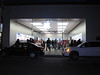
Apple Store Opens on Chestnut Street
Black Friday was opening day for a new Apple Store on Chestnut Street. I now live 3 blocks from an Apple store. I'll probably be in there every day now. It is impressive-looking, no doubt. All stainless steel & glass & bright lighting. & everything looks so tempting. It goes quite far back. & at the back of the store, where one would expect cash registers, there is a genius bar instead. One of employees claimed that they are the first store to have the floating icon.

Monday, November 19, 2007
Coming up at the PFA
The Pacific Film Archive has programs coming up for the 2 greatest film geniuses of the 20th century:
Charles Chaplin
Ingmar Bergman: Light and Shadow
Charles Chaplin
Ingmar Bergman: Light and Shadow
Subscribe to:
Posts (Atom)